

Democracy Tracker | The Global State of Democracy
Each report describes an event that affects the state of democracy in a given country, with assessments made relative to that country's context, not as comparisons or rankings between countries.
The Global State of Democracy 2026: Democracy in an Age of Conflict
In the face of increasing political and societal fragmentation, the Global State of Democracy 2026 explains the patterns that define the direction of democratization around the world. Drawing on the latest data from the Global State of Democracy Indices, the report documents both democratic stagnation and key declines in indicators that measure the credibility of elections, the effectiveness of legislatures, respect for freedoms of expression and the press, and access to justice. These phenomena affect countries across thespectrum of democratic performance.
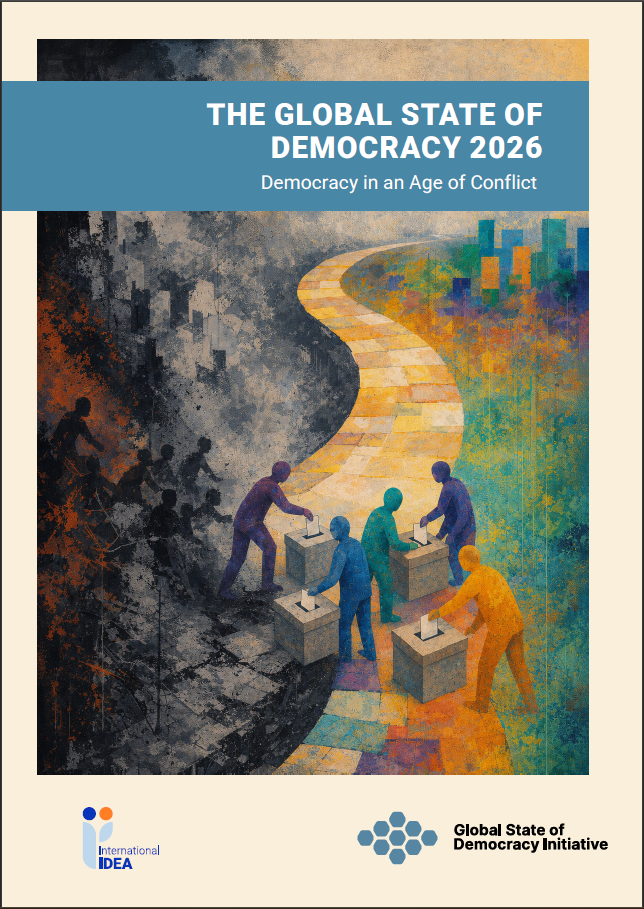
The Global State of Democracy 2026: Democracy in an Age of Conflict
In the face of increasing political and societal fragmentation, the Global State of Democracy 2026 explains the patterns that define the direction of democratization around the world. Drawing on the latest data from the Global State of Democracy Indices, the report documents both democratic stagnation and key declines in indicators that measure the credibility of elections, the effectiveness of legislatures, respect for freedoms of expression and the press, and access to justice. These phenomena affect countries across thespectrum of democratic performance.
Country Perception
How countries and global organizations are perceived around the world

Nira Data – DPI Report
The Democracy Perception Index (DPI) is a cornerstone of the Copenhagen Democracy Summit, providing the most comprehensive global snapshot of public opinion on democracy.
Democracy indicators in US at lowest levels for 50 years, data shows
Trump administration undermining rule of law at home and worldwide, according to intergovernmental report

Wang Huning, “The Structure of China’s Changing Political Culture”
Wang Huning, “The Structure of China’s Changing Political Culture”[1] Introduction by Matthew D. Johnson Introduction Wang Huning (b. 1955) is widely viewed as China’s most powerful...

The Future, Made in China
Beijing is competing with the U.S. for tech supremacy. Who wins will have huge political implications.

The V-Dem Dataset – V-Dem
Includes the world's most comprehensive and detailed democracy ratings. The latest version of the dataset and associated reference documents can be downloaded free of charge below.
European strategic autonomy as a double-edged sword? US perspectives in an Era of Sino-American competition
As the United States seeks to prioritise ‘competition with China’, debates have emerged about how this affects US engagements elsewhere. Europe occupies a contested role in this discussion. Traditi...

After recent tests, China appears likely to beat the United States back to the Moon
An expert explains why this will be enormously bad for the United States.

Sᴜɴʀɪsᴇ Oᴀᴛʜ 十 Tʜᴇ Sʏʟʟᴀʙᴜꜱ (ORI) - CC0 on Twitter / X
I am actually very pessimistic regarding the idea that China could be governed by any structure except the top-down (plus situational anarchic) imperial system it has had for millennia. The Chinese social consciousness is *much* smaller in scope than the Western one.— Sᴜɴʀɪsᴇ Oᴀᴛʜ 十 Tʜᴇ Sʏʟʟᴀʙᴜꜱ (ORI) - CC0 (@sunriseoath) October 14, 2026
China
The most important story of 2014 that most people ignored was the Chinese economy overtaking the US economy. (This is using the purchasing power parity metric, which incorporates differences in...

How Do We Explain China’s Higher-Than-Expected GDP Growth and Lower-Than-Expected Components of GDP Growth?
On Thursday, April 16, China’s National Bureau of Statistics (NBS) announced that China’s real GDP growth in the first quarter of 2026 was 5.0%.

China’s bigger, better batteries
It’s the world’s fastest-growing power technology — and Beijing is dominant

