

Does social media harm everyone? No. But it harms *most* adolescents. However, not all platforms are harmful. An analysis of 44,211 diaries from 479 adolescents over 100 days finds that 60% of adolescents experienced small, negative effects of social media link.springer.com/article/10.1007/s12144-025-08…
Jan 6, 2026 at 7:10 PM
Why Protecting Kids from Social Media May Make Things Worse — Douglas Rushkoff
I’m supposed to give a talk next week about kids and social media and the need for more media literacy education, more regulation of platforms, and more substantive discussion about how to keep our kids from media-induced self-harm. The whole event is well-meaning, but is characterized by a sense of worry and protection. And for some reason, after years of making those sorts of arguments in my articles and documentaries, I have a strong impulse to pivot the other way.
The Harms of Social Media Restrictions and Bans for Minors
How Age-Based Social Media Bans and Restrictions can Negatively impact Youth. The Benefits of Social Media for Youth - Education, Activism & Creating Community
The Impact of Social Media on Adolescent Mental Health: A Meta-Analysis
Introduction: The proliferation of social media has raised significant concerns about its potential effects on the mental health of adolescents. This meta-analysis aims to provide a comprehensive assessment of the existing research on the relationship between social media use and various mental health outcomes in adolescents. Methods: A systematic search of electronic databases (PubMed, PsycINFO, Scopus, Web of Science) from January 2018 to June 2024 was conducted to identify relevant studies. Studies were included if they examined the association between social media use and mental health outcomes in adolescents (aged 10-19) and reported quantitative data. Effect sizes were calculated and pooled using random-effects models. Results: A total of 45 studies (N = 153,285 adolescents) met the inclusion criteria. The meta-analysis revealed small but significant associations between increased social media use and increased depressive symptoms (r = 0.12), anxiety (r = 0.10), and loneliness (r = 0.15). Furthermore, a significant negative association was found between social media use and self-esteem (r = -0.08). The analysis also identified several moderators of these effects, including gender, age, and type of social media platform. Conclusion: The findings of this meta-analysis suggest that increased social media use is associated with a range of negative mental health outcomes in adolescents. However, the effects are small, and the relationship is complex, with several moderating factors. Further research is needed to understand the mechanisms underlying these associations and to develop effective interventions to mitigate the potential negative effects of social media on adolescent mental health.
The effect of social media on well-being differs from adolescent to adolescent
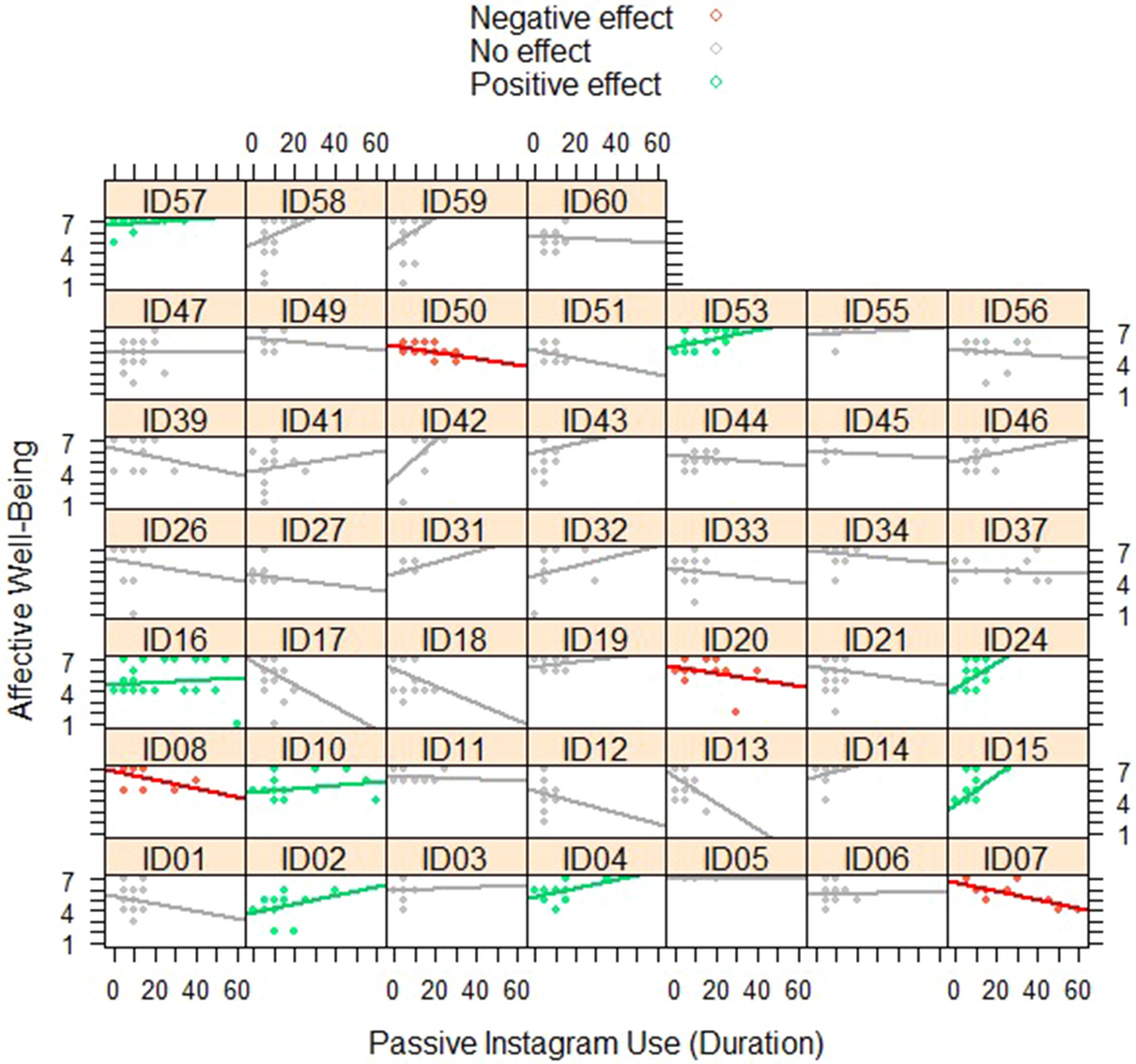
The question whether social media use benefits or undermines adolescents’ well-being is an important societal concern. Previous empirical studies have mostly established across-the-board effects among (sub)populations of adolescents. As a result, it is still an open question whether the effects are unique for each individual adolescent. We sampled adolescents’ experiences six times per day for one week to quantify differences in their susceptibility to the effects of social media on their momentary affective well-being. Rigorous analyses of 2,155 real-time assessments showed that the association between social media use and affective well-being differs strongly across adolescents: While 44% did not feel better or worse after passive social media use, 46% felt better, and 10% felt worse. Our results imply that person-specific effects can no longer be ignored in research, as well as in prevention and intervention programs.
Teen Life on Social Media in 2022: Connection, Creativity and Drama
Majorities of teens credit social media with strengthening their friendships and providing support while also noting the emotionally charged side of these platforms.
How Social Media Brings Out the Worst in Us
A new book argues that social media does more harm than good and we might be happier and healthier using it less.
Social media’s enduring effect on adolescent life satisfaction
In this study, we used large-scale representative panel data to disentangle the between-person and within-person relations linking adolescent social media use and well-being. We found that social media use is not, in and of itself, a strong predictor of life satisfaction across the adolescent population. Instead, social media effects are nuanced, small at best, reciprocal over time, gender specific, and contingent on analytic methods.

Debate: Social media in children and young people – time for a ban? Weighing up the implications and limitations of age-based social media restrictions
Recent legislation in Australia banning social media accounts for children under 16, alongside similar proposals worldwide, has ignited debate about whether age-based restrictions are an effective way to protect young people's mental health. While the intent of such bans is to reduce exposure to harmful content, their feasibility and effectiveness remain unclear. Enforcement requires robust age verification, often relying on sensitive data such as government-issued identification or facial scans, which raises privacy concerns and can be circumvented through the use of VPNs. Moreover, social media use is diverse. Although it can intensify harms such as bullying, it also provides vital opportunities for connection and support, particularly for marginalised adolescents. Removing access to accounts may limit risks within platforms, but does not prevent exposure to harmful content elsewhere, nor does it guarantee increased offline engagement. Importantly, blanket bans fail to address unsafe design features embedded within social media or to equip adolescents with the skills needed to navigate online environments. More targeted, evidence-based regulation that promotes safer platform design and accountability may provide a more effective pathway to protecting young people's well-being.

Social Media Bans & Restrictions for Minors: Laws & Policies
State Laws restricting minors on social media. Social media platforms restricting minors. Harms of Social Media bans for minors. Benefits of social media for youth
People Across the Globe Increasingly Say Social Media Is Harming Democracy
Most think social media leads to manipulation and division, but they also say it informs people and gives them a voice in politics.
The Kids Are (Mostly) Alright: New Pew Study Deflates The Social Media Panic
A couple weeks back, Jonathan Haidt published another entry in his ongoing campaign to convince the world that social media is inherently ruining kids’ lives. This one was a victory lap title…

The great rewiring: is social media really behind an epidemic of teenage mental illness?
The evidence is equivocal on whether screen time is to blame for rising levels of teen depression and anxiety — and rising hysteria could distract us from tackling the real causes.
The great rewiring: is social media really behind an epidemic of teenage mental illness?
The evidence is equivocal on whether screen time is to blame for rising levels of teen depression and anxiety — and rising hysteria could distract us from tackling the real causes.
Social Media Use and Well-Being Across Adolescent Development
Importance Social media’s association with adolescent well-being remains debated. Heavy use has been associated with distress, while abstinence may cause missed connections. Objective To investigate 3-year longitudinal associations between after-school social media use and adolescent well-being using a large longitudinal cohort dataset modeled within a repeated cross-sectional framework. Design, Setting, and Participants This cohort study included Australian students in grades 4 through 12 (2019-2022). After-school social media use was self-reported and grouped as none, moderate, or highest. Well-being was assessed using 8 validated indicators (eg, happiness, life satisfaction, emotional regulation), dichotomized as high vs low. Well-being was assessed concurrently with social media use during the annual school-based survey in each year of data collection. Data analysis was conducted from June to July 2025. Exposures Self-reported after-school social media use between 3 pm and 6 pm (weekdays), classified into 3 categories: none (0 h/wk), moderate (>0 to <12.5 h/wk), and highest (≥12.5 h/wk). Main Outcomes and Measures The primary outcome was overall well-being, measured as the mean score across 8 validated domains (happiness, optimism, life satisfaction, worry, sadness, perseverance, emotional regulation, and cognitive engagement), dichotomized as high vs low (<3 on a scale of 1-5). Secondary outcomes were each individual well-being indicator, similarly dichotomized. Mixed-effects logistic models were used for analyses, stratified by sex and adjusted for demographic covariates. Results The analytic sample included 100 991 adolescents, contributing 173 533 observations (86 582 [49.9%] observations from female participants; mean [SD] age, 13.5 [2.2] years). A U-shaped association was observed between after-school social media use and well-being. Compared with moderate users, adolescents with the highest use had greater odds of low well-being (grades 7-9, girls: odds ratio [OR], 3.13 [95% CI, 2.88-3.39]; boys: OR, 2.25 [95% CI, 1.86-2.72]), while nonusers also had higher odds of low well-being in later adolescence (grades 10-12, girls: OR, 1.79 [95% CI, 1.41-2.27]; boys: OR, 3.00 [95% CI, 2.01-4.46]). These patterns were consistent across survey years and robust to sensitivity analyses. Conclusions and Relevance In this cohort study of students in grades 4 through 12, social media’s association with adolescent well-being was complex and nonlinear, varying by age and sex. While heavy use was associated with poorer well-being and abstinence sometimes coincided with less favorable outcomes, these findings are observational and should be interpreted cautiously.

Ten Myths About the Effect of Social Media Use on Well-Being
This viewpoint reviews the empirical evidence regarding the association between social media use and well-being, including life satisfaction and affective well-being, and the association between social media use and ill-being, including loneliness, anxiety, and depressive symptomology. To frame this discussion, this viewpoint will present 10 widely believed myths about social media, each drawn from popular discourse on the topic. In rebuttal, this viewpoint will offer a warranted claim supported by the research. The goal is to bring popular beliefs into dialogue with state-of-the-art quantitative social scientific evidence. It is the intention of this viewpoint to provide a more accurate and nuanced claim to challenge each myth. This viewpoint will bring attention to the importance of using rigorous scientific evidence to inform public debates about social media use and well-being, especially among adolescents and young adults.

Every time I make the (correct) statement that social media use is not universally bad for teenagers, or state that the best consensus is that it's beneficial-to-neutral for many and any negative effects are a small subset of teenagers, people demand citations (and then refuse to believe them, sigh)

