

I’ve been hearing about this project for years from @fernpizza.bsky.social and I’m stoked to see it out. It’s wildly elegant mixture of theory and empirics, with novel methods that manages to ask and answer deep questions about selection. Paper of the year. science.org/doi/10.1126/science.adx0665

Intracellular competition shapes plasmid population dynamics
www.science.orgNov 22, 2025 at 11:42 PM
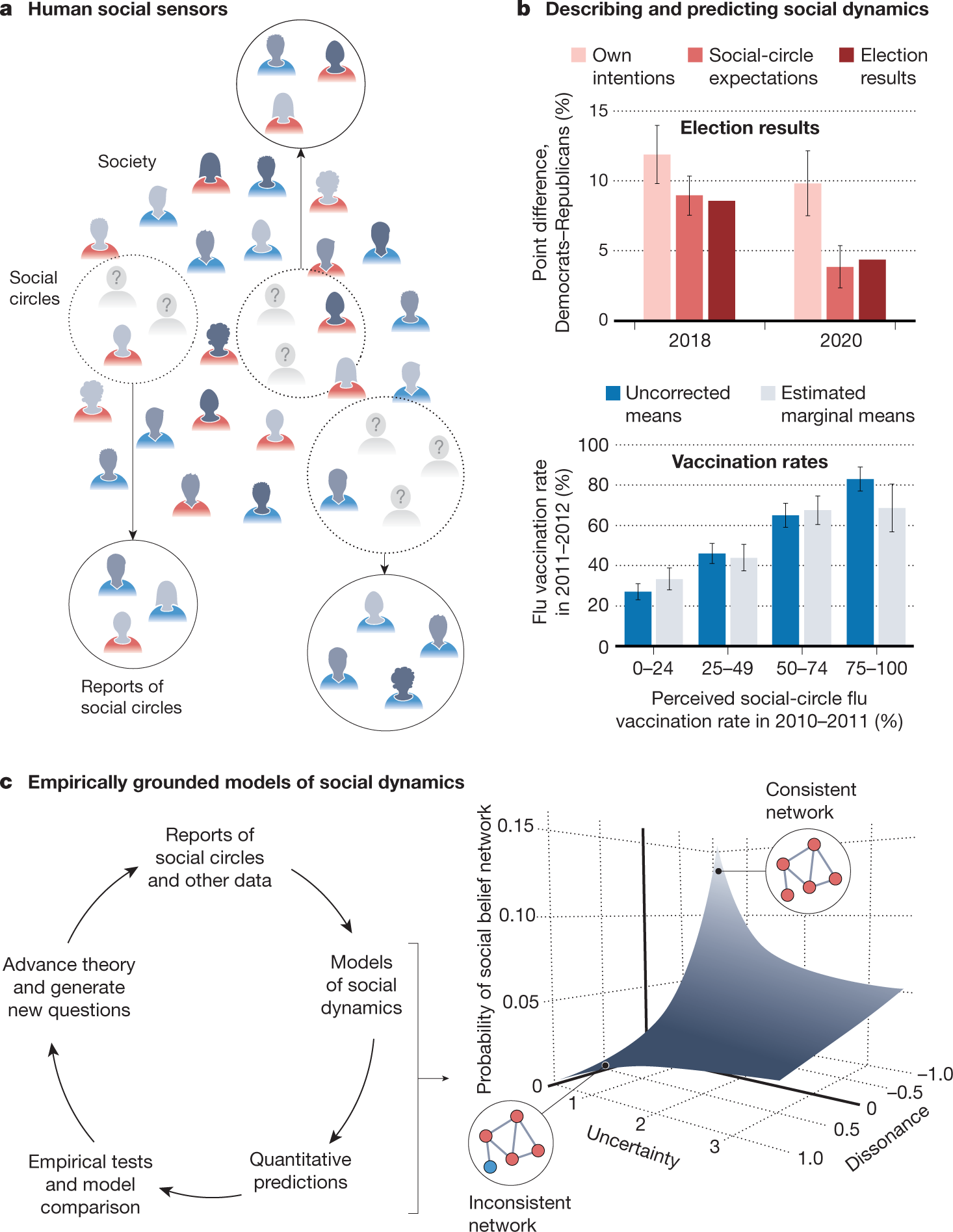
Human social sensing is an untapped resource for computational social science
The ability to ‘sense’ the social environment and thereby to understand the thoughts and actions of others allows humans to fit into their social worlds, communicate and cooperate, and learn from others’ experiences. Here we argue that, through the lens of computational social science, this ability can be used to advance research into human sociality. When strategically selected to represent a specific population of interest, human social sensors can help to describe and predict societal trends. In addition, their reports of how they experience their social worlds can help to build models of social dynamics that are constrained by the empirical reality of human social systems.
Creating Scientific Theories with Online Communities using Gut Instinct
People's lived experiences provide intuitions about their health. Can they transform these personal intuitions into scientific theories that inform both science and their lives? My research introduces social computing architectures and system principles for people to brainstorm and test causal scientific theories. These ideas are instantiated in the Gut Instinct system (gutinstinct.ucsd.edu). 344 voluntary online participants from 27 countries created 399 personally-relevant questions about the human microbiome, 75 (19%) of which microbiome experts found potentially scientifically novel. To test their theories, end users design structurally-sound experiments, improve them via community reviews, and run them with other participants. Controlled experiments show that participants create better hypotheses and experimental designs when they have access to procedural training. My research illustrates a novel way to tackle complex, creative tasks online by building expertise in online volunteer communities.

Ratioed — dame.is
I began this social art experiment in June 2025 and have “performed” it periodically since. My intent was to explore what it would look like to use a social media post as a medium for art (not for sharing art). Because I used Bluesky, the social data underlying this art projec…
PhD Recruitment by @sjgreenwood.bsky.social
Manoel Horta Ribeiro (@manoelhortaribeiro.bsky.social)
Assistant Professor @ Princeton Previously: EPFL 🇨🇭, UFMG 🇧🇷 Interests: Computational Social Science, Platforms, GenAI, Moderation

Excited to invite you to a panel I'll be on next week w/ @richardsever.bsky.social @joelchan86.bsky.social! We’ll discuss the future of open-access, new modular research tools (eg @discoursegraphs.bsky.social) and the role of social media in scientific discourse (@cosmik.network @atproto.science ..)

Frontiers In Research: Open Science · Zoom · Luma
luma.comSuper excited to share that our paper "An Experimental Method to Study Opinion Diffusion in Human-AI Hybrid Societies" has been accepted at #CogSci2026 for presentation as a talk! 🇧🇷 Here's a little thread to share some of the stuff we did :) 1/6 🧶 👇
A great write-up on #ATmosphere from New_ Public Expert-In-Residence @cjtait.bsky.social!

Reflections on ATmosphere Conference 2026...
leaflet.pubHello world! We are building *personalized* feeds to help you make sense of research discussions on BlueSky! Pin our first feed below, which shows posts about papers from accounts you follow! Follow this account for more updates! bsky.app/profile/paper-feed.bsky.socia…

Paper Skygest
Feed by @paper-feed.bsky.socialExcited to share our new research demo, where you can freely traverse the world of Bluesky through 20,000 interconnected trails, spanning “analysis of fictional tropes” to “rotisserie chicken” to “zoning and land use policy.” Try it out, and let us know what you think!

skytrails · 20,000 trails through Bluesky
www.skytrails.orgAnnouncing a new version of our 2024 paper on linguistic hypothesis generation from LMs! @najoung.bsky.social and I have systematized our hypothesis generation framework, added stringent criteria for model selection, 10x-ed our learning trials, and included an epigraph from Jeff Elman 🙏!
A new report from the Project Liberty Institute, Social Web Foundation, Public AI, & @modalfoundation.eurosky.social stresses the importance of continued dialogue to create shared problem definitions, priorities, and identify next steps across research, standards development, and gov communities.
I'm convinced that open social protocols like #atproto have a crucial role to play in the future of science. Excited to share MOSAIC - our best effort at articulating the thesis, why it matters, and how to build and fund it (in collab w/ @exgenesis.ingroup.social ) 🧵

MOSAIC — Modular Open Science, AI & Collective Intelligence
mosaic-program.orgRemarkable how over a decade ago @michaelnielsen.bsky.social pointed the way towards solving long standing issues plaguing science to this day (issues that are all the more relevant in the age of AI mediated science)

Ronen Tamari
This is why @atproto.science is so relevant rn This compilation of essays indicates that scientists are most frustrated by insufficient “community tools and resources... Essential infrastructure for sharing, maintaining and building on existing work and data is also badly underdeveloped." >
Is anyone considering going for this project. digital-strategy.ec.europa.eu/en/news/new-call-proposals-sh…
New call for proposals to shape safer and more inclusive social media platforms
digital-strategy.ec.europa.eu


