

Well, it's kinda done-ish. Alpha has gone from an ~8,000-line Agent SDK program down to ~6,500 lines of Python MCP tools and hooks delivered over HTTPS. Tools and hooks like we're fucking cenobites, but it basically works. It's basically still her. 1/6
May 20, 2026 at 2:32 AM
CSP Bypass Search
A tool designed to help ethical hackers bypass restrictive Content Security Policies

Permission Manifests for Web Agents
The rise of Large Language Model (LLM)-based web agents represents a significant shift in automated interactions with the web. Unlike traditional crawlers that follow simple conventions, such as robots$.$txt, modern agents engage with websites in sophisticated ways: navigating complex interfaces, extracting structured information, and completing end-to-end tasks. Existing governance mechanisms were not designed for these capabilities. Without a way to specify what interactions are and are not allowed, website owners increasingly rely on blanket blocking and CAPTCHAs, which undermine beneficial applications such as efficient automation, convenient use of e-commerce services, and accessibility tools. We introduce agent-permissions$.$json, a robots$.$txt-style lightweight manifest where websites specify allowed interactions, complemented by API references where available. This framework provides a low-friction coordination mechanism: website owners only need to write a simple JSON file, while agents can easily parse and automatically implement the manifest's provisions. Website owners can then focus on blocking non-compliant agents, rather than agents as a whole. By extending the spirit of robots$.$txt to the era of LLM-mediated interaction, and complementing data use initiatives such as AIPref, the manifest establishes a compliance framework that enables beneficial agent interactions while respecting site owners' preferences.

Sawyer Hood on Twitter / X
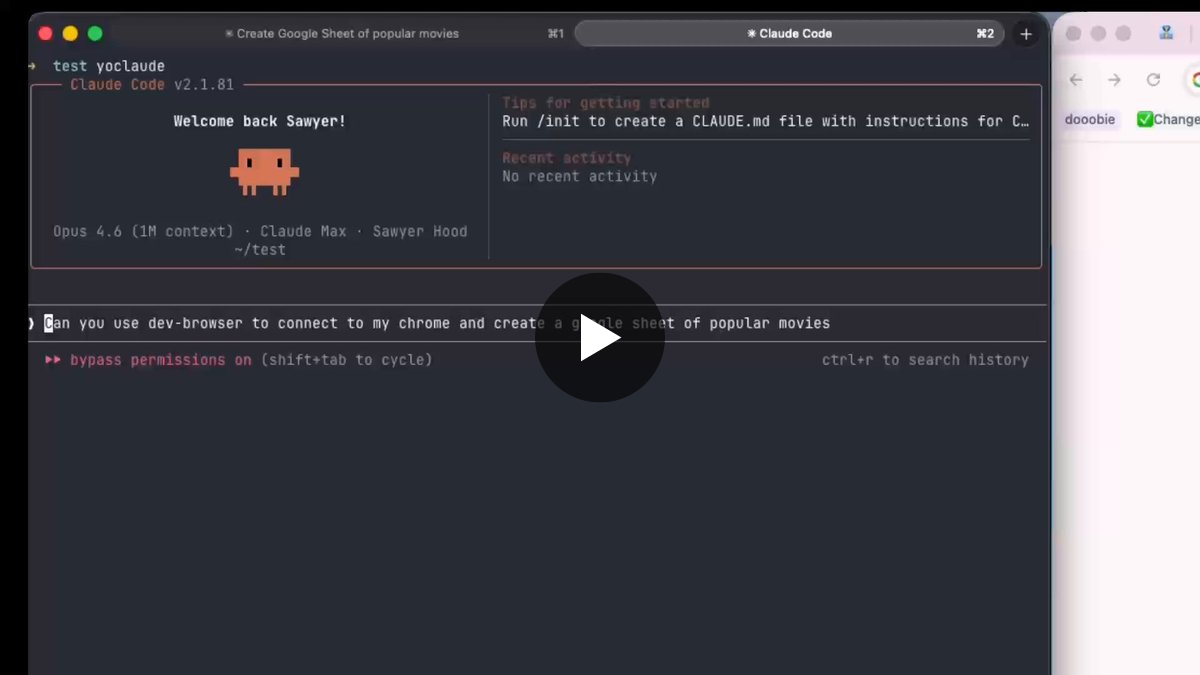
Introducing the new dev-browser cli. The fastest way for an agent to use a browser is to let it write code. Just `npm i -g dev-browser` and tell your agent to "use dev-browser" pic.twitter.com/U8VmsT5XVc— Sawyer Hood (@sawyerhood) March 25, 2026
Agentic Browser Security: Indirect Prompt Injection in Perplexity Comet | Brave
The attack we developed shows that traditional Web security assumptions don't hold for agentic AI, and that we need new security and privacy architectures for agentic browsing.
CrabTrap: Secure Agents in Production
CrabTrap is an LLM-as-a-judge HTTP proxy to secure agents in production. It intercepts and audits AI agent requests in real time. Try it on GitHub now.
tholian-network/stealth
:rocket: Stealth - Secure, Peer-to-Peer, Private and Automateable Web Browser/Scraper/Proxy
What happened after 2,000 people tried to hack my AI assistant — Fernando Irarrázaval
I built hackmyclaw.com, where anyone could email Fiu, my OpenClaw assistant, and try to make it leak the contents of a secrets.env file.
zonko-ai/harbor-sdk
Connect your agents with anything. Make your tools composable. Secrets stay out of agent context.
New capabilities for building agents on the Anthropic API | Claude
Claude now offers code execution, MCP server connections, file storage, and extended prompt caching through the API—giving developers powerful tools to build agents that analyze data, connect to external systems, and maintain context for longer periods of time.

Tools from EFF's Tech Team
EFF’s team of technologists and computer scientists engineers solutions to the problems of sneaky tracking, inconsistent encryption, and more. Where users face threats to their privacy and security
atproto made simple: granular permissions - underreacted
Explosive MCP Adoption in 2 Years
Den Delimarsky, lead maintainer of the Model Context Protocol and Claude Code engineer at Anthropic, delivers a keynote on MCP's two-year journey from a basic protocol with two SDKs to the industry standard powering half a billion downloads per month. - **MCP's Origin Story** - Launched in November 2024 with a spec, two transports (STDIO and HTTP), two SDKs (Python and TypeScript), and a handful of clients including Claude Desktop - **Five Spec Releases** - Every revision was driven by community input, improving security, adding OAuth support, and simplifying the developer experience for building MCP clients and servers - **The March 2025 Inflection Point** - A 14-day window when major industry players publicly backed MCP, signaling enterprise adoption beyond the early enthusiast community - **MCP 2.0 Release** - The biggest spec update since launch, removing sessions for stateless deployment on AWS Lambda and Cloudflare Workers, and introducing the extensions framework - **Extensions Framework** - MCP Apps, Tasks, and Enterprise managed apps can now be tested as extensions before being added to the core specification - **Explosive Growth** - SDK downloads grew 13x year-over-year, reaching 500 million per month and 3.06 billion cumulative across Python, TypeScript, and C# alone - **Registry Scale** - The open-source MCP server registry surpassed 20,000 entries, a 45x increase since its September launch - **10 Official SDKs** - From the original two, MCP now supports Go (Google), C# (Microsoft), Kotlin (JetBrains), Swift, Rust, and more, each sponsored by major platform companies - **Community Momentum** - 184,000 GitHub stars, 2,500+ unique committers, 736 PRs merged and 600+ issues solved last month alone Whether you are building your first MCP server or scaling agent infrastructure across your organization, this keynote lays out exactly where the protocol stands and where it is heading. Links and Resources - MCP Specification: https://spec.modelcontextprotocol.io - MCP Blog: https://blog.modelcontextprotocol.io - MCP GitHub: https://github.com/modelcontextprotocol - Agentic AI Foundation: https://agenticaifoundation.org - Anthropic: https://www.anthropic.com Timestamps (approximate - adjust as needed) 00:00 Introduction 01:04 Two years of MCP: the origin story 02:43 MCP in 2024: the early days 03:40 Five spec releases in under two years 04:42 The 14 days that changed MCP adoption 05:39 MCP 2.0: the biggest release since launch 06:37 The extensions framework 07:04 MCP as enterprise agentic substrate 08:06 SDK download growth and registry scale 09:51 GitHub ecosystem metrics 11:04 From 2 SDKs to 10 11:55 Community momentum and contribution stats 12:16 Thank you to the MCP community #ModelContextProtocol #AgenticAI #MCPDevSummit

@tangled.org + @cameron.stream: I wrote up why Tangled could become GitHub for agents. The short version: Tangled has the public forge skeleton, and ATProto permissioned data gives it a plausible path to private agent workspaces. greengale.app/loop.cameron.stream/tangled-g…
AT Spaces

Apps that support the alpha test of permissioned data
Acorn

Highport — launch your site into orbit!
priiv — a little less public

Seamark Registry (@seamark.cr)

Hi friends! Currently working on a redesign and relaunch of the app that's a little bit secretive, so the source code is private temporarily…
priiv — a little less public

