GM. We are going to win. An internet where 4 corporations wall us all into their surveillance state and make us pay rent forever is just incompatible with human flourishing. The only question is how long it takes everyone propping up history's worst billionaires to figure this out.
Oct 21, 2026 at 2:42 PM
Internet for the People: The Fight for Our Digital Future
"For all the informational convenience the internet offers, it is deeply flawed. How can it be improved? Writer Ben Tarnoff proposes one possibility in this intriguing book, which urges the development of 'a public lane on the information superhighway.' It's worth checking out for yourself." – Seth MacFarlane Why is the internet so broken, and what could ever possibly fix it? In Internet for the People, leading tech writer Ben Tarnoff offers an answer. The internet is broken, he argues, because it is owned by private firms and run for profit. Google annihilates your privacy and Facebook amplifies right-wing propaganda because it is profitable to do so. But the internet wasn't always like this—it had to be remade for the purposes of profit maximization, through a years-long process of privatization that turned a small research network into a powerhouse of global capitalism. Tarnoff tells the story of the privatization that made the modern internet, and which set in motion the crises that consume it today. The solution to those crises is straightforward: deprivatize the internet. Deprivatization aims at creating an internet where people, and not profit, rule. It calls for shrinking the space of the market and diminishing the power of the profit motive. It calls for abolishing the walled gardens of Google, Facebook, and the other giants that dominate our digital lives and developing publicly and cooperatively owned alternatives that encode real democratic control. To build a better internet, we need to change how it is owned and organized. Not with an eye towards making markets work better, but towards making them less dominant. Not in order to create a more competitive or more rule-bound version of privatization, but to overturn it. Otherwise, a small number of executives and investors will continue to make choices on everyone’s behalf, and these choices will remain tightly bound by the demands of the market. It's time to demand an internet by, and for, the people now.
Please Let the Internet Die
Online spaces are captured by oligarchs and saturated with slop—and they’re exacerbating humanity’s worst impulses. It’s time to start over.

The future of the open internet — and our way of life — is in your hands
There are a lot of scary things happening these days, but here’s what keeps me up late at night. A handful of corporations are turning our open internet into this: These corporations want to lock down the internet and give us access to nothing more ...

Pluralistic: Defense (of the internet) (from billionaires) in depth (23 Jan 2025) – Pluralistic: Daily links from Cory Doctorow
The only way to truly billionaire-proof the internet is to a) abolish billionaires and b) abolish the system that allows people to become billionaires. Short of that, any levees we build will need constant tending, reinforcement, and re-evaluation.
Freeing Ourselves From The Clutches Of Big Tech
Right to repair and other efforts to liberate technology from monopolistic corporations is a precondition for winning many vital societal battles.

The rise of AI ‘civilizations’ and the fall of corporate responsibility
The internet fights over anthropomorphism around the Hugging Face hack.

The state has lost control: tech firms now run western politics
Democracy is under threat from rising inequality and terrorism. Google and Facebook have taken over

The Internet Transition
The Internet is allowing us to build a richer, more complex society but the way in which we Internet today is failing to support the governance systems that a more complex world requires. I take a look at why these issues are related, try to develop an intuition for a way forward, and point at the emerging field that is coming together to build that future.

The Internet Transition
The Internet is allowing us to build a richer, more complex society but the way in which we Internet today is failing to support the governance systems that a more complex world requires. I take a look at why these issues are related, try to develop an intuition for a way forward, and point at the emerging field that is coming together to build that future.
Internet Infrastructure | Service | GMO Internet Group, Inc.
GMO Internet Groups policy is to develop and offer its own services. It comprehensively develops Internet businesses, including Internet Infrastructure, Internet Finance, Online Advertising & Media, and Cryptoassets (Cryptocurrency) businesses, and each hold top share in their respective markets in Japan.

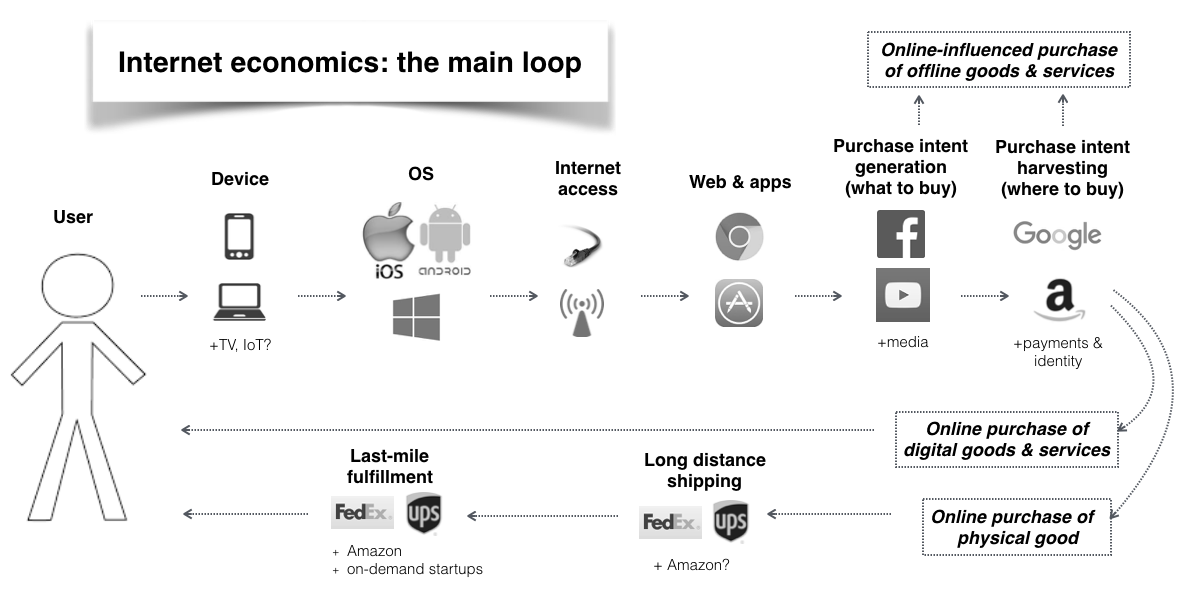
The Internet Economy
We are living in an era of bundling. The big five consumer tech companies — Google, Apple, Facebook, Amazon, and Microsoft — have moved far…
The Next Great (Digital) Extinction
How today's internet is rapidly and indifferently killing off many systems while allowing new types of organizations to emerge.

Pluralistic: The worst possible antitrust outcome (03 Sep 2025) – Pluralistic: Daily links from Cory Doctorow
Last year, Google lost an antitrust case to Biden's DoJ. The DoJ lawyers beat Google like a drum, proving beyond a shadow of a doubt that Google had deliberately sought to create and maintain a monopoly over search, and that they'd used that monopoly to make search materially worse, while locking competitors out of the market.
The Internet Has Become Too American to Trust | The Walrus
Trump and Big Tech have fused into a new kind of threat