How the Tech World Turned Evil
Once upon a time, they were counterculture idealists bringing power to the people. Today they’re greedy monopolists who’d sooner destroy our democracy than be reined in by government in any way—and they have to be stopped.

HACKING – A Hacker Manifesto
The apologists for the vectoral interest want to limit the se- mantic productivity of the term “hacker” to a mere crimi- nality, precisely because they fear its more abstract and multiple potential—its class potential. Everywhere one hears rumors of the hacker as the new form of juvenile delinquent, or nihilist vandal, or servant of organized crime. Or, the hacker is presented as a mere harmless subculture, an obsessive garage pursuit with its restrictive styles of appear- ance and codes of conduct. Everywhere the desire to open the virtuality of information, to share data as a gift, to ap- propriate the vector for expression is represented as the object of a moral panic, an excuse for surveillance, and the re- striction of technical knowledge to the “proper authorities.” This is not the first time that the productive classes have faced this ideological blackmail. The hacker now appears in the official organs of the ruling order alongside its earlier ar- chetypes, the organized worker, the rebellious farmer. The hacker is in excellent company
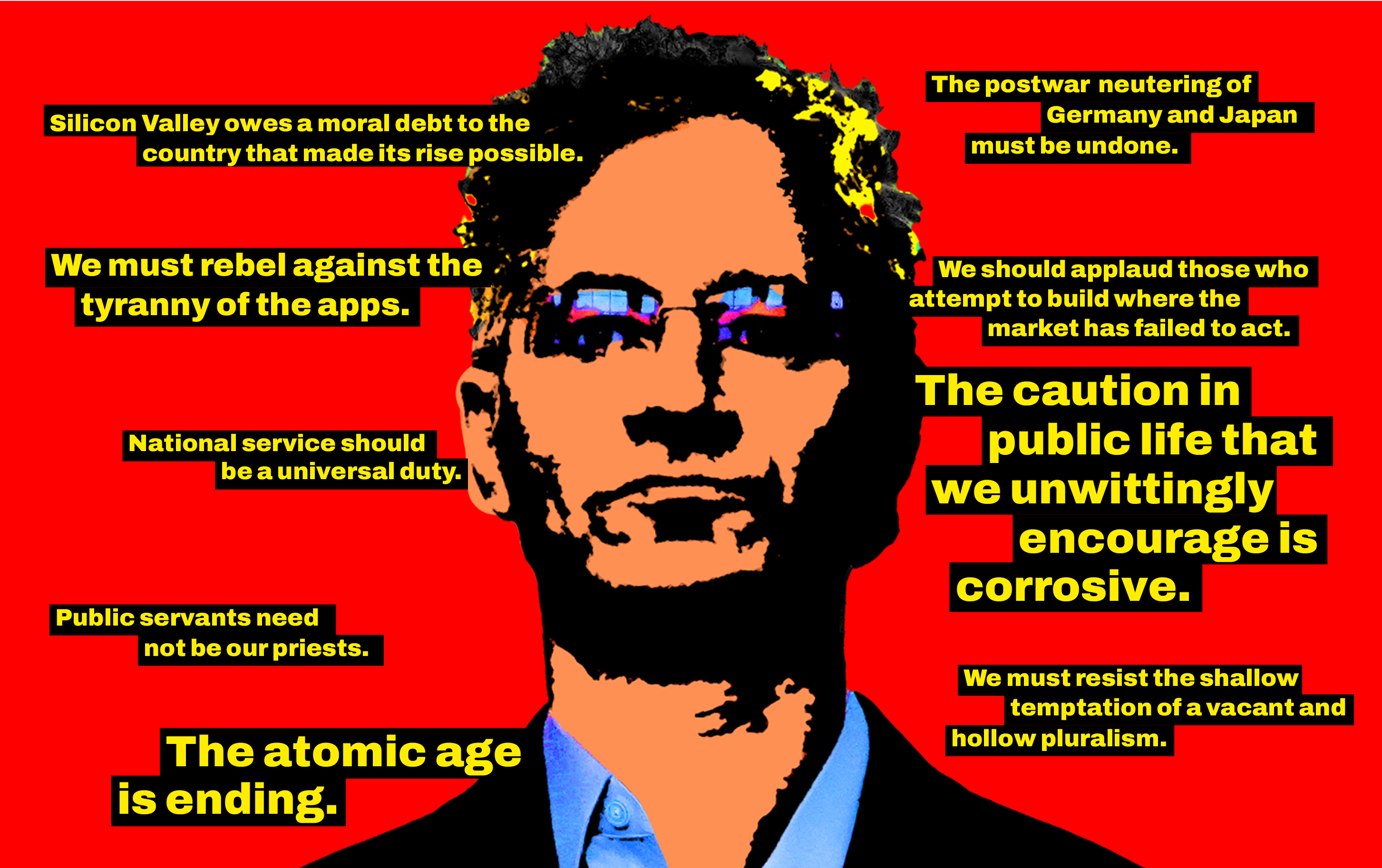
Palantir's social media manifesto is a blueprint for technofascism
The surveillance firm’s viral X post calls for hard power, conscription and the end of pluralism. AI expert and academic Mark Coeckelbergh on what happens when technology becomes the gateway to authoritarianism
+KAOS: Ten Years of Hacking and Media Activism
At the end of the 20th century, hacking was bleeding edge. When the ideas, practices and pranks of this experimental niche of technophiles attracted the attention of a handful of activists in Italy, they understood that information and communication were what would give shape and voice to social, political, and cultural processes in the near future. +KAOS is a cut and paste of interviews, like a documentary film transposed on paper. It describes the peculiar relationship between hacktivism and activism, in Italy and beyond, highlighting the importance of maintaining digital infrastructures. While this may not sound as glamorous as sneaking into a server and leaking data, it is a fundamental topic: not even the most emblematic group of hacktivists can operate without the services of radical server collectives. Autistici/Inventati (https://www.autistici.org - https://www.inventati.org)

Technopoly: The Surrender of Culture to Technology
A witty, often terrifying that chronicles our transform…

Big Mother: The Technological Body of Evil
A bold examination of artificial intelligence, consciou…

Decoding the Technofascist Tendency in Palantir's Manifesto
Palantir's CEO Alex Karp has confirmed the anti-democratic agenda of the company's founder Peter Thiel

Bringing experiments down to earth - Jack Stilgoe, 2026
A commentary on Thao Phan’s ‘Testing-in-the-wild: innovation nationalism and the colonial dynamics of new technology testbeds’.

Old Tricks, New Tech: How Legacy Media Capture Fuels Today’s Digital Authoritarianism
Marius Dragomir and Minna Aslama Horowitz discuss how digital authoritarianism is rising as states and Big Tech align, threatening independent media.

HOME - Daniel Schmachtenberger
EXPLORATIONS ON THE FUTURE OF CIVILIZATION Some of the central questions being explored here: With the first fully globalized civilization, how do we avoid the collapse fate that has befallen all previous civilizations? What are effective types of immune systems for identifying and correcting corruption in governance systems? How do we comprehensively disincentivize misinformation and harm to … HOME Read More »

The Critical Legacy of Chinese Cybernetics
In Post-War America, cybernetics inspired countercultural visions of wild complexity. Its Chinese legacy, in contrast, is as an applied science of technocratic nation-building. As the world tilts towards new geopolitical priorities, it is this latter legacy that may prove more prophetic.

Technocracy References
References and Revisions “Should Scientists and Engineers Run Society?” References [1] Wikipedia: “Technocracy.” [2] Academic Paper: Gunnell, John G. "The technocratic image and the theory of technocracy." Technology and culture 23.3 (1982): 392-416. [3] Academic Paper: Oh, Kyunghwan. "A non-co...


Enshittification, Despotification, and the Open Internet
It’s not about whether technology is inherently good or bad, liberating or oppressive. Architecture shapes incentives; incentives shape outcomes.

Akhilesh Thite
Akhilesh is an Indian computer scientist passionate about decentralization and peer-to-peer technology.