


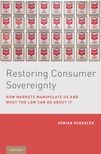
Restoring Consumer Sovereignty: How Markets Manipulate Us and What the Law Can Do About It
Abstract. For decades, there has been broad consensus within antitrust, intellectual property, and consumer law scholarship that consumers make decisions i
Why restaurants are facing backlash for fake food pictures | CNN
Generative AI is being used to advertise food around the world to the disdain of many beholders. But there are real reasons why consumers are repelled by the sometimes bizarre-looking meals.

Boycott US products? New tariffs make people choose European products. Are we seeing a trend? | Tuta
With the growing movement to boycott US products and services, more people are choosing European alternatives. Let’s take a look at the best European products you can use.

Research Shows ICE Raids Are Killing Local Economies
Contrary to the “worst of the worst” posturing presented by the Trump administration, it’s long been known that immigrants (both legal or otherwise) commit fewer crimes than natur…

Restoring Consumer Sovereignty
For decades, there has been broad consensus within antitrust, intellectual property, and consumer law scholarship that consumers make decisions in their own best interests by consciously weighting the market’s relative prices, quantities, and qualities against each other. That consensus is unraveling in light of novel findings from cognitive and social psychology that explain how individuals’ concepts of what they prefer drive the global economy. At the same time, producers nowadays no longer merely satisfy consumers’ needs but also communicate their values, identities, and aspirations through the sale and marketing of products. As part of the growing interest in observations such as these, a wealth of psychological studies challenge the fundamental teaching of economics that the interplay of demand and supply of goods in a free market economy provides us with material wealth. This book provides a normative defense of that assumption and a theoretical framework for understanding its contradictions. It argues that the erosion of consumer sovereignty through the ability of product manufacturers and sellers to systematically take advantage of individuals’ psychological weaknesses demands a twenty-first-century reconceptualization of the consumer and a modern account of how the law should regulate the digital economy. Such an account is justified to ensure a diverse marketplace in which consumers can influence how our societies are structured and arranged. By examining the role that market manipulation plays, it offers ingredients for a realistic descriptive and normative market regulatory theory that is aware of its political economy, its behavioral suppositions, and its distributional consequences.
What Trump Sells Is Impunity
Trump stands out in the GOP not for his racism, but his vision of emancipatory irresponsibility.
Yet Again, The Data Shows Migrants Are More Law-Abiding Than US Citizens
This has always been the truth. And it has always been ignored by people like Donald Trump, who combine “if it bleeds, it leads” media narratives with the always-exploitable fear of …
Capitalism Without Humans
As new technologies (not immigrants) replace human labor, "machine breaking" as a tactic of rebellion is taking on a renewed vitality.

Why Free Markets Make Fools of Us
George Akerlof and Robert Shiller believe that once we understand human psychology, we will be a lot less enthusiastic about free markets and a lot more worried about the harmful effects of competition. In their view, companies exploit human weaknesses not necessarily because they are malicious or venal, but because the market makes them do it.

ICE Deportation Flights Are Getting Longer and Crueler
A private equity–owned airline profits off Trump’s migrant crackdown.

241. Distillation Is Not Anti-American, Weaponizing It Is
Recent attempts at pursuing government intervention in distillation of AI models are short-sighted and technically weak arguments to attempt regulatory capture
annotations: Des droits de douane sur toutes les importations américaines provoqueraient un chaos pour les entreprises
Traduction du billet de blog "Tariffs on all imports would create chaos for business" de Wendy Edelberg & Maurice Obstfeld (PIIE)
Pluralistic: They’re just trying to earn a buck (07 Oct 2025) – Pluralistic: Daily links from Cory Doctorow
Life as a prisoner of the neoliberal mind palace must suck: it's a world where every person who suffers under predatory business practices is a "consumer" who has "revealed a preference" for being screwed:
Consumer Boycotts | The Paper Pilot
The Paper Pilot's digital garden of thoughts on philosophy, politics, and sociology
the viability of many right-wing intellectuals and intellectual spaces is enormously dependent on the largesse of reactionary billionaires and foreign governments, who help them circumvent a marketplace of ideas where they would otherwise post extraordinarily poor sales

Don Moynihan
Its fair to ask if Orban's successful cultivation of the Western right wing intellectuals reflected that their networks were already dependent on patronage. Rod Dreher was funded by a weird billionaire, and when he stopped paying his salary, Orban did. Dreher already looking for a new gig.


