Russian Revolution becomes the property relations that are common to.
Rudy's Theory of Revolution
Eclecticisms Conversations Series: Episode 001 - Interview with Rudy Fraser of Blacksky
Radical markets: uprooting capitalism and democracy for a just society
Many blame today's economic inequality, stagnation, and political instability on the free market. The solution is to rein in the market, right? Radical Markets turns this thinking on its head. With a new foreword by Ethereum creator Vitalik Buterin and virtual reality pioneer Jaron Lanier as well as a new afterword by Eric Posner and Glen Weyl, this provocative book reveals bold new ways to organize markets for the good of everyone. It shows how the emancipatory force of genuinely open, free, and competitive markets can reawaken the dormant nineteenth-century spirit of liberal reform and lead to greater equality, prosperity, and cooperation. Only by radically expanding the scope of markets can we reduce inequality, restore robust economic growth, and resolve political conflicts. But to do that, we must replace our most sacred institutions with truly free and open competition Radical Markets shows how

The Counter-Revolution of 1776: Slave Resistance and th…
Illuminates how the preservation of slavery was a moti…

Rudy's Theory of Revolution - Eclecticisms
Eclecticisms Conversations Series: Episode 001 - Interview with Rudy Fraser of Blacksky
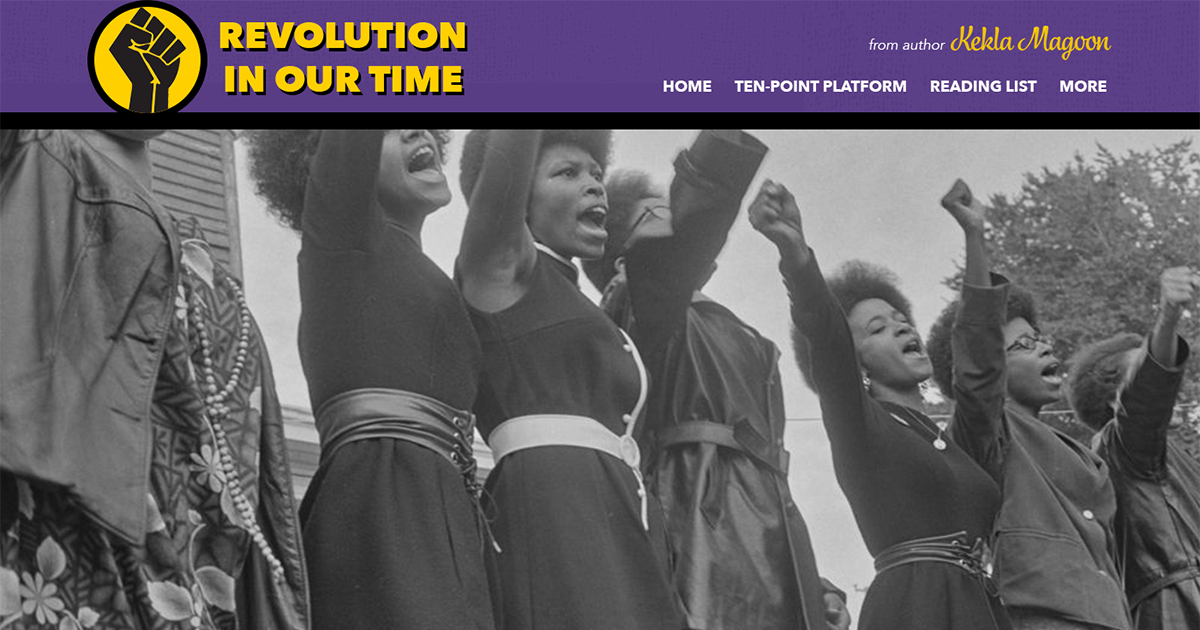
Revolution in Our Time: The Black Panther Party's Promise to the People
Kekla Magoon relays an essential account of the Black Panthers—as militant revolutionaries and human rights advocates.
The revolution will not be funded: beyond the non-profit industrial complex
Introduction : the revolution will not be funded / Andrea Smith -- The political logic of the non-profit industrial complex / Dylan Rodríguez -- In the shadow of the shadow state / Ruth Wilson Gilmore -- From black awakening in capitalist America / Robert L. Allen -- Democratizing American philanthropy / Christine E. Ahn -- The filth on philanthropy : progressive philanthropy's agenda to misdirect social justice movements / Tiffany Lethabo King and Ewuare Osayande -- Between radical theory and community praxis : reflections on organizing and the non-profit industrial complex / Amara H. Pérez -- Native organizing before the non-profit industrial complex / Madonna Thunder Hawk -- Fundraising is not a dirty word : community-based economic strategies for the long haul / Stephanie Guilloud and William Cordery -- "We were never meant to survive" : fighting violence against women and the fourth world war / Ana Clarissa Rojas Durazo -- Social service or social change? / Paul Kivel -- Pursuing a radical anti-violence agenda inside/outside a non-profit structure / Alisa Bierria -- The NGOization of the Palestine liberation movement : interviews with Hatem Bazian, Noura Erekat, Atef Said, and Zeina Zaatari / Andrea Smith -- Radical social change : searching for a new foundation / Adjoa Florência Jones de Almeida -- Are the cops in our heads and hearts? / Paula X. Rojas -- Non-profits and the autonomous grassroots / Eric Tang -- On our own terms : ten years of radical community building with Sista II Sista / Nicole Burrowes ... [et al.]

Cognitive Capitalism - Public Seminar
There are broadly three ways of thinking historically about capitalism. One draws on Marx’s value theory and pretty much treats...Read More

Exocapitalism: economies with absolutely no limits
There is a touch of destiny with this one. We have real…

Anarchism and The Black Revolution and Other Essays
An analysis of white supremacy vs the black struggle an…

The Antitrust Revolution, by Barry C. Lynn
Liberal democracy’s last stand against Big Tech

Individuals, institutions, and innovation in the debates of the French Revolution
Significance How do democracies make decisions? We can read transcripts from parliament houses and legislative halls to see how particular ideas are introduced and debated, but we understand very little about the general principles of how these systems deal with information, or the origins of those principles. Here we study the parliamentary assembly of the first 2 years of the French Revolution, a model for democracies and revolutions across the globe, and show how patterns of speaking are created, picked up, and ignored or propagated. Political ideology, top–down rules, and individual charisma all affect how word patterns survive and thrive or, conversely, disappear and drop away. , The French Revolution brought principles of “liberty, equality, fraternity” to bear on the day-to-day challenges of governing what was then the largest country in Europe. Its experiments provided a model for future revolutions and democracies across the globe, but this first modern revolution had no model to follow. Using reconstructed transcripts of debates held in the Revolution’s first parliament, we present a quantitative analysis of how this body managed innovation. We use information theory to track the creation, transmission, and destruction of word-use patterns across over 40,000 speeches and a thousand speakers. The parliament as a whole was biased toward the adoption of new patterns, but speakers’ individual qualities could break these overall trends. Speakers on the left innovated at higher rates, while speakers on the right acted to preserve prior patterns. Key players such as Robespierre (on the left) and Abbé Maury (on the right) played information-processing roles emblematic of their politics. Newly created organizational functions—such as the Assembly president and committee chairs—had significant effects on debate outcomes, and a distinct transition appears midway through the parliament when committees, external to the debate process, gained new powers to “propose and dispose.” Taken together, these quantitative results align with existing qualitative interpretations, but also reveal crucial information-processing dynamics that have hitherto been overlooked. Great orators had the public’s attention, but deputies (mostly on the political left) who mastered the committee system gained new powers to shape revolutionary legislation.

"Bread and circuses" except the bread has never been more expensive and the circus is lining the pockets of the oligarchy.
Aaron Rupar
it's notable to me that the administration tried to frame tonight's UFC event as a "gift to Americans" but you can't watch it unless you have a paid subscription to Paramount+