

a thread on how to generate connecting corridors between rooms, caves, etc.! classic pathfinding like a* or gradient descent will tend to make meandering passages like this. that might be what you want. but depending on your application, you might want some expressive control.
Jan 22, 2026 at 4:37 AM
Room-based maps
There are a couple of different ways to go about creating room-based maps. We'll look at doing this by generating random rectangles, by using random BSP trees and Waveform Function Collapse (WFC).
Rabbithole - Thinking with portals
Directional Wayfinding: Designing Seamless Navigation for Modern Spaces
The Importance of Directional Wayfinding

Think Labyrinth: Maze Algorithms
Mazes in general (and hence algorithms to create Mazes) can be organized along seven different classifications. These are: Dimension, Hyperdimension, Topology, Tessellation, Routing, Texture, and Focus. A Maze can take one item from each of the classes in any combination.
Can You Solve This Impossible Shot?


The Glimmer — thefugue.space
A brief history of my attempts to bring Spatial Computing to the wider audience..

Who needs Graphviz when you can build it yourself?
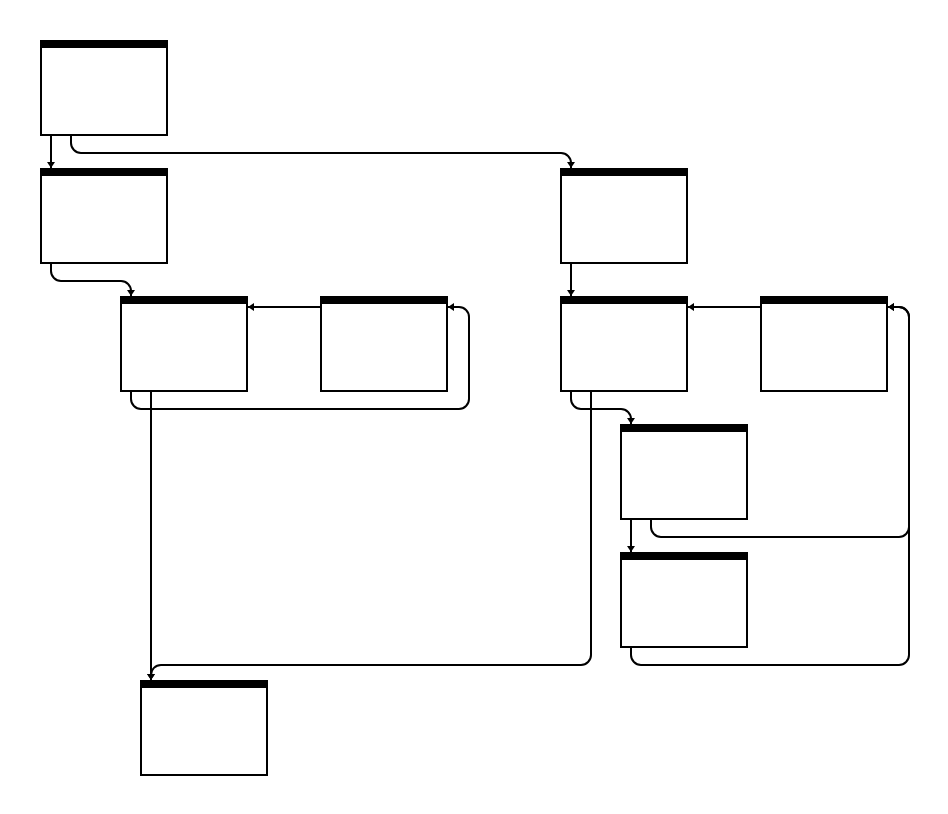
Exploring a new layout algorithm for control flow graphs.
Herbert Wolverson - Procedural Map Generation Techniques
Curved Text Along a Path | CSS-Tricks
We can flow text along a curved line with three tools built right into SVG: , and .

Toward Wayfinding Infrastructure for the Living Web · Atlas Research Group
Our world is getting crazier by the day. Our old maps and compasses weren’t made for this complexity. While new tools may open up amazing possibilities, they also make it easier to lose ourselves – especially when they don’t belong to us, and make us vulnerable to other people’s hidden choices and unsavory intentions about what is worth attending to.

Sensor-based Coverage of Unknown Environments: Incremental Construction of Morse Decompositions
The goal of coverage path planning is to determine a path that passes a detector over all points in an environment. This work prescribes a provably complete coverage path planner for robots in unknown spaces. We achieve coverage using Morse decompositions which are exact cellular decompositions whose cells are defined in terms of critical points of Morse functions. Generically, two critical points define a cell. We encode the topology of the Morse decomposition using a graph that has nodes corresponding to the critical points and edges representing the cells defined by pairs of critical points. The robot simultaneously covers the space while incrementally constructing this graph. To achieve this, the robot must sense all the critical points. Therefore, we first introduce a critical point sensing method that uses range sensors. Then we present a provably complete algorithm which guarantees that the robot will encounter all the critical points, thereby constructing the full graph, i.e., achieving complete coverage. We also validate our approach by performing experiments on a mobile robot equipped with a sonar ring.

Real-time Motion Retargeting to Highly Varied User-Created Morphologies - Chris Hecker's Website
Chris Hecker[1] Bernd Raabe[2] Ryan W. Enslow[3]John DeWeese[4] Jordan Maynard[5] Kees van Prooijen[6]
