


Assistant Professor @ Princeton Previously: EPFL 🇨🇭, UFMG 🇧🇷 Interests: Computational Social Science, Platforms, GenAI, Moderation
Human social sensing is an untapped resource for computational social science
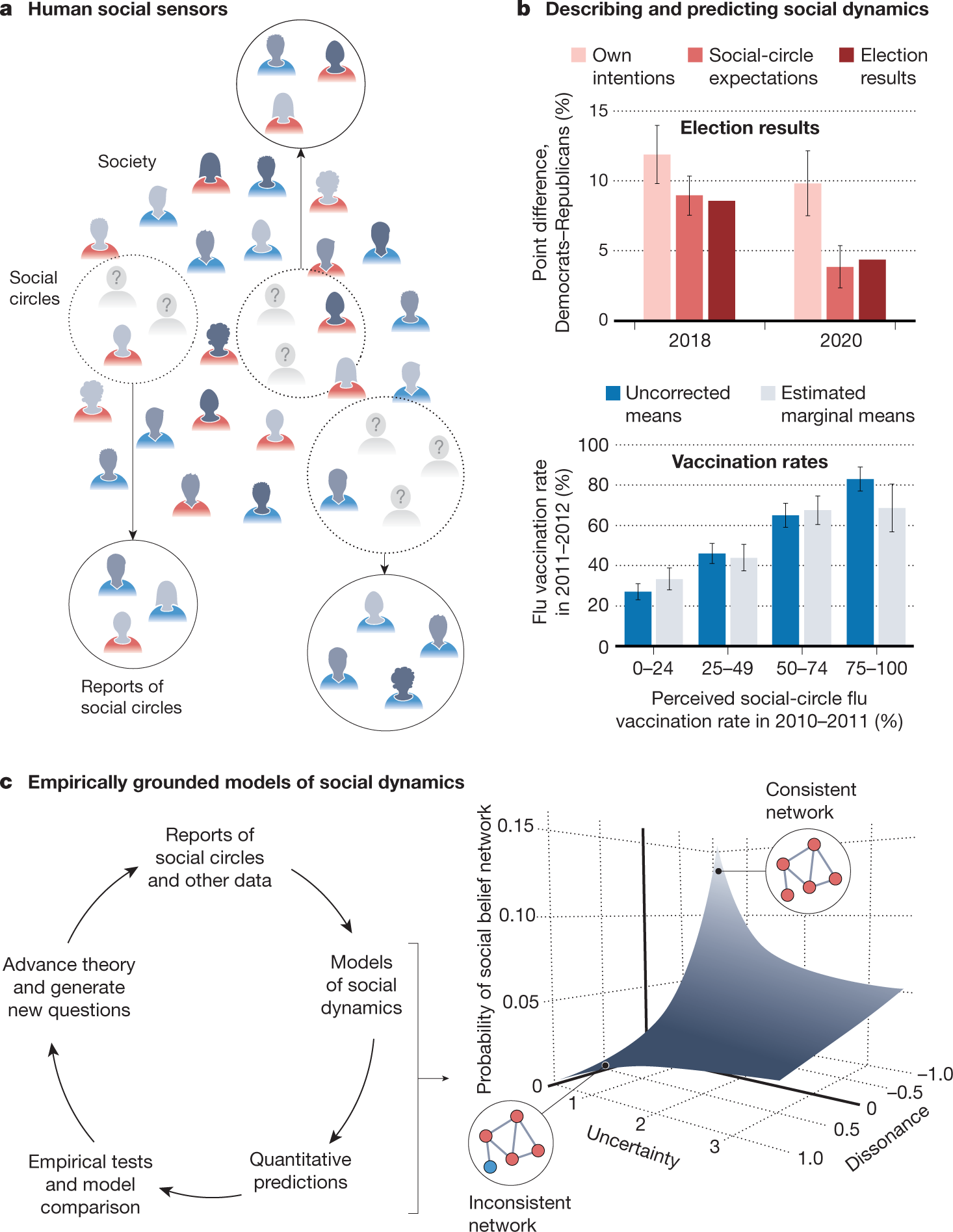
The ability to ‘sense’ the social environment and thereby to understand the thoughts and actions of others allows humans to fit into their social worlds, communicate and cooperate, and learn from others’ experiences. Here we argue that, through the lens of computational social science, this ability can be used to advance research into human sociality. When strategically selected to represent a specific population of interest, human social sensors can help to describe and predict societal trends. In addition, their reports of how they experience their social worlds can help to build models of social dynamics that are constrained by the empirical reality of human social systems.
Governing Together: Toward Infrastructure for Community-Run Social Media | Proceedings of the 2026 CHI Conference on Human Factors in Computing Systems
Collaborative and social computing theory, concepts and paradigms

FediForum | Growing the Open Social Web un-workshop, 2026/03/02

New Studies: How Commercial Forces Make Science Less Reliable
Computational social science has been distorted by commercial forces, and AI is making it worse.

[Keynote 01] A Theory of Appropriateness: Social Norms for Humans and AIs
Computational Public Space
Chapters — Intro, Communal computing, This presentation, Physicality — Globalization, Centrally-planned, Isolating, Private property, Surveillance, Consumption, Hidden — Summary, Outline
Victoria (@vicwalker.dev.br)
• QA Architect • Community Moderator • +30 yo • Português • English • Español • Français (un peu) 🇧🇷 🏳️🌈 ☭ ⁂ 🍉 🎗 🚂 Icon by @alphajn.bsky.social Atmosphere: https://linkat.blue/did:plc:fip3nyk6tjo3senpq4ei2cxw Tags: #Blog • #BskyTips • #Cupom

Growing the Social Web
I'm going to be participating in the Growing the Open Social Web workshop at Fediforum on March 2, 2026. I'm excited to talk to other people who care about the Fediverse about ways to connect more people through ActivityPub. Fediforum invited attendees to publish position papers before the workshop. SWF has a number of hypotheses…

Towards a Post-Social Media Studies
For two decades, "social media" has been the master lens through which scholars have understood digital communication—an era defined by user-generated content, networked publics, and participatory culture. That era is drawing to a close. This paper argues that three interrelated dynamics are dissolving the social media paradigm: an algorithmic shift from social-graph-based to interest-based recommendation, which is remaking the active "user" into a passive "viewer"; the generative AI revolution, which is replacing user-generated content with synthetic media and decoupling platforms from any dependence on human participation; and an exodus from public platforms toward private, closed spaces. Together, these dynamics are giving rise to three distinct post-social formations: algorithmically governed broadcasting platforms, semi-private spheres and micro-communities, and AI-mediated communication as a new media form in its own right. Understanding this transformation demands a fundamental reorientation of the field—new conceptual tools that move beyond networked publics and participatory culture, new methods suited to synthetic and ephemeral media environments, and renewed attention to the political stakes of communication systems that no longer require human participation.
Towards a Post-Social Media Studies
For two decades, "social media" has been the master lens through which scholars have understood digital communication—an era defined by user-generated content, networked publics, and participatory culture. That era is drawing to a close. This paper argues that three interrelated dynamics are dissolving the social media paradigm: an algorithmic shift from social-graph-based to interest-based recommendation, which is remaking the active "user" into a passive "viewer"; the generative AI revolution, which is replacing user-generated content with synthetic media and decoupling platforms from any dependence on human participation; and an exodus from public platforms toward private, closed spaces. Together, these dynamics are giving rise to three distinct post-social formations: algorithmically governed broadcasting platforms, semi-private spheres and micro-communities, and AI-mediated communication as a new media form in its own right. Understanding this transformation demands a fundamental reorientation of the field—new conceptual tools that move beyond networked publics and participatory culture, new methods suited to synthetic and ephemeral media environments, and renewed attention to the political stakes of communication systems that no longer require human participation.
“No One’s Coming to Save Us. Why Communities Must Build Their Own Internet” -Rudy Fraser, Blacksky
[Keynote 03] Simulating Emergent LLM Social Behaviors in Multi Agent Systems
LIMITS 2026 -- Workshop on Computing within Limits
LIMITS concerns the role of computing in human societies situated in a world of planetary boundaries and limits, such as limits of extractive logics, limits to a biosphere’s ability to recover, limits to our knowledge, or limits of technological solutions to societal issues. As an interdisciplinary group of researchers, practitioners, and scholars, we seek to reshape and orient the broader computing research agenda, grounded by an awareness that contemporary computing research is embedded in finite socio-ecological conditions and must reckon with with ecological limits in general, and climate- and climate justice-related limits in particular. LIMITS 2026 solicits submissions that move us closer towards computing that supports ecological and just futures for diverse human and non-human lifeforms and thriving biospheres.
Social media algorithms don't allow us to understand or control what we see online and why... until now! Top scholars @jonathanstray.com and @noupside.bsky.social are sharing @mysky.social, a tool that allows users to adjust their feed’s priorities and explains why certain posts appear over others.

🎛️📲 Meet the algorithm you can actually control and understand
newpublic.substack.comExcited to invite you to a panel I'll be on next week w/ @richardsever.bsky.social @joelchan86.bsky.social! We’ll discuss the future of open-access, new modular research tools (eg @discoursegraphs.bsky.social) and the role of social media in scientific discourse (@cosmik.network @atproto.science ..)

Frontiers In Research: Open Science · Zoom · Luma
luma.comRemarkable how over a decade ago @michaelnielsen.bsky.social pointed the way towards solving long standing issues plaguing science to this day (issues that are all the more relevant in the age of AI mediated science)

Ronen Tamari
This is why @atproto.science is so relevant rn This compilation of essays indicates that scientists are most frustrated by insufficient “community tools and resources... Essential infrastructure for sharing, maintaining and building on existing work and data is also badly underdeveloped." >
