

Does this mean that Psych Science should retract the Cuddy et al. p-curve paper on power posing in which the authors declare "no conflict of interest" despite the first author making millions of dollars off of the claims made in the article? The article is, of course, deeply flawed in other ways.

Kathleen Bachynski
“The journal’s retraction was prompted by a December 8 email from Markowitz and Rosner to the journal, which identified a glaring conflict of interest. They presented evidence that the commentary was written by a consultant paid by Johnson & Johnson” @profgoldberg.bsky.social
May 14, 2026 at 2:20 PM
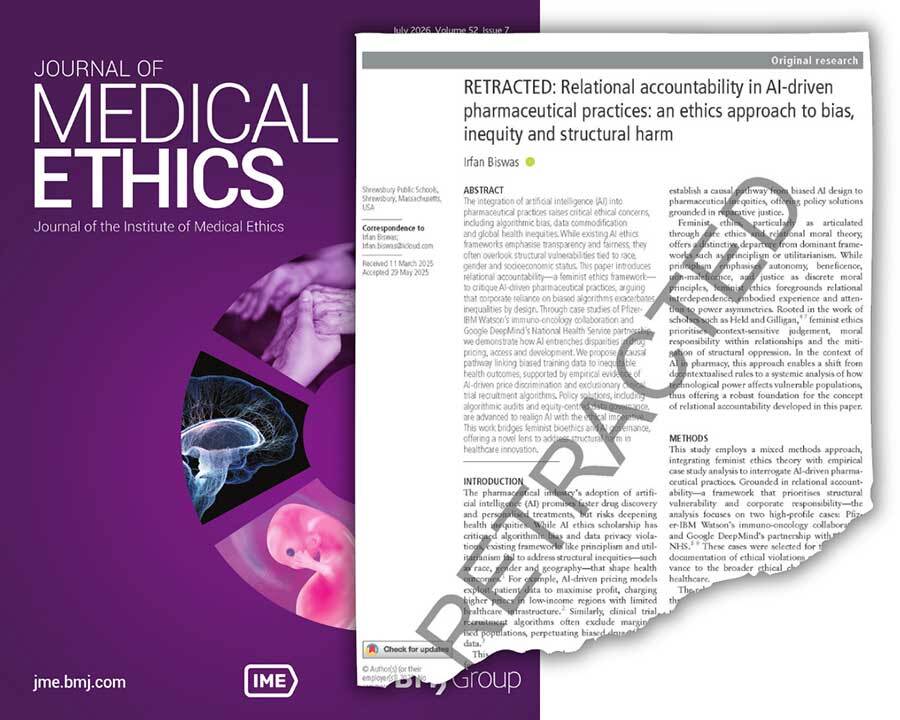
Ethics journal retracts paper by high school student for AI, peer review manipulation
The Journal of Medical Ethics has retracted a paper on the use of AI in the pharmaceutical industry for containing references that don’t exist. The article’s sole author: a high school student.&nbs…
Andreas De Block on Twitter / X
It took Nature three years to publish this rebuttal, which clearly demonstrates the fundamental flaws in the original paper. In the meantime, the paper's conclusions influenced scientific debate and policy decisions. Such delays in correcting flawed research do real damage. https://t.co/QI3Ei3PE70— Andreas De Block (@DeblockBlock) August 13, 2026
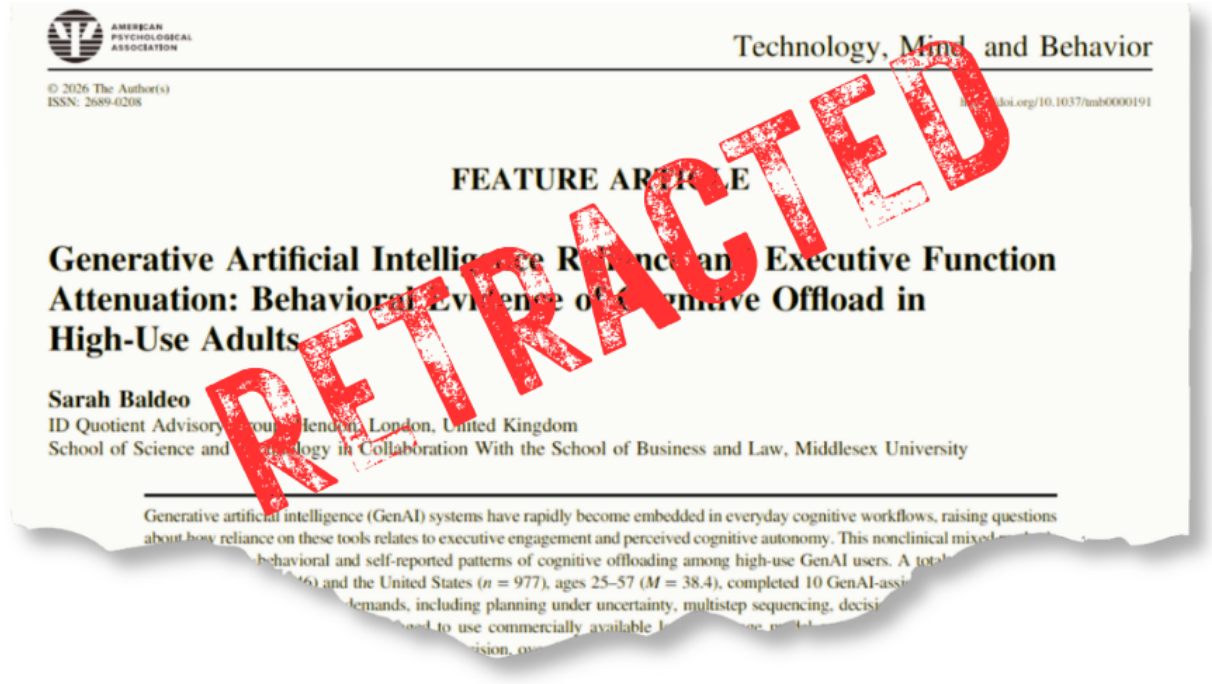
CEO of AI company loses paper on cognitive impact of generative AI
A psychology journal has retracted a paper on how using generative AI can affect confidence in work tasks after its sole author refused to share data with the editors. The April paper, publis…
When Nature Calls: The Enshittification of Science and Its Enablers
Proof-of-work papers, policy laundering, and the collapse of self-correction
It’s time to get rid of the peer-reviewed paper
The peer-reviewed journal article, perhaps the single most important device behind the expansion of scientific knowledge in the last century, is an extraordinarily expensive way to share novelty: e…

Is the scientific paper due to be replaced?
AI is pushing scientific publishing to the brink. For neuroscience, the crisis may be an opportunity to finally connect findings across subfields.
Is the scientific paper due to be replaced?
AI is pushing scientific publishing to the brink. For neuroscience, the crisis may be an opportunity to finally connect findings across subfields.
Investigation finds ‘egregious misconduct’ by CUNY scientist
In a report shared with Science in October 2023, a committee investigating allegations of misconduct by Dr. Hoau-Yan Wang, a professor at the City College of New York (CCNY, which falls under the C…

Cas (Stephen Casper) on Twitter / X
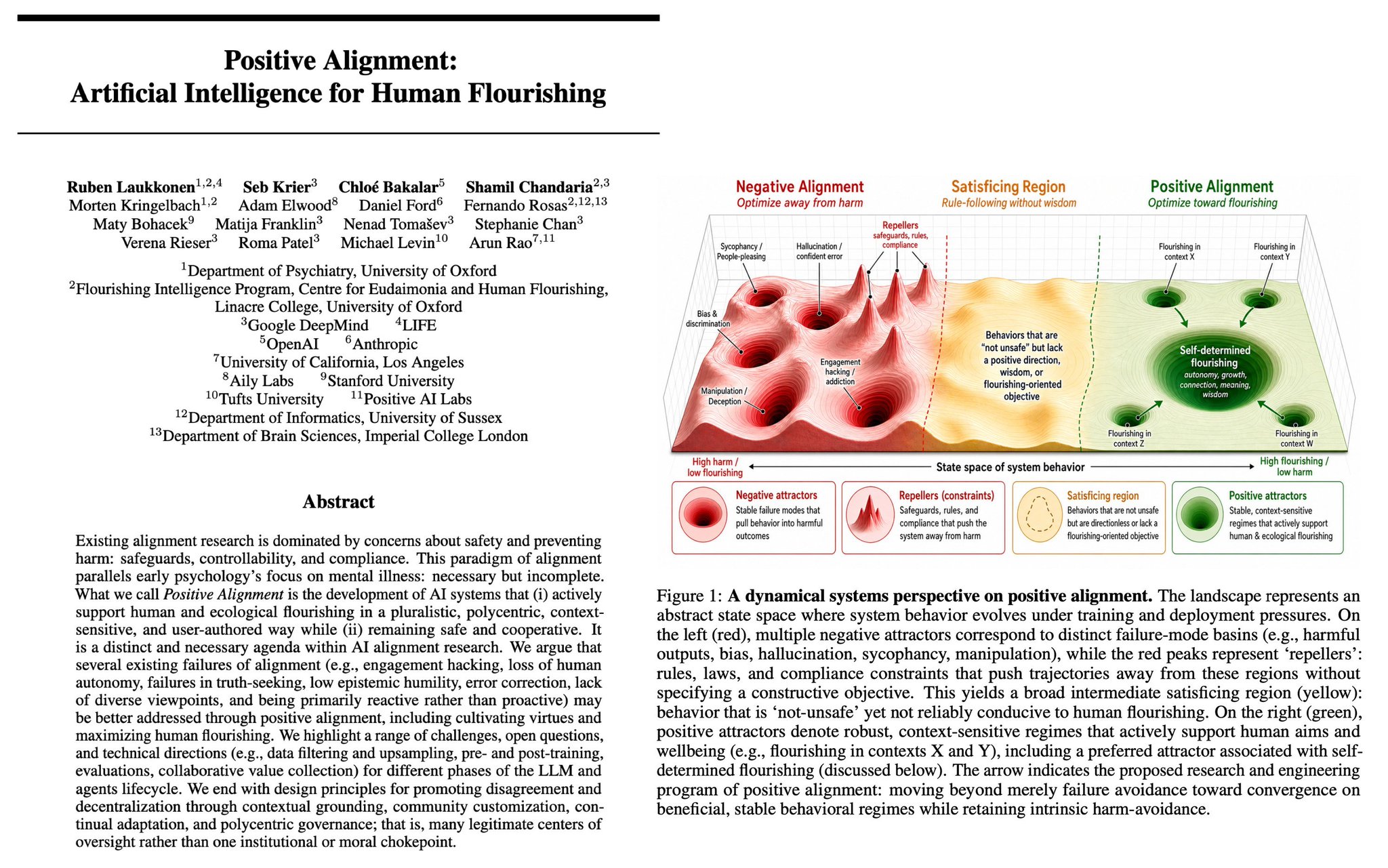
It is hard to overstate how disappointing I think this new paper from Oxford, OpenAI, Anthropic, and Google (et al) is. I can't take it seriously as academic work, just as propaganda. It also has some very bad scholarship and questionable adherence to research ethics. Having… pic.twitter.com/Z5fBx360ya— Cas (Stephen Casper) (@StephenLCasper) May 13, 2026
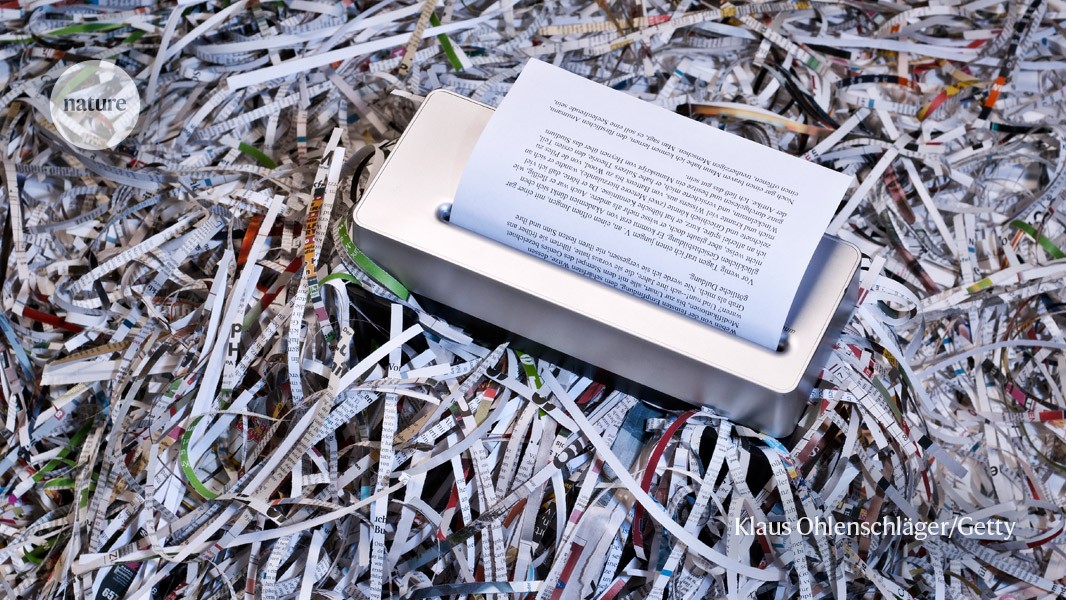
More than 10,000 research papers were retracted in 2023 — a new record
The number of articles being retracted rose sharply this year. Integrity experts say that this is only the tip of the iceberg.
More than 10,000 research papers were retracted in 2023 — a new record
The number of articles being retracted rose sharply this year. Integrity experts say that this is only the tip of the iceberg.
Are Scientific Papers Bad?
Curious about the competing interests statesments for @i4replication.bsky.social’s @pnas.org paper. 1) funding for i4r comes heavily from an AI/tech tied group and 2) that many authors and none has a conflict of interest with LLMs and science? pnas.org/doi/10.1073/pnas.2524747123
PNAS
www.pnas.orgIn February 2024, I wrote Scientific Reports about a published meta-analysis claiming that mindfulness interventions affect neural plasticity, 'cementing the neuropsychological basis of mindfulness-based interventions'. The paper was retracted yesterday—here a little summary of the process.🧵
Article now retracted. Retraction notice focuses on data sharing, but doesn't mention - the ethics review body is the author's own company - the tech used to to collect the data by intercepting users' LLM prompts does not exist ht @grinschglsandra.bsky.social psycnet.apa.org/fulltext/2027-53135-001.html
APA PsycNet
psycnet.apa.org
Ian Hussey
Retractionwatch coverage of this article retractionwatch.com/2026/06/16/technology-mind-be… @grinschglsandra.bsky.social @malte.the100.ci @jamiecummins.bsky.social
This is the future of scientific papers. Instead of a PDF, the paper is an AI agent that you can talk to, ask questions, run analyses. No more digging through supplements - just ask the paper directly: "what p-value cutoff was used in Fig 3B? Re-run at 0.01." nature.com/articles/s41586-026-11044-y

Reimagining research papers as interactive and reliable AI agents - Nature
www.nature.com


