"Sometimes the best method of information retrieval is talking to people." logicmag.io/care/informatics-of-the-oppre…

Informatics of the Oppressed
logicmag.ioMay 5, 2026 at 2:12 PM
Curated retrieval versus open web search in public AI information...
Public institutions increasingly use large language models (LLMs) to answer citizens' questions, often pairing a curated knowledge base with live web search, yet whether the sources behind these...

Google Search's guidance about AI-generated content | Google Search Central Blog | Google for Developers
In this post, we'll share more about how AI-generated content fits into our long-standing approach to show helpful content to people on Search.
tobi/qmd
mini cli search engine for your docs, knowledge bases, meeting notes, whatever. Tracking current sota approaches while being all local
Public use of a generalist LLM chatbot for health queries
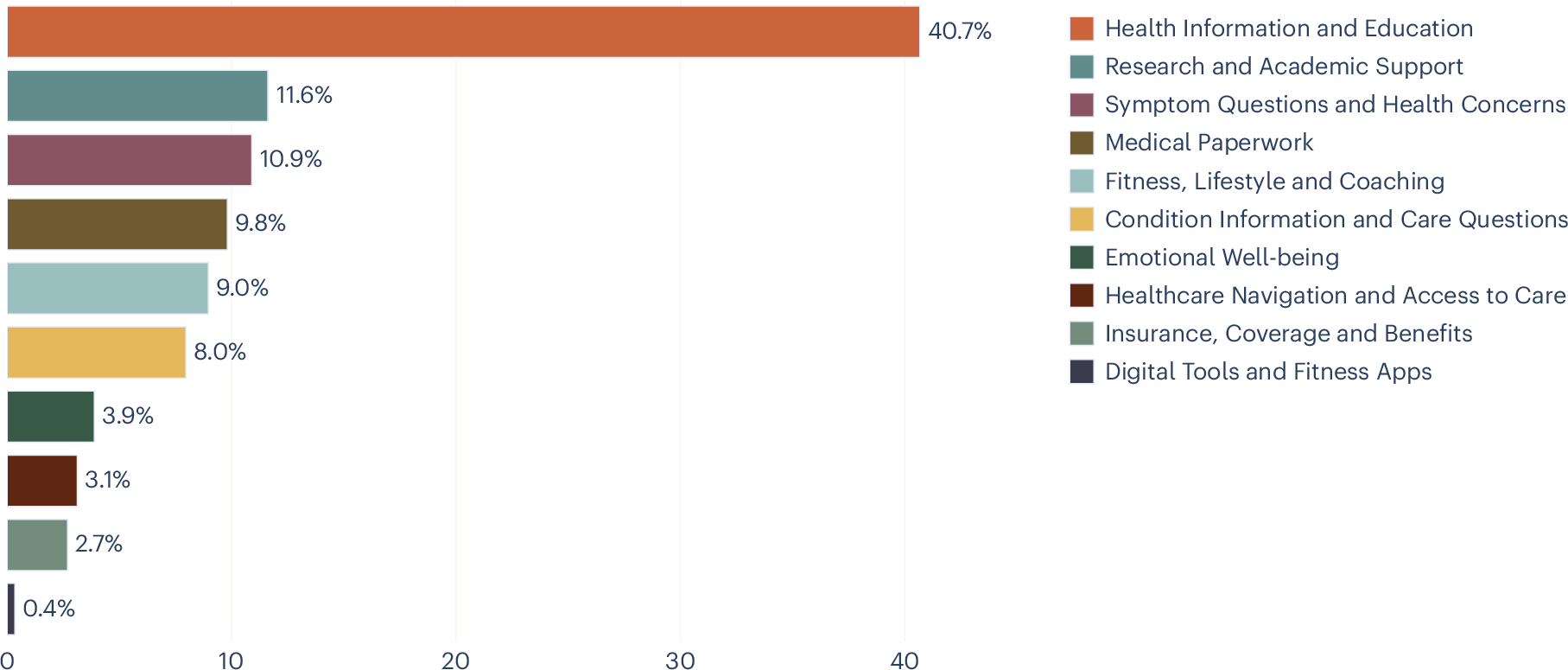
Here we analyse over 500,000 de-identified health-related conversations with Microsoft Copilot from January 2026 to characterize what people ask conversational artificial intelligence (AI) about health. We apply a hierarchical intent taxonomy of 12 primary categories using privacy-preserving large language model-based classification validated against expert human annotation and use topic clustering for prevalent themes within each intent. We then characterize the intents and topics behind health queries, identify who they are about, and analyse how usage varies by device and time of day. Nearly one in five conversations involves personal symptom assessment or condition discussion, and the dominant general information category is also concentrated on specific treatments and conditions, suggesting that this is a lower bound on personal health intent. One in seven of these personal health queries concerns someone other than the user, suggesting that conversational AI can also be a caregiving tool. Personal queries increase markedly in the evening and nighttime hours, when traditional healthcare is most limited. Usage diverges sharply by device: mobile concentrates on personal health concerns, while desktop is dominated by professional and academic work. A substantial share of queries focuses on navigating healthcare systems. These patterns have direct implications for platform-specific design, safety considerations and the responsible development of health AI.
Public use of a generalist LLM chatbot for health queries
Here we analyse over 500,000 de-identified health-related conversations with Microsoft Copilot from January 2026 to characterize what people ask conversational artificial intelligence (AI) about health. We apply a hierarchical intent taxonomy of 12 primary categories using privacy-preserving large language model-based classification validated against expert human annotation and use topic clustering for prevalent themes within each intent. We then characterize the intents and topics behind health queries, identify who they are about, and analyse how usage varies by device and time of day. Nearly one in five conversations involves personal symptom assessment or condition discussion, and the dominant general information category is also concentrated on specific treatments and conditions, suggesting that this is a lower bound on personal health intent. One in seven of these personal health queries concerns someone other than the user, suggesting that conversational AI can also be a caregiving tool. Personal queries increase markedly in the evening and nighttime hours, when traditional healthcare is most limited. Usage diverges sharply by device: mobile concentrates on personal health concerns, while desktop is dominated by professional and academic work. A substantial share of queries focuses on navigating healthcare systems. These patterns have direct implications for platform-specific design, safety considerations and the responsible development of health AI.
Performance of a large language model on the reasoning tasks of a physician
More than 65 years ago, complex clinical diagnostic reasoning cases were introduced as the gold standard for the evaluation of expert medical computing systems, a standard that has held ever since. In this study, we report the results of a physician ...

Learning with AI falls short compared to old-fashioned web search
Doing the mental work of connecting the dots across multiple web queries appears to help people understand the material better compared to an AI summary.

Learning with AI falls short compared to old-fashioned web search
Doing the mental work of connecting the dots across multiple web queries appears to help people understand the material better compared to an AI summary.
The enshittification of online search? Privacy and quality of Google, Bing and Apple in coding advice
Even though currently being challenged by ChatGPT and other large-language models (LLMs), Google Search remains one of the primary means for many individuals to find information on the internet. Interestingly, the way that we retrieve information on the web has hardly changed ever since Google was established in 1998, raising concerns as to Google's dominance in search and lack of competition. If the market for search was sufficiently competitive, then we should probably see a steady increase in search quality over time as well as alternative approaches to the Google's approach to search. However, hardly any research has so far looked at search quality, which is a key facet of a competitive market, especially not over time. In this report, we conducted a relatively large-scale quantitative comparison of search quality of 1,467 search queries relating to coding advice in October 2023. We focus on coding advice because the study of general search quality is difficult, with the aim of learning more about the assessment of search quality and motivating follow-up research into this important topic. We evaluate the search quality of Google Search, Microsoft Bing, and Apple Search, with a special emphasis on Apple Search, a widely used search engine that has never been explored in previous research. For the assessment of search quality, we use two independent metrics of search quality: 1) the number of trackers on the first search result, as a measure of privacy in web search, and 2) the average rank of the first Stack Overflow search result, under the assumption that Stack Overflow gives the best coding advice. Our results suggest that the privacy of search results is higher on Bing than on Google and Apple. Similarly, the quality of coding advice -- as measured by the average rank of Stack Overflow -- was highest on Bing.
Personal information firehose · Adam Wiggins
My new research project asks whether a personal algorithm, inspired by social media, can help us filter our email, group chats, and other personal correspondence.

Personal information firehose · Adam Wiggins
My new research project asks whether a personal algorithm, inspired by social media, can help us filter our email, group chats, and other personal correspondence.
your long-form atmosphere · pub search
what you publish, who reads it, your semantic neighborhoods, and what you recommend
How to Make Sense of Any Mess
Information Architecture for Everybody. Based on a book by Information Architect, Abby Covert.
Datalog
Datalog is a declarative logic programming language. While it is syntactically a subset of Prolog, Datalog generally uses a bottom-up rather than top-down evaluation model. This difference yields significantly different behavior and properties from Prolog. It is often used as a query language for deductive databases. Datalog has been applied to problems in data integration, networking, program analysis, and more.
Meilisearch: Unified Search & AI Retrieval Platform
Build lightning-fast search and AI retrieval with Meilisearch. Open-source, developer-friendly search engine trusted by 20,000+ teams worldwide.