

Capitalism and markets are closely connected, but they aren't exactly the same thing. And once we recognize that it opens up a huge new terrain for different types of social organization. J.K. Gibson Graham wrote on this a lot. en.wikipedia.org/wiki/J._K._Gibson-Graham
J. K. Gibson-Graham - Wikipedia
en.wikipedia.orgMay 31, 2026 at 3:28 PM
Capitalism
Capitalism is an economic system based on the private ownership of the means of production and its use for the purpose of obtaining profit. This socioeconomic system has developed historically in several stages, and is defined by a number of constituent elements: private property, profit motive, capital accumulation, competitive markets, commodification, wage labor, and an emphasis on innovation and economic growth. Capitalist economies may experience business cycles of economic expansion followed by recessions.
Denizen
What are some of the fundamental flaws of capitalism? How might we instantiate a market-based economy that is growth agnostic?
Will capitalism end capitalism? | Steve Loftus | The Critic Magazine
Imagine waking up one morning to discover your job still exists, but your services are no longer required. The work is being done, just not by you, not by anybody. Somewhere, a machine is doing it…
Cognitive Capitalism - Public Seminar
There are broadly three ways of thinking historically about capitalism. One draws on Marx’s value theory and pretty much treats...Read More

Le nouveau capitalisme (1/3)
Traduction de "New capitalism in America. Richest capitalists and richest workers are increasingly the same people" de Branko Milanovic

Le nouveau capitalisme (2/3) : inégalités compositionnelles versus inégalités de revenu
Traduction de "New capitalism II: Compositional vs income inequality. Are all class-based societies unequal?" de Branko Milanovic

New Capitalism II: Compositional vs income inequality
Are all class-based societies unequal?
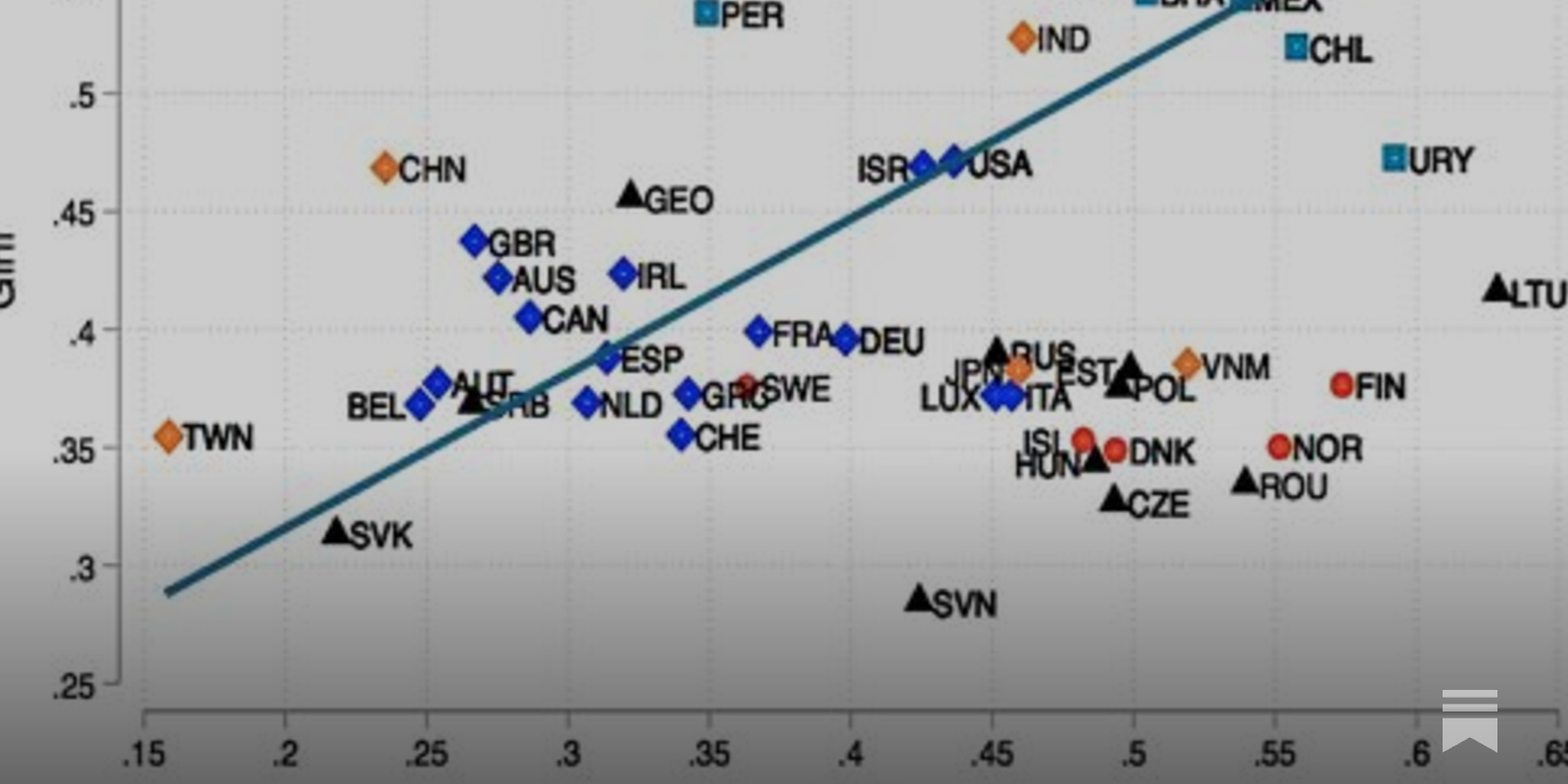
Market Socialism | The Paper Pilot
The Paper Pilot's digital garden of thoughts on philosophy, politics, and sociology
After Capitalism: A Cooperative Economy (Documentary)
Capitalism in Crisis Amid Slow Growth and Growing Inequality
Six years after the Lehman disaster, the industrialized world is suffering from Japan Syndrome. Growth is minimal, another crash may be brewing and the gulf between rich and poor continues to widen. Can the global economy reinvent itself?

Hope in Common
We seem to have reached an impasse. Capitalism as we know it appears to be coming apart. But as financial institutions stagger and crumble, there is no obvious alternative. Organized resistance appears scattered and incoherent; the global justice movement a shadow of its former self. There is good reason to believe that, in a generation […]

A Brief History of Neoliberalism
Abstract. Neoliberalism--the doctrine that market exchange is an ethic in itself, capable of acting as a guide for all human action--has become dominant in

The Cooperative Economy (@cooperatives.bsky.social)
Advocating for a democratic, equitable, and inclusive world through cooperatives, worker ownership, unions, mutual aid, and workplace democracy. 💜 #EconomicDemocracy 🌲🌲 usworker.coop | ncbaclusa.coop | workers.coop | ica.coop

Are there other ways to organize our economy? Economic democracy expands the ideal of "one person, one vote" into the economy. Democracy in our economy is the next step in realizing a society that features genuine self-determination for all people.

After Capitalism: A Cooperative Economy (Documentary)
youtu.be“What we’ve got to understand is that this epistemic chaos, this collective psychosis, has risen as a result of the shareholder-driven model of global capitalism. What we’ve got to do is look at the mechanisms of that wealth pump itself & start to change that.” theecologist.org/2026/sep/09/soft-body-turtle

The soft body of the turtle
theecologist.org


