

Interoperable Serendipity
If you had asked my thoughts on interoperability some years ago, I wouldn't have had much to say. Nowadays, it has become one of my most revered ideals. And today, I want to take you along for a journey towards its summum: Interoperable Serendipity.

The Cooperative Economy (@cooperatives.bsky.social)
Advocating for a democratic, equitable, and inclusive world through cooperatives, worker ownership, unions, mutual aid, and workplace democracy. 💜 #EconomicDemocracy 🌲🌲 usworker.coop | ncbaclusa.coop | workers.coop | ica.coop

After Capitalism: A Cooperative Economy (Documentary)
The Direction of Interoperability
Talking in terms of horizontal or vertical interoperability is too constrictive a mental model to understand what interoperability does. Doing better matters, and it's right within reach.

The Routledge Handbook of Cooperative Economics and Management
Cooperatives have spread across virtually all continents. Today, the International Cooperative Alliance (ICA) recognises over 3 million cooperatives with 1 billion cooperative members or about 12% of the human population and serving many more members of the public, collectively owning trillions in assets. This handbook provides a comprehensive introduction to the subject and the current state of affairs with regard to the study of cooperation in the economy generally and of the cooperative and related sectors particularly. It highlights the essential issues and debates; provides a future research agenda, outlining the distinctions and similarities between individual and (inter)organisational cooperation; and explores the connections of cooperative economics and management to fundamental ethical principles. This book examines coopetition and the similarities and differences between competitive economics and cooperative economics, identifying to what extent and how cooperative economics and management are more capable of addressing the problems of global neoliberalism, such as ecological collapse, wealth inequity, value capture, and distribution, including via online platforms and social/relational problems. This book offers a variety of new research and theory‑building from various disciplines, particularly focusing on the fields of economics and management but extending beyond these disciplines to domains such as sociology, psychology, anthropology, and political science. It will become the standard reference work for not only a broad and large audience of scholars, researchers, and students but also interested professionals, policymakers, regulators, and cooperators in the field wishing to orient themselves in a global, rapidly developing movement and field of study with reference to issues of producing and allocating resources and focusing on the impact of cooperation on issues like risk, trust, the development of preferences, institutional governance, networks, and inequity. The Open Access version of this book, available at https://www.taylorfrancis.com, has been made available under a Creative Commons Attribution-Non Commercial-No Derivatives (CC-BY-NC-ND) 4.0 license. The handbook has received an Honorable Mention for the Joyce Rothschild book prize.
Eventual Interoperability – Pieter Colpaert
A pragmatic approach to interoperability: model your data richly for your own needs, then allow the eventual creation of one‑to‑many alignments.

Liberating work - workers.coop
Worker cooperatives enable workers to unite and collectively advance their economic, social, and cultural interests.
Adversarial Interoperability
“Interoperability” is the act of making a new product or service work with an existing product or service: modern civilization depends on the standards and practices that allow you to put any dish

Will we have a theory for in-the-wild AI agents? - undisciplinary
Thoughts after writing a sociology-meets-physics-meets-agents paper I just put out a preprint out on a theory of role emergence in multi-agent systems (soci…
Start.coop | Empower Cooperative Growth
Discover resources and support to build and grow cooperatively-owned businesses, fostering community wealth-building and economic stability.

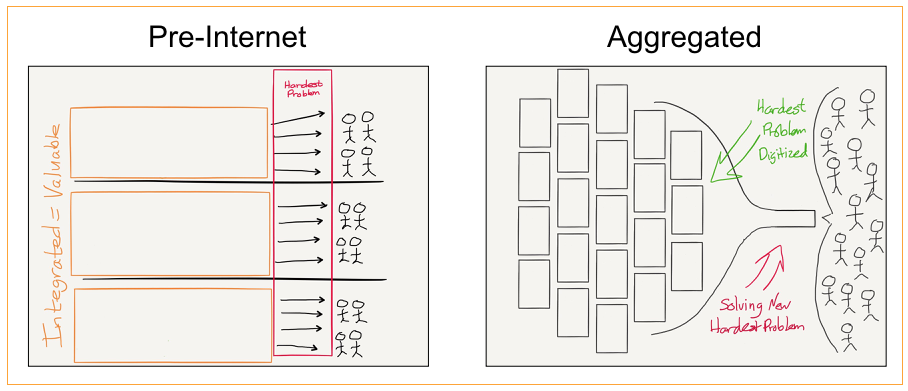
Aggregation Theory
About | Articles | Updates | Speaking | Consulting What is Aggregation Theory? Aggregation Theory is a completely new way to understand business in the Internet age. Business schools suggest that w…
Radical Interoperability is a Political Agenda
Model the world you want to live in.
Worker Co-Ops Have a Role to Play in Socialist Strategy
Establishing worker-owned firms is no substitute for building a strong labor movement and a socialist presence within the state. But worker co-ops can play a key part in a broader socialist strategy, by making tangible the material benefits of cooperation.

Composability with other tools
Interoperability, exchange, and composition are some of my primary motivations for building Subconscious. Why isn’t interoperability more common between tools for thought? Why is it that most of our tools are silos? How did we get here?

Capitalism and markets are closely connected, but they aren't exactly the same thing. And once we recognize that it opens up a huge new terrain for different types of social organization. J.K. Gibson Graham wrote on this a lot. en.wikipedia.org/wiki/J._K._Gibson-Graham
J. K. Gibson-Graham - Wikipedia
en.wikipedia.org"Teams working across organizational boundaries, sharing structured data, and building on each other’s work with ease." I know it's called "adversarial interop", but it actually feels like "community interop", at least right now

Toni Schneider
Conference Takeaways I’m back from ATmosphereConf in Vancouver, and I'm processing what I saw and heard. The atproto developer community could not have been nicer and more welcoming. Here are some takeaways. ... toni.org/2026/04/03/conference-takeawa…


