Joseph Weizenbaum's 1976 book, Computer Power and Human Reason, has long been out of print - used copies sell for hundreds of dollars. It's wild that this is not more widely available given how much his ideas still apply to the world we're in now. 🧵/
Jul 5, 2026 at 4:20 PM
Computer power and human reason : from judgment to calculation
xii, 300 pages : 24 cm; Includes bibliographical references and index

Experts Argue Whether Computers Could Reason, and if They Should (Published 1977)
Computer world is in midst of fundamental dispute over question of computer intelligence since MIT Prof Joseph Weizenbaum wrote book arguing that machines can never be made to reason like people and should not be; Weizenbaum por (M)

“Computers enable fantasies” – On the continued relevance of Weizenbaum’s warnings
“The computer has long been a solution looking for problems—the ultimate technological fix which insulates us from having to look at problems.” – Joseph Weizenbaum (1983) Trying to kee…

Humanities in the Machine - Blain Smith
There is something quietly remarkable about the people who built the foundations of modern computing. Not their technical achievements, though those are extraordinary. What is remarkable is where they came from before they ever touched a machine.
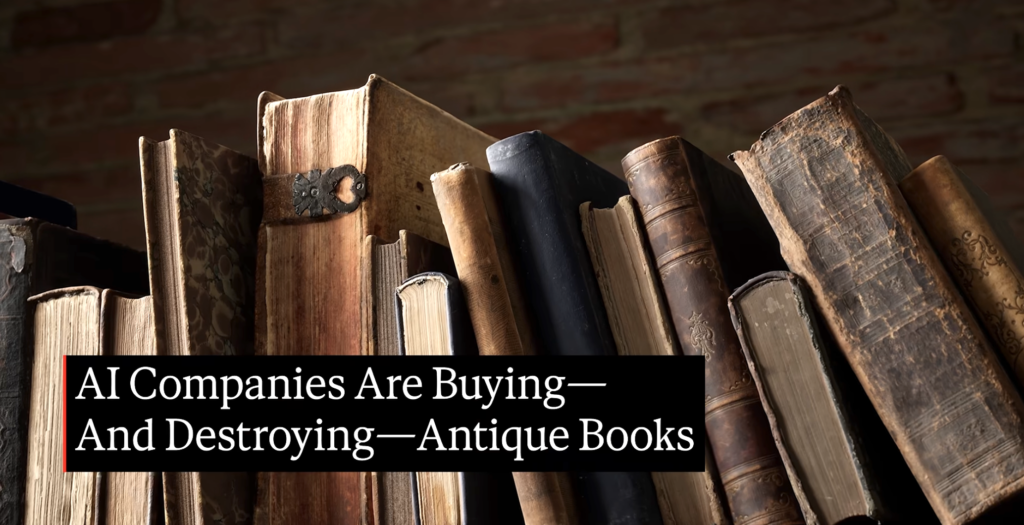
Why AI Companies Are Buying—And Then Destroying—Old Books
We've long joked about delaying bedtime in order to read the entire internet, but the prospect of actually doing so doesn't sound as appealing as it used to. An ever-growing proportion of text online, we may sense, hasn't been written by humans, but generated by artificial intelligence.
Anthropic destroyed millions of print books to build its AI models
Company hired Google's book-scanning chief to cut up and digitize "all the books in the world."

AI Companies Are Buying—And Destroying—Antique Books. Here’s Why.
Computer: A History of the Information Machine
Computer: A History of the Information Machine is a history of computing written by Martin Campbell-Kelly and William Aspray first published in 1996. It follows the history of "information machines" from Charles Babbage's difference engine through Herman Hollerith's tabulating machines to the invention of the modern electronic digital computer. A revised 2nd edition published in 2004 included new material on the Internet and World Wide Web, while the updated 3rd edition published in 2013 includes contributions from historians Nathan Ensmenger and Jeffrey Yost. The 3rd edition extends the story to include recent phenomena such as social networking and revises the discussion of early history to reflect new insights from the literature.

Writing books isn't a good idea
Could the creator economy provide a better one?

Silence is a Commons by Ivan Illich
Ivan Illich is doing to computers what he did to education (De-Schooling Society, 1971), to energy (Energy and Equity, 1974), to medicine (Medical Nemesis, 1975), and to sex roles (Vernacular Gender, 1983). Each time it has been radical analysis that changes our perception of what is really going on. Each time, and with growing clarity, it is an economic/historical analysis having to do with the idea of scarcity as a means of exploitation. This article is from Illich's remarks at the "Asahi Symposium Science and Man - The computer-managed Society," Tokyo, Japan, March 21, 1982. The ideas here are part of a book Illich is working on, The History of Scarcity. - Stewart Brand The CoEvolution Quarterly, Winter 1983
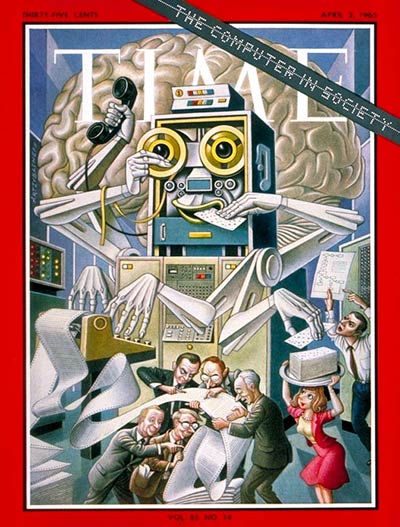
TIME Magazine Cover: Computer in Society - Apr. 2, 1965
TIME Magazine Cover: Computer in Society
AI Companies Are Buying Tons of Old Books Because They're Free of AI Slop
ISBNdb, a company that sources printed books for AI companies to turn into training data, tells clients “the optics problem is real.”

Against Usefulness
In a Brooklyn warehouse, a man handed me a piece of paper that was a running computer program.