

This is more than the NSF social sciences division - now on the chopping block - awarded in grants last year. Think about that: a single AI company has the money to fund more social science research than the US govt.

Hetan Shah
Anthropic AI research fund offers $5m - $30m for social science research on themes of AI impact on workers; transition initiatives; income support; building worker stakes; and wider evidence on public investments. Total fund of $200m available anthropic.com/news/economic-futures-researc…
Jul 31, 2026 at 11:27 AM
Humanity AI Announces More Than $18 Million in New Grants to Shape AI for the Public Good - Humanity AI
Humanity AI Announces More Than $18 Million in New Grants to Shape AI for the Public Good Pooled philanthropic fund […]
TechAccess: AI-Ready America
NSF Financial Assistance awards (grants and cooperative agreements) made on or after October 1, 2024, will be subject to the applicable set of award conditions, dated October 1, 2024, available on the NSF website. These terms and conditions are consistent with the revised guidance specified in the OMB Guidance for Federal Financial Assistance published in the Federal Register on April 22, 2024.

AI Is Changing Who Wins Research Grants
A new study from the Northwestern Innovation Institute finds that proposals showing stronger signs of AI-assisted writing were more likely to receive support from the National Institutes of Health, while also tending to align more closely with ideas that had already been funded.
National Data Platform Receives NSF Category I Award to Expand AI-Ready Data Infrastructure for U.S.
UC San Diego researchers will lead a collaborative project to expand a national platform connecting data, computing and AI resources to empower nationwide researchers and educators.

NSF plans cuts to core science programmes to fund White House initiative
A proposed clawback of already distributed research funds comes as the US agency struggles with a squeezed budget and a backlog of grant applications.
New Studies: How Commercial Forces Make Science Less Reliable
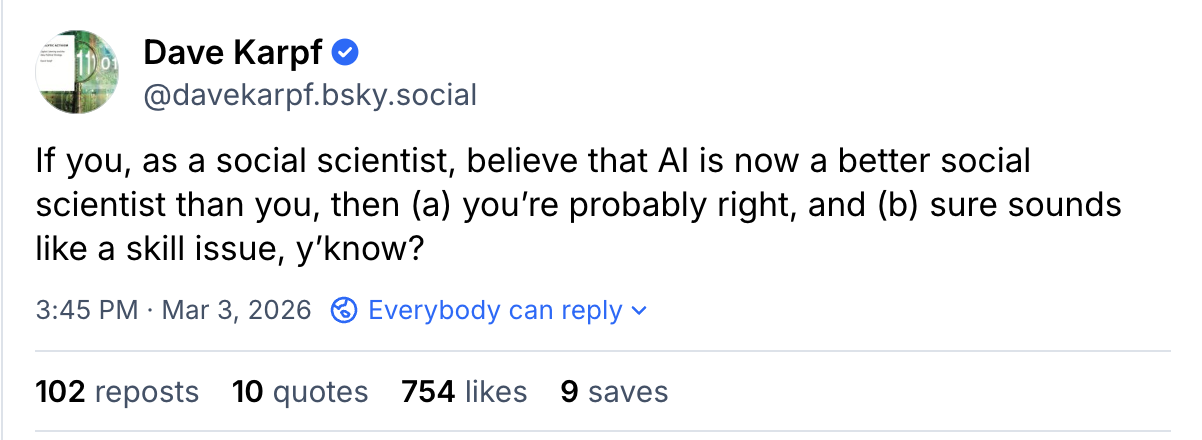
Computational social science has been distorted by commercial forces, and AI is making it worse.

OpenAI, Google, and Microsoft Back Bill to Fund ‘AI Literacy’ in Schools
A new bill introduced by Senators Adam Schiff and Mike Rounds would award grants to the National Science Foundation—which has endured massive funding cuts under the Trump Administration for science research—to put “AI literacy” in schools.

National Science Foundation Fostering Interdisciplinary Networks to Develop Emergent and Responsive Solutions Foundry (NSF FINDERS FOUNDRY)
NSF Financial Assistance awards (grants and cooperative agreements) made on or after October 1, 2024, will be subject to the applicable set of award conditions, dated October 1, 2024, available on the NSF website. These terms and conditions are consistent with the revised guidance specified in the OMB Guidance for Federal Financial Assistance published in the Federal Register on April 22, 2024.
Key Congress staffers in AI debate are funded by tech giants like Google and Microsoft
Big tech companies are funneling money through a science nonprofit to help pay the salaries of AI staffers in Congress — and it’s just one example of the increasing influence outside-funded fellows are exerting on tech policy in Washington.

NSF and NVIDIA award Ai2 a combined $152M to support building a national level fully open AI ecosystem | Ai2
Ai2 has been awarded a combined $152 million from the U.S. National Science Foundation (NSF) and NVIDIA as part of a jointly funded project to advance our research and develop truly open AI models and solutions that will accelerate scientific discovery.
Announcing the initial People-First AI Fund grantees
The OpenAI Foundation announces the initial recipients of the People-First AI Fund, awarding $40.5M in unrestricted grants to 208 nonprofits supporting community innovation and opportunity.

The Ed. Dept. Wants to Steer Grant Money to AI. What That Means for Schools
The Education Department is proposing to make advancing AI in education one of its grantmaking priorities.

Open Call for Proposals - Humanity AI
Open Call for Proposals: Communities Leading on AI $10M Investment in U.S.-Based Community-Led AI Initiatives Humanity AI, an initiative spearheaded […]

– Next Frontier AI
Next Frontier AI is run by SPRIND – the German Federal Agency for Breakthrough Innovation. Think of SPRIND as a state-backed deep-tech fund and company builder: we deploy public money with a venture mindset, take real technical risk and are explicitly mandated to try things that can fail.

The Rise of Large Language Models and the Direction and Impact of US Federal Research Funding
Federal research funding shapes the direction, diversity, and impact of the US scientific enterprise. Large language models (LLMs) are rapidly diffusing into scientific practice, holding substantial promise while raising widespread concerns. Despite growing attention to AI use in scientific writing and evaluation, little is known about how the rise of LLMs is reshaping the public funding landscape. Here, we examine LLM involvement at key stages of the federal funding pipeline by combining two complementary data sources: confidential National Science Foundation (NSF) and National Institutes of Health (NIH) proposal submissions from two large US R1 universities, including funded, unfunded, and pending proposals, and the full population of publicly released NSF and NIH awards. We find that LLM use rises sharply beginning in 2023 and exhibits a bimodal distribution, indicating a clear split between minimal and substantive use. Across both private submissions and public awards, higher LLM involvement is consistently associated with lower semantic distinctiveness, positioning projects closer to recently funded work within the same agency. The consequences of this shift are agency-dependent. LLM use is positively associated with proposal success and higher early-stage publication output at NIH, whereas no comparable associations are observed at NSF. Notably, the productivity gains at NIH are concentrated in non-hit papers rather than the most highly cited work. Together, these findings provide large-scale evidence that the rise of LLMs is reshaping how scientific ideas are positioned, selected, and translated into publicly funded research, with implications for portfolio governance, research diversity, and the long-run impact of science.

