

"A department generating high credit-hour production across the university but with few declared majors is not an inefficient department. It is a department whose students are not being counted in the metric being used against it."

Asheesh Kapur Siddique
An excellent analysis of the war on Black studies that also includes a deeply perceptive critique of the neoliberal logic of valuing disciplines based on # of undergrad majors: chronicle.com/article/the-erasure-of-black-…
Mar 15, 2026 at 1:55 PM
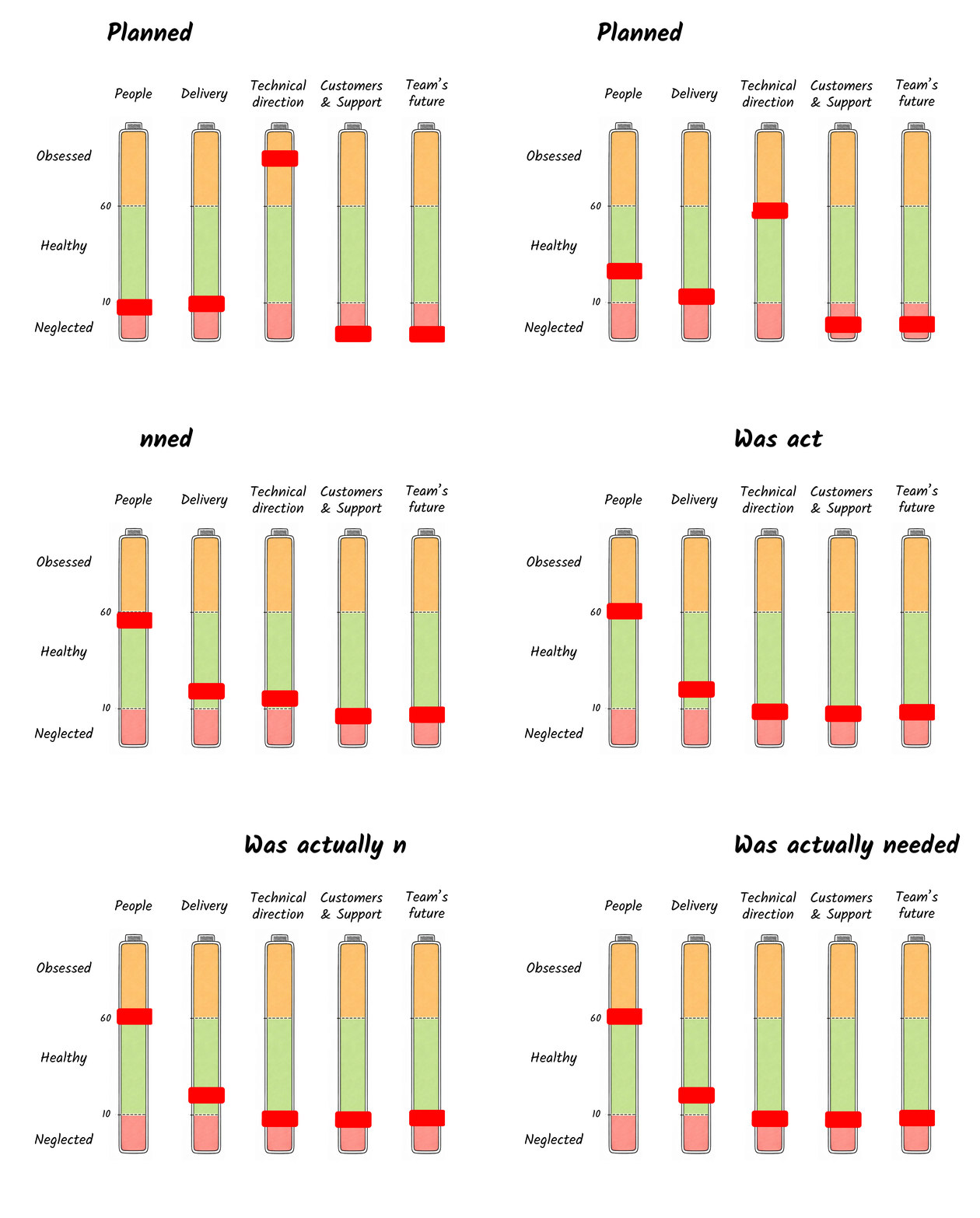
The engineering manager's attention budget
Every Engineering Manager has 5 jobs - most distribute their 100 'attention points' across only 2-3 of them
Lower Ed: The Troubling Rise of For-Profit Colleges
Lower Ed: The Troubling Rise of For-Profit Colleges in the New Economy by Tressie McMillan Cottom (2017, The New Press) is simply excellent. Here's an excerpt, here's Dr. McMillan Cottom's page about the book, here's … | Cogito, Ergo Sumana | Blog by Sumana Harihareswara, Changeset founder

Why Good Managers Are So Rare
Gallup data shows they have a combination of hard-to-teach traits.
Pay Enough or Don't Pay at All*
Abstract. Economists usually assume that monetary incentives improve performance, and psychologists claim that the opposite may happen. We present and disc

Doing nothing at work
Many engineers should be doing less work. I don’t necessarily mean producing less code or fewer changes, but literally working fewer hours in the day. When they do work, they should be working at a slower pace. I like to aim to be running at 80% utilization by default: unless I have a high-pressure project going on, I spend 20% of my workday away from the computer.

Have Data Centers Raised Your Electric Bill? Causal Evidence from the United States
We estimate that data centers caused average retail electricity rates to fall modestly in the United States from 2015 to 2024 using an instrumental variables approach. Despite prevailing sentiment, the finding is consistent with economic reasoning: existing large power system fixed costs, economies of scale in transmission and distribution, and declining unit costs for generation imply that durable demand growth lowers average prices. We find patterns of economies of scale for transmission, distribution, and generation costs as well as within and across retail customer classes. We caution that future supply constraints could reverse the effect.

Have Data Centers Raised Your Electric Bill? Causal Evidence from the United States
We estimate that data centers caused average retail electricity rates to fall modestly in the United States from 2015 to 2024 using an instrumental variables approach. Despite prevailing sentiment, the finding is consistent with economic reasoning: existing large power system fixed costs, economies of scale in transmission and distribution, and declining unit costs for generation imply that durable demand growth lowers average prices. We find patterns of economies of scale for transmission, distribution, and generation costs as well as within and across retail customer classes. We caution that future supply constraints could reverse the effect.
Is Revenue Model More Important than Culture?
HN Discussion Here: I always loved getting problems of the type “What is the limit as x approaches infinity” type in high-school/college. You’re given an equation (of the classic y=x format), and a…
Intelligence Per Watt: A Study of Local Intelligence Efficiency
Jon Saad-Falcon*, Avanika Narayan*, John Hennessy, Azalia Mirhoseini, Chris Ré

Efficiency is the Enemy
If you ever find yourself stressed, overwhelmed, sinking into stasis despite wanting to change, or frustrated when you can’t respond to new opportunities, you need more slack in your life. Here’s how slack works and why you need more of it.
College admissions insanity is substantially explained by this fact: The number of elite entry level jobs (e.g. McKinsey, Goldman Sachs, Google, The Economist) is flat, demand for them has exploded, and hiring managers and people teams have no cap on the # of hires they can make from target schools

SE Gyges
at some point in looking at university admissions scandals it becomes inescapable that elite colleges are, functionally, granting admission to an aristocracy, which makes this sort of thing much, much more legible the lesser noble houses are upset that their children are not being elevated
This will be bad for: - the students - the research progress - the universities - the towns the universities are in - the companies hiring students - the states the universities are in - the national economy - national security - the country - the world

Michael Clemens
The US President's new proposal to tax international students has been approved by the White House for release this week. It's an unprecedented $100,000 tax on int'l grads who stay to work after graduation on Optional Practical Training (most grads do), a crucial bridge to remaining by any channel.
Harvard just dropped a study AI productivity in software engineering and it found the average increase in productivity from using Claude code is.....zero and for exactly the reasons you'd think fion.ac/jellyfish.pdf


