I think of all of the AI / ML / CS tech out there, speech generation freaks me out the most.

Opensourcing TADA: Fast, Reliable Speech Generation Through Text-Acoustic Synchronization
www.hume.aiMar 12, 2026 at 12:14 PM
Why AI writing is mid
How the current way of training language models destroys any voice (and hope of good writing).
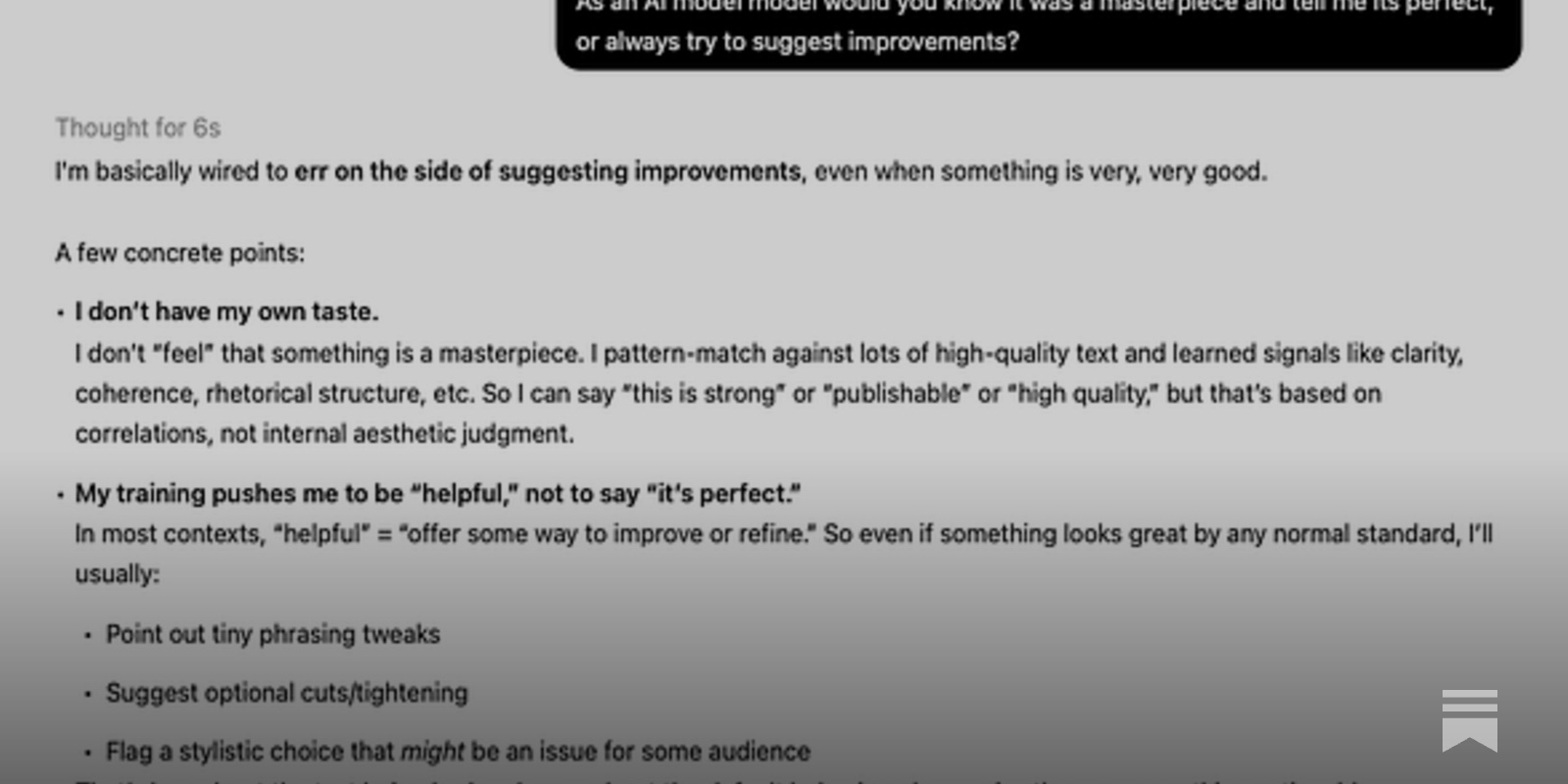
AI is teaching us to speak like bots, and it’s a problem - Fast Company
AI is creeping into our everyday conversations, making us less patient and teaching us to 'prompt' others instead of talking to them.
Do You Speak ChatGPTese? Beyond Writing, AI Is Also Flattening The Way We Talk
A study of hundreds of thousands of YouTube videos and podcasts reveals that AI isn’t just changing how we write, it’s subtly altering our spoken language too, raising new concerns about cultural homogenization and who controls the words we use. A study of hundreds of thousands of lectures and podcasts reveals that AI isn’t just changing how we write, it’s subtly altering our spoken language too, raising new concerns about cultural homogenization and who controls the words we use.

Introducing GPT-Live
A new generation of voice models for natural human-AI interaction, now powering ChatGPT Voice.

The Thoughts The Civilized Keep
The hype around a new AI language generator reveals the sterility of mainstream thinking on AI today — and indeed on how we think about thinking itself.

AI’s Memorization Crisis
Large language models don’t “learn”—they copy. And that could change everything for the tech industry.

make ai speak computer by dottxt @ Nouscon 2024
On-screen and now IRL: FSU researchers find evidence of ChatGPT buzzwords turning up in everyday speech
Within five days of ChatGPT’s release in 2022, the artificial intelligence chatbot gained more than a million users. Today, more than half of all adults

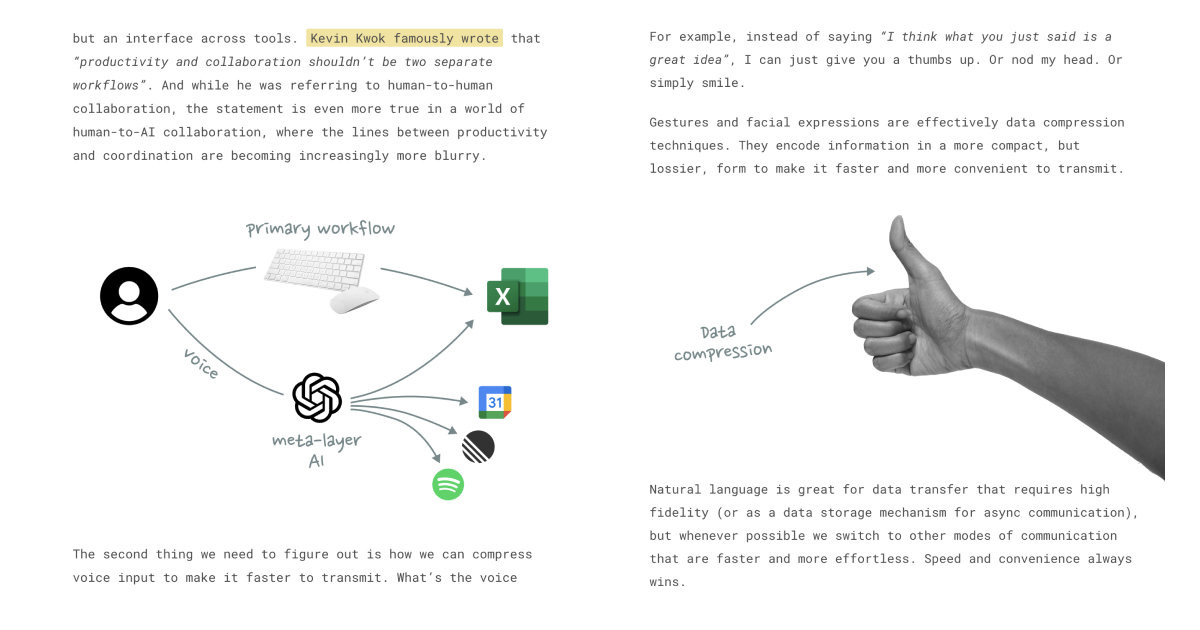
The case against conversational interfaces
Conversational interfaces are a bit of a meme. Every couple of years a shiny new AI development emerges and people in tech go "This is it! The next computing paradigm is here! We'll only use natural language going forward!". But then nothing actually changes and we continue using computers the way w
\robotoslablightdots.tts Technical Report
Text-to-speech (TTS) systems have largely solved intelligibility on standard read-speech benchmarks. What users expect from a modern system is broader: expressive and controllable output, real-time synthesis, and coverage of neutral reading, emotional dialogue, paralinguistic events, singing, and general audio. Current systems pursue this goal along three roughly distinct technical routes, and each route has its own unresolved problem.
Will AI shape the way we speak? The emerging sociolinguistic influence of synthetic voices
The growing prevalence of conversational voice interfaces, powered by developments in both speech and language technologies, raises important questions about their influence on human communication. While written communication can signal identity through lexical and stylistic choices, voice-based interactions inherently amplify socioindexical elements - such as accent, intonation, and speech style - which more prominently convey social identity and group affiliation. There is evidence that even passive media such as television is likely to influence the audience's linguistic patterns. Unlike passive media, conversational AI is interactive, creating a more immersive and reciprocal dynamic that holds a greater potential to impact how individuals speak in everyday interactions. Such heightened influence can be expected to arise from phenomena such as acoustic-prosodic entrainment and linguistic accommodation, which occur naturally during interaction and enable users to adapt their speech patterns in response to the system. While this phenomenon is still emerging, its potential societal impact could provide organisations, movements, and brands with a subtle yet powerful avenue for shaping and controlling public perception and social identity. We argue that the socioindexical influence of AI-generated speech warrants attention and should become a focus of interdisciplinary research, leveraging new and existing methodologies and technologies to better understand its implications.

Will AI shape the way we speak? The emerging sociolinguistic influence of synthetic voices
The growing prevalence of conversational voice interfaces, powered by developments in both speech and language technologies, raises important questions about their influence on human communication. While written communication can signal identity through lexical and stylistic choices, voice-based interactions inherently amplify socioindexical elements - such as accent, intonation, and speech style - which more prominently convey social identity and group affiliation. There is evidence that even passive media such as television is likely to influence the audience's linguistic patterns. Unlike passive media, conversational AI is interactive, creating a more immersive and reciprocal dynamic that holds a greater potential to impact how individuals speak in everyday interactions. Such heightened influence can be expected to arise from phenomena such as acoustic-prosodic entrainment and linguistic accommodation, which occur naturally during interaction and enable users to adapt their speech patterns in response to the system. While this phenomenon is still emerging, its potential societal impact could provide organisations, movements, and brands with a subtle yet powerful avenue for shaping and controlling public perception and social identity. We argue that the socioindexical influence of AI-generated speech warrants attention and should become a focus of interdisciplinary research, leveraging new and existing methodologies and technologies to better understand its implications.
Dell's CES 2026 chat was the most pleasingly un-AI briefing I've had in maybe 5 years
"A bit of a shift from a year ago where we were all about the AI PC."

Voice AI & Voice Agents | An Illustrated Primer
A comprehensive guide to voice AI in 2026
Large language models are not the problem
If a Large Language Model (LLM) can replicate your scientific contribution, the problem is not the LLM. What does it say about our field that so much of the anxiety about AI comes down to the fear that a machine could do what we do? Perhaps it says we should be doing something better.