

“Writing is hard.” Thrilled to share that this simple idea led to a new paper in Political Analysis! Where most text methods focus on content, I test if expression is also effortful action. I find simple measures like character counts reveal attitudes and predict voting. cup.org/4cUmoXi 1/
May 6, 2026 at 6:16 PM
Writing With AI Is Harder Than You Think
It takes rigor, judgment, and willingness to be told your work isn't good enough.

Redesigning algorithms to intervene on social norm misperceptions during a national election
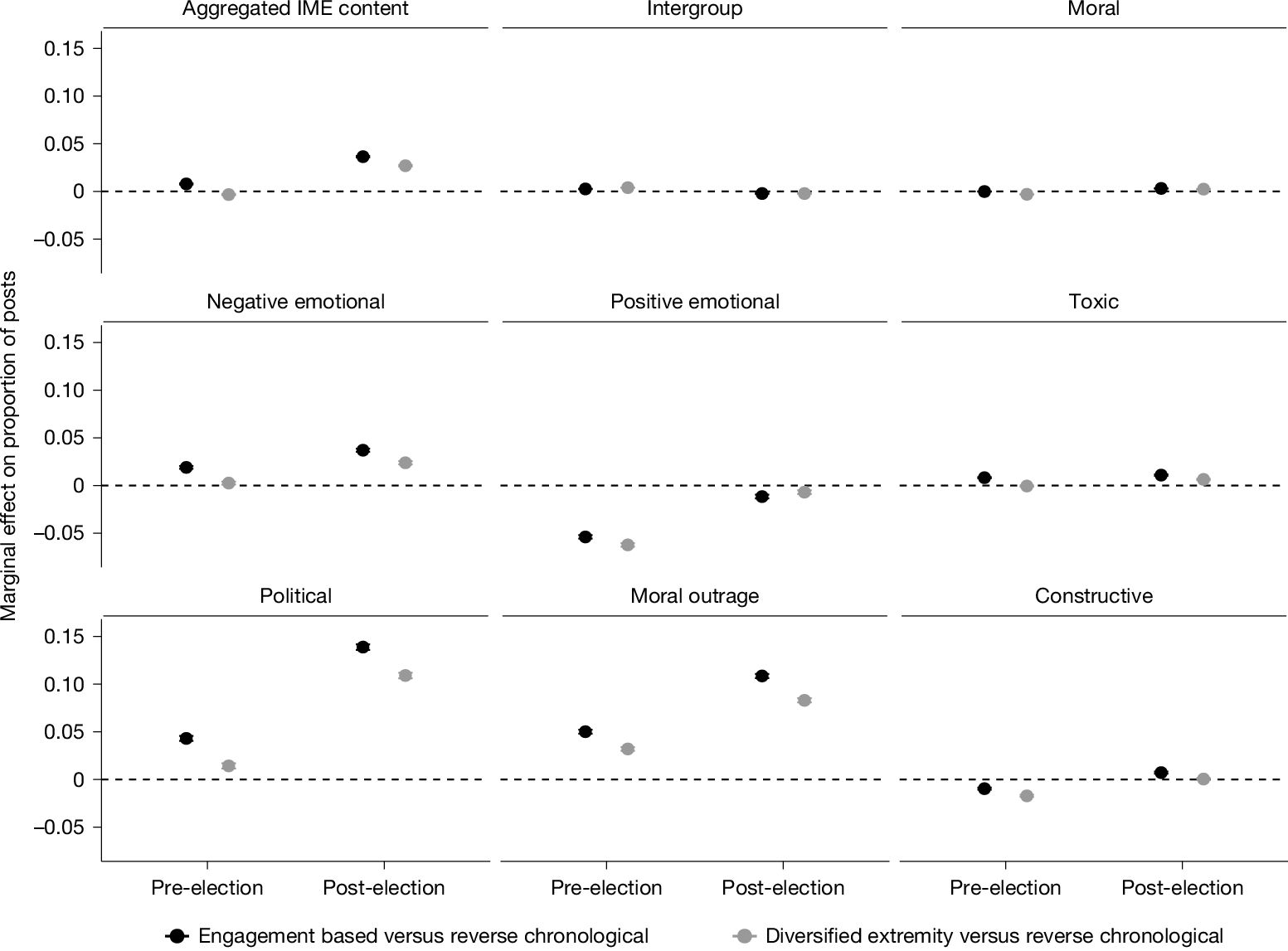
For the first time in history, civic discourse commonly occurs in digital environments in which algorithms influence exposure to social information1,2. It is increasingly important to understand whether and how these algorithms affect political discourse3–5. Here we built custom feed-ranking algorithms with full control over their features, and randomly assigned 2,000 participants to use them for 8 weeks (before and after the 2024 US presidential election). We tested whether an engagement-based algorithm (used on major social media platforms6,7) amplifies intergroup, moralized and emotional (IME) information in ways that skew perceptions of social norms around political dialogue5,8, and whether it increased engagement with IME content and perceptions of partisan animosity (compared with a reverse-chronological feed9,10). We also developed and tested a ‘diversified extremity’ algorithm to reduce the influence of extreme users11–13 to improve the accuracy of social norm perception14–16 and reduce perceptions of partisan animosity. We found that engagement-based feeds amplified IME and toxic content relative to reverse-chronological feeds, with the largest increases in moral outrage and political content. Engagement-based feeds also reduced prescriptive norm perception accuracy (albeit in an unexpected direction) and increased perceived partisan animosity. However, they did not significantly alter users’ own engagement behaviours. The diversified extremity algorithm reduced IME and toxic content exposure, improved prescriptive norm accuracy, yet maintained comparable platform enjoyment—suggesting that reducing the influence of extreme users can curb algorithmic distortions without diminishing user experience.
The levers of political persuasion with conversational artificial intelligence
There are widespread fears that conversational artificial intelligence (AI) could soon exert unprecedented influence over human beliefs. In this work, in three large-scale experiments ( N = 76,977 participants), we deployed 19 large language models (LLMs)—including some post-trained explicitly for persuasion—to evaluate their persuasiveness on 707 political issues. We then checked the factual accuracy of 466,769 resulting LLM claims. We show that the persuasive power of current and near-future AI is likely to stem more from post-training and prompting methods—which boosted persuasiveness by as much as 51 and 27%, respectively—than from personalization or increasing model scale, which had smaller effects. We further show that these methods increased persuasion by exploiting LLMs’ ability to rapidly access and strategically deploy information and that, notably, where they increased AI persuasiveness, they also systematically decreased factual accuracy. , Editor’s summary Many fear that we are on the precipice of unprecedented manipulation by large language models (LLMs), but techniques driving their persuasiveness are poorly understood. In the initial “pretrained” phase, LLMs may exhibit flawed reasoning. Their power unlocks during vital “posttraining,” when developers refine pretrained LLMs to sharpen their reasoning and align with users’ needs. Posttraining also enables LLMs to maintain logical, sophisticated conversations. Hackenburg et al . examined which techniques made diverse, conversational LLMs most persuasive across 707 British political issues (see the Perspective by Argyle). LLMs were most persuasive after posttraining, especially when prompted to use facts and evidence (information) to argue. However, information-dense LLMs produced the most inaccurate claims, raising concerns about the spread of misinformation during rollouts of future models. —Ekeoma Uzogara , INTRODUCTION Rapid advances in artificial intelligence (AI) have sparked widespread concerns about its potential to influence human beliefs. One possibility is that conversational AI could be used to manipulate public opinion on political issues through interactive dialogue. Despite extensive speculation, however, fundamental questions about the actual mechanisms, or “levers,” responsible for driving advances in AI persuasiveness—e.g., computational power or sophisticated training techniques—remain largely unanswered. In this work, we systematically investigate these levers and chart the horizon of persuasiveness with conversational AI. RATIONALE We considered multiple factors that could enhance the persuasiveness of conversational AI: raw computational power (model scale), specialized post-training methods for persuasion, personalization to individual users, and instructed rhetorical strategies. Across three large-scale experiments with 76,977 total UK participants, we deployed 19 large language models (LLMs) to persuade on 707 political issues while varying these factors independently. We also analyzed more than 466,000 AI-generated claims, examining the relationship between persuasiveness and truthfulness. RESULTS We found that the most powerful levers of AI persuasion were methods for post-training and rhetorical strategy (prompting), which increased persuasiveness by as much as 51 and 27%, respectively. These gains were often larger than those obtained from substantially increasing model scale. Personalizing arguments on the basis of user data had a comparatively small effect on persuasion. We observe that a primary mechanism driving AI persuasiveness was information density: Models were most persuasive when they packed their arguments with a high volume of factual claims. Notably, however, we documented a concerning trade-off between persuasion and accuracy: The same levers that made AI more persuasive—including persuasion post-training and information-focused prompting—also systematically caused the AI to produce information that was less factually accurate. CONCLUSION Our findings suggest that the persuasive power of current and near-future AI is likely to stem less from model scale or personalization and more from post-training and prompting techniques that mobilize an LLM’s ability to rapidly generate information during conversation. Further, we reveal a troubling trade-off: When AI systems are optimized for persuasion, they may increasingly deploy misleading or false information. This research provides an empirical foundation for policy-makers and technologists to anticipate and address the challenges of AI-driven persuasion, and it highlights the need for safeguards that balance AI’s legitimate uses in political discourse with protections against manipulation and misinformation. Persuasiveness of conversational AI increases with model scale. The persuasive impact in percentage points on the y axis is plotted against effective pretraining compute [floating-point operations (FLOPs)] on the x axis. Point estimates are persuasive effects of different AI models. Colored lines show trends for models that we uniformly chat-tuned for open-ended conversation (purple) versus those that were post-trained using heterogeneous, opaque methods by AI developers (green). pp, percentage points; CI, confidence interval.

Automatic Against the People: Reading, Writing, and AI

Wherein I Find Myself Writing About Writing
Most everyone finds writing to be challenging (especially those who say they enjoy it). This is because writing is an intentional, thoughtful act. This is as it should be, but “AI” has recently exacerbated the misbelief that writing is simply an output. In fact, it's a creative process that has merit in and of itself.

The small effects of political advertising are small regardless of context, message, sender, or receiver: Evidence from 59 real-time randomized experiments
Campaign persuasion operates with notable consistency across political parties, message tone, and information environment., Evidence across social science indicates that average effects of persuasive messages are small. One commonly offered explanation for these small effects is heterogeneity: Persuasion may only work well in specific circumstances. To evaluate heterogeneity, we repeated an experiment weekly in real time using 2016 U.S. presidential election campaign advertisements. We tested 49 political advertisements in 59 unique experiments on 34,000 people. We investigate heterogeneous effects by sender (candidates or groups), receiver (subject partisanship), content (attack or promotional), and context (battleground versus non-battleground, primary versus general election, and early versus late). We find small average effects on candidate favorability and vote. These small effects, however, do not mask substantial heterogeneity even where theory from political science suggests that we should find it. During the primary and general election, in battleground states, for Democrats, Republicans, and Independents, effects are similarly small. Heterogeneity with large offsetting effects is not the source of small average effects.

Subscribe to Strength In Numbers
Independent, data-driven analysis of politics, public opinion polls, and elections. From author, journalist, and pollster G. Elliott Morris. Click to read Strength In Numbers, by G. Elliott Morris, a Substack publication with tens of thousands of subscribers.
Subscribe to Strength In Numbers
Independent, data-driven analysis of politics, public opinion polls, and elections. From author, journalist, and pollster G. Elliott Morris. Click to read Strength In Numbers, by G. Elliott Morris, a Substack publication with tens of thousands of subscribers.
Political Compass or Spinning Arrow? Towards More Meaningful Evaluations for Values and Opinions in Large Language Models
Much recent work seeks to evaluate values and opinions in large language models (LLMs) using multiple-choice surveys and questionnaires. Most of this work is motivated by concerns around real-world LLM applications. For example, politically-biased LLMs may subtly influence society when they are used by millions of people. Such real-world concerns, however, stand in stark contrast to the artificiality of current evaluations: real users do not typically ask LLMs survey questions. Motivated by this discrepancy, we challenge the prevailing constrained evaluation paradigm for values and opinions in LLMs and explore more realistic unconstrained evaluations. As a case study, we focus on the popular Political Compass Test (PCT). In a systematic review, we find that most prior work using the PCT *forces models to comply with the PCT's multiple-choice format. We show that models give substantively different answers when not forced; that answers change depending on how models are forced; and that answers lack paraphrase robustness. Then, we demonstrate that models give different answers yet again in a more realistic open-ended answer setting. We distill these findings into recommendations and open challenges in evaluating values and opinions in LLMs.
GermanPartiesQA: Benchmarking Commercial Large Language Models and AI Companions for Political Alignment and Sycophancy
Large language models (LLMs) are increasingly shaping citizens’ information ecosystems. Products incorporating LLMs, such as chatbots and AI Companions, are now widely used for decision support and information retrieval, including in sensitive domains, raising concerns about hidden biases and growing potential to shape individual decisions and public opinion. This paper introduces GermanPartiesQA, a benchmark of 418 political statements from German Voting Advice Applications across 11 elections to evaluate six commercial LLMs. We evaluate their political alignment based on role-playing experiments with political personas. Our evaluation reveals three specific findings: (1) Factual limitations: LLMs show limited ability to accurately generate factual party positions, particularly for centrist parties. (2) Model-specific ideological alignment: We identify consistent alignment patterns and degree of political steerability for each model across temperature settings and experiments. (3) Claim of sycophancy: While models adjust to political personas during role-play, we find this reflects persona-based steerability rather than the increasingly popular, yet contested concept of sycophancy. Our study contributes to evaluating the political alignment of closed-source LLMs that are increasingly embedded in electoral decision support tools and AI Companion chatbots.
GermanPartiesQA: Benchmarking Commercial Large Language Models and AI Companions for Political Alignment and Sycophancy
Large language models (LLMs) are increasingly shaping citizens’ information ecosystems. Products incorporating LLMs, such as chatbots and AI Companions, are now widely used for decision support and information retrieval, including in sensitive domains, raising concerns about hidden biases and growing potential to shape individual decisions and public opinion. This paper introduces GermanPartiesQA, a benchmark of 418 political statements from German Voting Advice Applications across 11 elections to evaluate six commercial LLMs. We evaluate their political alignment based on role-playing experiments with political personas. Our evaluation reveals three specific findings: (1) Factual limitations: LLMs show limited ability to accurately generate factual party positions, particularly for centrist parties. (2) Model-specific ideological alignment: We identify consistent alignment patterns and degree of political steerability for each model across temperature settings and experiments. (3) Claim of sycophancy: While models adjust to political personas during role-play, we find this reflects persona-based steerability rather than the increasingly popular, yet contested concept of sycophancy. Our study contributes to evaluating the political alignment of closed-source LLMs that are increasingly embedded in electoral decision support tools and AI Companion chatbots.
Algorithms may be making political polarization worse than we think
Marc Torrens and Carlos Carrasco-Farré analyze how algorithms influence opinions and heighten our emotional responses.
How easy is it to spot AI writing?
With AI writing becoming increasingly commonplace, how can we spot it and what difference does it make?

A meta-analysis of the persuasive power of large language models
Large language models (LLMs) are increasingly used for persuasion, such as in political communication and marketing, where they affect how people think, choose, and act. Yet, empirical findings on the effectiveness of LLMs in persuasion compared to humans remain inconsistent. The aim of this study was to systematically review and meta-analytically assess whether LLMs differ from humans in persuasive effectiveness, and under which contextual conditions LLMs are particularly effective. We identified 7 studies with 17,422 participants primarily recruited from English-speaking countries and 12 effect size estimates. Egger’s test indicated potential small-study effects ($$p =.018$$), but the trim-and-fill analysis did not impute any missing studies, suggesting a low risk of publication bias. We then compute the standardized effect sizes based on Hedges’ g. The results show no significant overall difference in persuasive performance between LLMs and humans ($$g = 0.02$$, $$p =.530$$). However, we observe substantial heterogeneity across studies ($$I^2 = 75.97\%$$), suggesting that persuasiveness strongly depends on contextual factors. In separate exploratory moderator analyses, no individual factor (e.g., LLM model, conversation design, or domain) reached statistical significance, which may be due to the limited number of studies. When considered jointly in a combined model, these factors explained a large proportion of the between-study variance ($$R^2 = 81.93\%$$), and residual heterogeneity is low ($$I^2 = 35.51\%$$). Although based on a small number of studies, this suggests that differences in LLM model, conversation design, and domain are important contextual factors in shaping persuasive performance, and that single-factor tests may understate their influence. Our results highlight that LLMs can match human performance in persuasion, but their success depends strongly on how they are implemented and embedded in communication contexts.

Do LLMs write like humans? Variation in grammatical and rhetorical styles
As large language models (LLMs) have grown in power and become more widely available, research has focused on their ability to complete various tasks and the biases they exhibit when doing so. In this study, we instead examine their writing style in detail. We show that instruction-tuned models, which are trained to answer questions and solve problems, have a distinct noun-heavy, informationally dense writing style, even when prompted to match the style of informal speech and writing. These findings suggest that instruction-tuned models generate text that does not align with genre conventions familiar to human audiences, and demonstrate the value of linguistic variables in evaluating the output of LLMs., Large language models (LLMs) are capable of writing grammatical text that follows instructions, answers questions, and solves problems. As they have advanced, it has become difficult to distinguish their output from human-written text. While past research has found some differences in features such as word choice and punctuation and developed classifiers to detect LLM output, none has studied the rhetorical styles of LLMs. Using several variants of Llama 3 and GPT-4o, we construct two parallel corpora of human- and LLM-written texts from common prompts. Using Douglas Biber’s set of lexical, grammatical, and rhetorical features, we identify systematic differences between LLMs and humans and between different LLMs. These differences persist when moving from smaller models to larger ones and are larger for instruction-tuned models than base models. This observation of differences demonstrates that despite their advanced abilities, LLMs struggle to match human stylistic variation. Attention to more advanced linguistic features can hence detect patterns in their behavior not previously recognized.
✨New paper out @nature.com ✨ For 8 weeks around the 2024 US election, we randomly assigned 2,000 people to use social media algos we built ourselves. Do engagement-based algorithms amplify intergroup, moral & emotional (IME) content—and does that distort how we see political norms? 🧵🔗 👇

