

code and tests aren't the moat. they never were. no need for agents to copy a project. forking was always an option. the moat of an oss project is its community, its governance, and its ecosystem connections. agents will never be able to replicate that. don't hide. let's build in the open, together
Feb 25, 2026 at 7:30 PM
Tests Are The New Moat | Daniel Saewitz
As AI becomes better at cloning people's open source work, what ends up becoming most valuable are software contracts, tests, and API surface area. This clashes the incentives of clearly defining your commercialized open source software with protecting it.
Agents Done Right: A Framework Vision for 2026
Agents choke on context, loop on failures, and dump walls of code for review. It's time to rethink the architecture.
Don't fork the ecosystem
Software can be rebuilt, because software is a machine. But a software ecosystem is not a machine. It is a living system.
Nx - Grow your repos not your build times.
The Monorepo Platform that amplifies both developers and AI agents.
Code Was Never the Asset - The Phoenix Architecture
Why AI makes the hidden economics of software unavoidable
Where Should the Agent(s) Live? – OpenComputer
Isolation models, agent placement tradeoffs, credential design, and sandbox lifecycle patterns for agentic systems.
Computers for agents
Sandboxes aren't enough. Give your agent a real computer and get back to building.
Infrastructure in the Age of AI Gatekeepers
What happens when AI agents choose your stack
AWS Emulator and the engineer's job when agents write the code
AWS Emulator, launched today and written and tested entirely by agents, gives you a local copy of more than 200 AWS services to test against. Swami Sivasubramanian recalls the high-fidelity simulation his team built to test one of Amazon's earliest distributed systems, and writes about how the engineer's work changes when agents write the code.
Sandboxing Untrusted AI Agents at Scale: Google Donates Agent Substrate and gVisor to the CNCF
by Mofi Rahman, Developer Relations Engineer, and Brandon Royal, Product Manager, Google Cloud

Fly · Computers for agents
Sandboxes aren't enough. Give your agent a real computer and get back to building.
Adoption and Impact of Command-Line AI Coding Agents: A Study of Microsoft's Early 2026 Rollout of Claude Code and GitHub Copilot CLI
Organizations rolling out agentic command line tools like Anthropic's Claude Code and GitHub's Copilot CLI need to know who will try them, who will keep using them, and whether the tools produce enough output to justify their cost. At organizational scale, token spend can run into millions of dollars annually, so misreading adoption, retention, or impact can make a rollout expensive without changing engineering velocity. Studying tens of thousands of engineers at Microsoft over its early-2026 rollout, we find that first use spread primarily through social networks, retention was associated more with engineers' coding activity than with demographics, and adopters merged roughly 24% more pull requests than they would have otherwise. We use merged pull requests as our proxy for output -- acknowledging that a merged PR is not the same as the value it delivers -- and the lift persists across our four-month window. These results suggest that CLI coding agents are neither uniformly adopted nor mere novelty effects and that organizations should treat visible peer use as central to rollout strategy.

Why AI agent startup /dev/agents commanded a massive $56M seed round at a $500M valuation | TechCrunch
/dev/agents, a new company by the developers of Android, believes a new operating system is needed to fully realize the potential of AI agents.

Simon Willison on Twitter / X
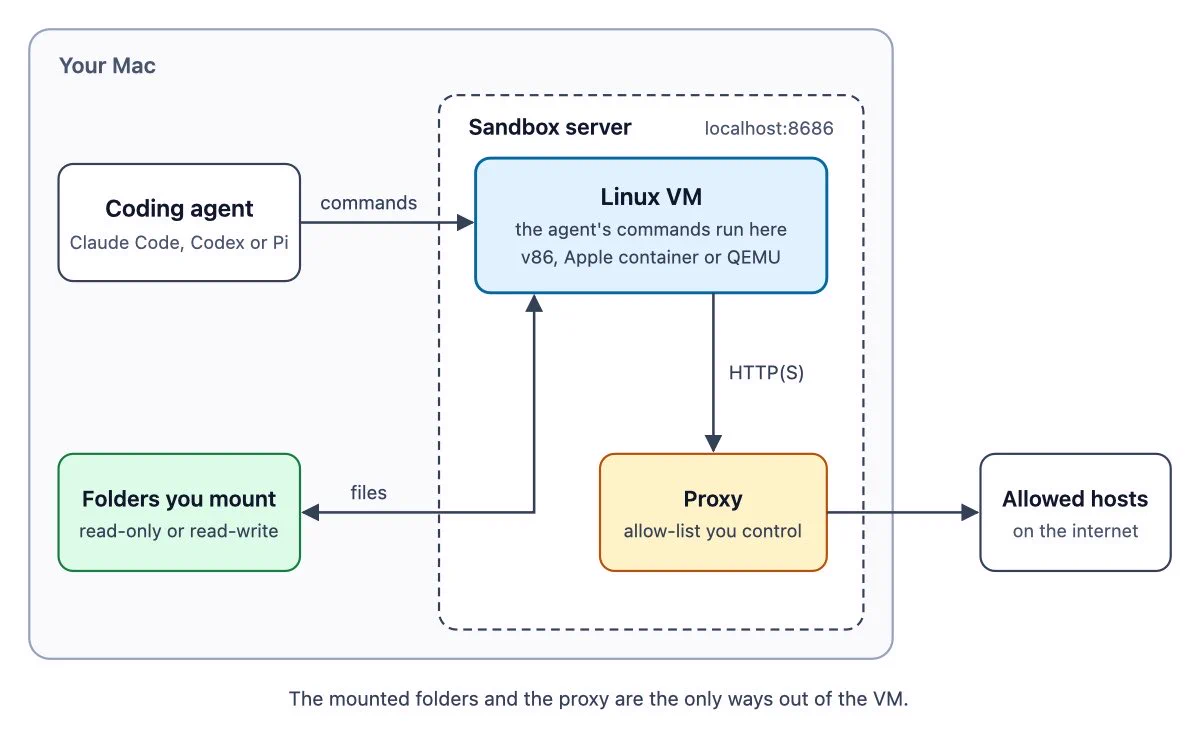
I've been exploring new ways to sandbox code written by coding agents - here's a description of the external sandbox pattern, where agents run on your Mac but execute code in a WebAssembly or QEMU or Apple Container sandbox - with demos for Claude Code, Codex and Pi… pic.twitter.com/rpk8Q3nYoi— Simon Willison (@simonw) November 17, 2026
dagger/container-use
Development environments for coding agents. Enable multiple agents to work safely and independently with your preferred stack.
agentOS — A faster, lighter, cheaper alternative to sandboxes
A portable open-source operating system for agents. Stateful runtime, universal agent interface, and secure code execution. One SDK, deploy anywhere.

