What I Found Interesting in Claude Code's Source
A breakdown of the most interesting engineering patterns in Claude Code's leaked source code: composable system prompts, runtime instruction injection, context compression, forking, prompt caching architecture, and more.
Diving into Claude Code's Source Code Leak
Engineer’s Codex is a publication about real-world software engineering.
Sourcegraph — Code Understanding, Oversight and Evolution
Give humans and agents complete context to understand, oversee, and evolve the world's largest, most complex codebases.
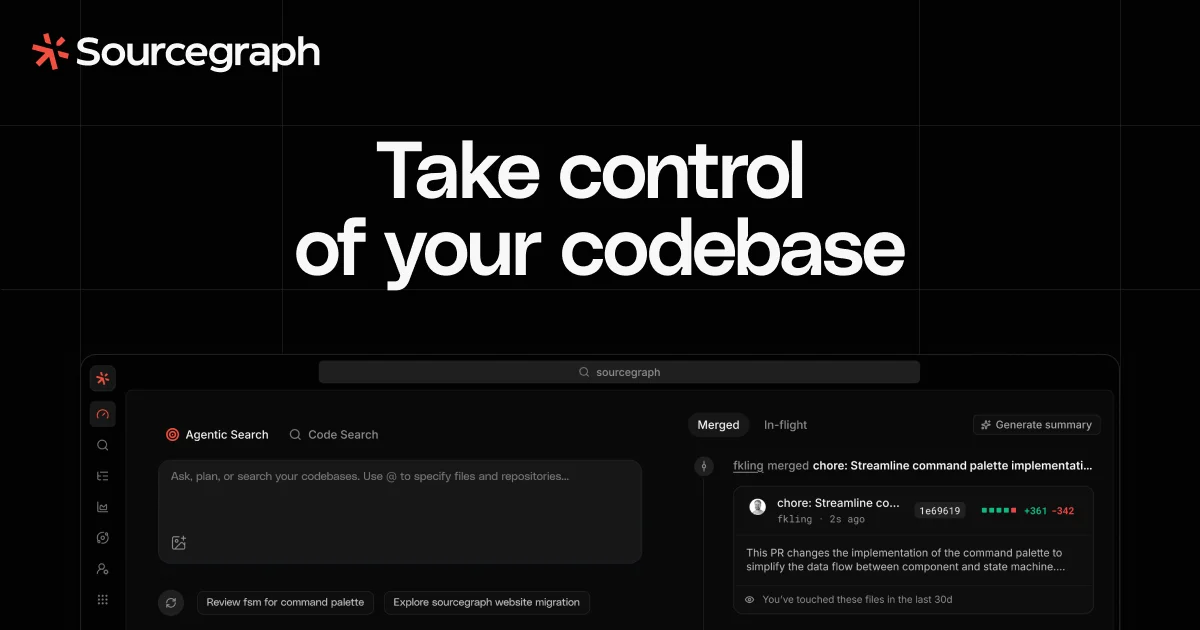
Entire Claude Code CLI source code leaks thanks to exposed map file
512,000 lines of code that competitors and hobbyists will be studying for weeks.

Software 4.0: When Code Stops Being an Artifact
The next step in Andrej Karpathy’s Software evolution: what happens when code is generated at runtime, executed once, and never saved…

Specs 2
Specs 2 is an ecosystem for specs driven component development. Via the plugin, turn a selected Figma component or component set into a compact, complete, schema-valid specification — computed directly from the file, not inferred from a screenshot. From the command line, generate specs from an en...
When Science Goes Agentic
In a couple of years, we will inspect AI-generated source code about as often as we inspect the assembly output of a compiler. Which is to say, far less often—outside of high-stakes and adversarial settings. The trajectory is clear: vibe coding is not a fad but a transition, a stepping stone. Debugging AI-generated code will shrink dramatically for a lot of everyday software—not because the code will be flawless, but because the feedback loops between generation, testing, and correction will tighten until human inspection becomes the bottleneck rather than the safeguard. In this respect, requiring the co-generation, with code, of mechanically verifiable formal attestations can also improve the process.

crawshaw - 2026-05-07
The industry-established code review process, review-then-commit, was a straightforward mechanism that allowed a relatively low-trust group of engineers to collaborate. It appears to have been initially developed for the Apache server OSS project in the 90s, corporatized by Google in the early 2000s, and popularized throughout the industry by several means, most notable of which was the GitHub PR.

Priivacy-ai/spec-kitty
Spec-Driven Development for serious software developers. Spec Coding with with Claude, Cursor, Gemini, Codex. Kanban dashboard, git worktrees, auto-merge and more.
Sung Kim (@sungkim.bsky.social)
I like this quote on code review: "The idea that humans will reliably look through code to find the increasingly rare issues that automated tools miss seems like a fantasy." By Marc Brooker, AWS.

Random Tech Thoughts
This article is about standardisation, particularly how it relates to understanding code. I’ll first go into an historical example that highlights the lack of standardisation in an area where we take it for granted today. After that I’ll get into code, and how understanding code is like understanding data via visualisations. In both the historic … Continue reading Standardisation and code

Cognition | Agent Trace: Capturing the Context Graph of Code
We’re excited to join in Cursor, Cloudflare, Vercel, git-ai, OpenCode and others in support of [Agent Trace](https://agent-trace.dev/). As described in the spec, Agent Trace is an open, vendor-neutral spec for recording AI contributions alongside human authorship in version-controlled codebases.
Code Is Cheap Now, And That Changes Everything | Pere Villega
AI coding agents have made code production nearly free. Drawing on insights from Kent Beck, Paul Ford, and Simon Willison, this post argues that the value has shifted from writing code to defining systems — contracts, invariants, SLAs, and verification.