

PREreview joins #LoveData26 celebration with a strong commitment to encouraging open peer review of diverse research outputs, including datasets. 📊 Try out our modular review workflow for datasets here: prereview.org/review-a-dataset Learn more: bit.ly/dataset-workflow @lovedataweek.bsky.social
Feb 11, 2026 at 1:53 PM
Democratizing Data
Democratizing Data builds a community-driven data ecosystem by identifying how datasets are used and reducing barriers to accessing high-quality public data. The initiative enhances the discoverability, usability, and relevance of data for researchers, policymakers, and stakeholder communities. A suite of tools and strategic partnerships supports this work by connecting users to the data, insights, and networks needed to inform decisions and generate impact.
From Social Network to Sense Making
Collective Social | Track what you love. Share what matters.
Curate lists, track your progress, and share recommendations across books, movies, TV shows, and more — all on the open social web.

Reviewing post-publication peer review
Post-publication peer review (PPPR) is transforming how the life sciences community evaluates published manuscripts and data. Unsurprisingly, however, PPPR is experiencing growing pains, and some elements of the process distinct from standard pre-publication review remain controversial. I discuss the rapid evolution of PPPR, its impact, and the challenges associated with it.

Coding Club: a positive peer-learning community
Free and accessible tutorials on data analysis, manipulation, visualisation and more.


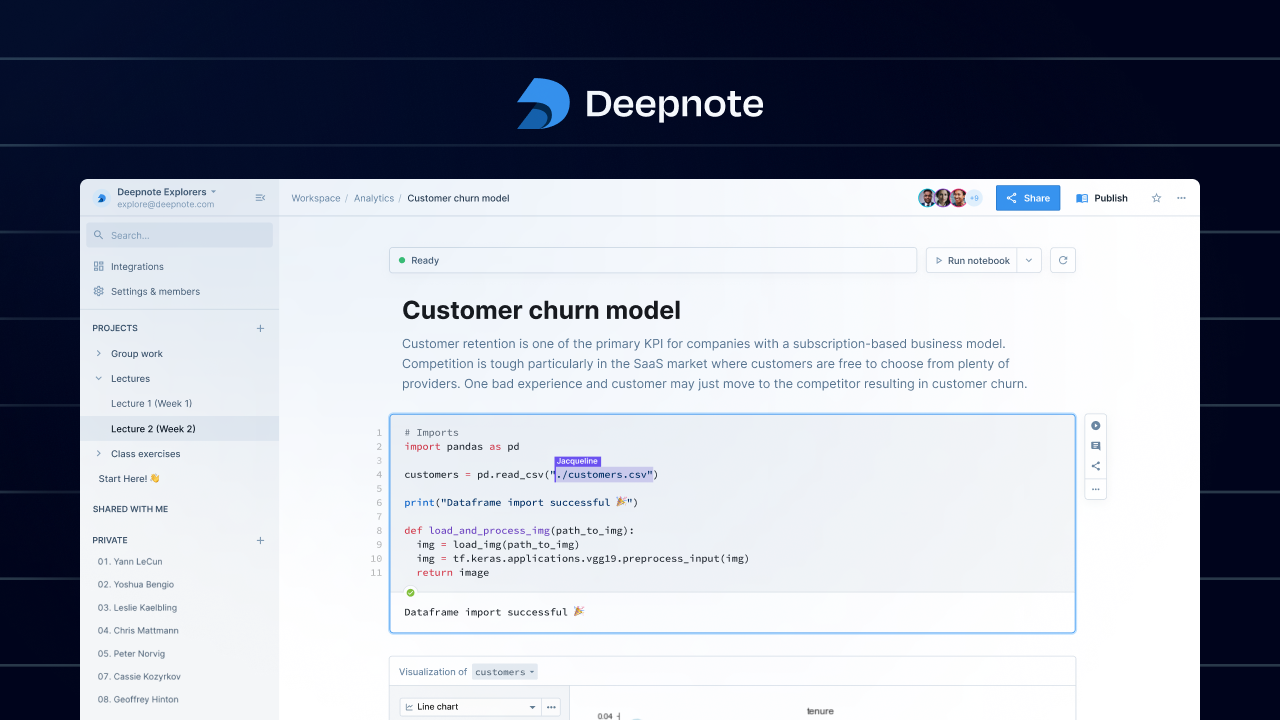
Deepnote: Collaborative analytics & data science notebook
Explore data with Python & SQL, work together with your team, and share insights that lead to action — all in one place with Deepnote.
A Claude skill for pre-submission peer review
Open-source skill to use Claude + Consensus for pre-submission mock peer review backed by citations to published, peer-reviewed literature.

RegCheck: A tool for structured comparisons between study registrations and papers
Across the social and medical sciences, researchers recognize that specifying planned research activities (i.e., 'registration') prior to the commencement of research has benefits for both the transparency and rigour of science. Despite this, evidence suggests that study registrations frequently go unexamined, minimizing their effectiveness. In a way this is no surprise: manually checking registrations against papers is labour- and time-intensive, requiring careful reading across formats and expertise across domains. The advent of AI unlocks new possibilities in facilitating this activity. We present RegCheck, a modular LLM-assisted tool designed to help researchers, reviewers, and editors from across scientific disciplines compare study registrations with their corresponding papers. Importantly, RegCheck keeps human expertise and judgement in the loop by (i) ensuring that users are the ones who determine which features should be compared, and (ii) presenting the most relevant text associated with each feature to the user, facilitating (rather than replacing) human discrepancy judgements. RegCheck also generates shareable reports with unique RegCheck IDs, enabling them to be easily shared and verified by other users. RegCheck is designed to be adaptable across scientific domains, as well as registration and publication formats. In this paper we provide an overview of the motivation, workflow, and design principles of RegCheck, and we discuss its potential as an extensible infrastructure for reproducible science with an example use case.

A new automated feedback option for authors - openRxiv
Authors who post preprints on openRxiv servers can get formal and informal feedback on their manuscripts in a number of ways. Our bioRxiv to journal (B2J) and medRxiv to journal (M2J) pipelines are linked to traditional peer review venues, enabling authors to save time by submitting directly from bioRxiv or medRxiv to any one of…
Guest Post — Exploring Data Spaces in Scholarly Communications - The Scholarly Kitchen
Today's guest post explains the new data space pilot, which will be the focus of the upcoming BISG/SSP webinar on May 12, 2026.

Introduction to Open Science
This course introduces the principles and practices of open science, with an emphasis on reproducible research workflows, transparent reporting, and collaborative scholarship. Students will critically examine reproducibility, explore tools that support openness (such as Git, GitHub, and Quarto), and apply these tools in hands-on assignments and a final open project. Students will also explore how open science practices vary across disciplines, including education, humanities, social sciences, industry and government, and STEM contexts. This course emphasizes applying open science principles to real-world data problems in alignment with the principles of producing reproducible research.
Two billion citation links in Crossref help research travel further - Crossref
We’ve recently reached an important milestone for the research nexus: the works in our metadata corpus are now connected with over 2 billion citation links! This is a great opportunity to share a dedicated dataset and discuss why these are important for science.

Position: The ML Community Must Build an AI-Augmented Peer-Review Ecosystem
Peer review, the bedrock of scientific advancement in machine learning (ML), is strained by a crisis of scale. Exponential growth in manuscript submissions to premier ML venues such as NeurIPS, ICML, and ICLR is outpacing the finite capacity of qualified reviewers, leading to concerns about review quality, consistency, and reviewer fatigue. This position paper argues that AI-assisted peer review must become an urgent research and infrastructure priority. We advocate for a comprehensive AI-augmented ecosystem, leveraging Large Language Models (LLMs) not as replacements for human judgment, but as sophisticated collaborators for authors, reviewers, and Area Chairs (ACs). We propose specific roles for AI in enhancing factual verification, guiding reviewer performance, assisting authors in quality improvement, and supporting ACs in decision-making. Crucially, we contend that the development of such systems hinges on access to more granular, structured, and ethically-sourced peer review process data. We outline a research agenda, including illustrative experiments, to develop and validate these AI assistants, and discuss significant technical and ethical challenges. We call upon the ML community to proactively build this AI-assisted future, ensuring the continued integrity and scalability of scientific validation, while maintaining high standards of peer review.
Meet Rosalind Workbench: Empowering every scientist to be their own research team | OpenAI Developers
How guided tasks, scientific viewers, and sequencing analysis help researchers follow a question from data to evidence.

🚨Free data alert!! 🚨 Please share. Large new dataset of Amazon product reviews, including full text and photos and product characteristics, with individual *reviews labeled as fake reviews*. I believe this is the first publicly available data of this kind. github.com/bretthollenbeck/fake-reviews-…

