

Products like @margin.at and @semble.so have the potential to change scientific publishing as we know it today. These are early-stage products but they're clearly ahead of the curve when it comes to new ways to organize and share knowledge.
Jul 26, 2026 at 3:03 PM

Empowering science communities with open, democratic, researcher-owned infrastructure.
We’re building communities and tech for publishing, curating, sharing, and discussing research online using ATProto and other decentralized protocols.
Empowering science communities with open, democratic, researcher-owned infrastructure.
We’re building communities and tech for publishing, curating, sharing, and discussing research online using ATProto and other decentralized protocols.
Sensemaking Networks: Transforming Social Media into a Sensemaking Layer for Science | Ronen Tamari
Sensemaking Networks is a project aiming to address three interrelated limitations of the current science publishing and communication infrastructure: (1) poor reach and feedback, (2) knowledge fragmentation, and (3) rigid formats. To address these issues, Sensemaking Networks combine two promising trends in science publishing and communication: science social media and semantic nanopublishing. While science social media significantly impacts scientific processes and public engagement, it lacks formal recognition and accessibility. On the other hand, nanopublications offer the benefits of formal scientific publishing and machine-readable knowledge representation. Their integration represents a promising direction that could serve as a transformative sensemaking layer for science, enhancing the collective synthesis, dissemination, and evaluation of research.

Scientists no Longer Find Twitter Professionally Useful, and have Switched to Bluesky
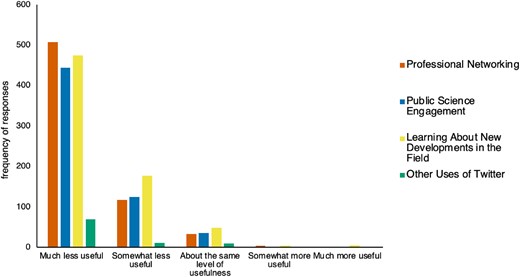
Synopsis Social media has become widely used by the scientific community for a variety of professional uses, including networking and public outreach. For the past decade, Twitter has been a primary home of scientists on social media. In recent years, new leadership at Twitter has made substantive changes that have resulted in increases in the prevalence of pseudoscience, conspiracy theory, and harassment on the platform, causing many scientists to seek alternatives. Bluesky has been suggested as a good alternative to Twitter, but the phenomenon of academics switching social media platforms has not previously been studied. Here we report on the results of a survey distributed to scientists on Twitter and Bluesky (n = 813). Results overwhelmingly confirm that changes to Twitter have made the social media platform no longer professionally useful or pleasant, and that many scientists have abandoned it in favor of Bluesky. Results show that for every reported professional benefit that scientists once gained from Twitter, scientists can now gain that benefit more effectively on Bluesky than on Twitter.
Lead UX designer, @mikemorrison.bsky.social also studies interface design for scientists. He used @curvenote.com SCMS to host his own journal, Science UX: real DOIs, Google Scholar indexing, + more, published in one command. Same platform for a single researcher or a large publisher. Here's how 🎥

Why I Started My Own Scientific Journal with the Curvenote SCMS
www.youtube.comWish there was a better academic publishing system? Bluesky and its underlying ATProto technology, along with services like @chive.pub and the broader @atproto.science ecosystem, could do the job. #AcademicSky 🧪 leaflet.pub/2f431faf-c125-4d34-ac52-e41a2…

Each academic paper should have its own Bluesky account
leaflet.pub
Chive
We're ramping up our alpha, and we'd love for you to join at chive.pub! Since we launched back in January, we've been adding a ton of fun features; and to introduce them, we're going to be doing a series of deep dives over the next couple weeks on chive.leaflet.pub.
Great post! There is a clear parallel to how the @atproto.science ecosystem can disrupt the extractive science publishing industry & bring on millions of researchers with a new cooperative research stack. The system is ripe for disruption - see also @edhagen.net's post in the thread linked below >

Joe Basser
Who wants to make money in the Atmosphere? 🙋♂️
We're thinking about publishing a compendium of #ATScience projects submitted to the workshop (incl abstracts, preprints and published works) - @aaronstevenwhite.io could @chive.pub potentially support that use case?
Super cool! Imagining how something like this could be used for @atproto.science "journal" publishing

Standard Reader
New Feature: Collections on Standard Reader. Curate articles from across the network into magazine editions. Include your editorial intro, notes on each piece, a closing statement and a theme. Publish as a series readers can follow. Tell a story. Check out the first one 👇
Frontiers In Research webinar on changes in science communication, the role of social media, and new infrastructure/tools - tomorrow (7/18) at 2 pm ET Looking forward to chatting with @ronentk.me & @joelchan86.bsky.social luma.com/7l18yyg4

Frontiers In Research: Open Science · Zoom · Luma
luma.comToday I'm excited to announce @sequoia.pub: a CLI for self-hosted blogs to publish @standard.site lexicons to the ATmosphere sequoia.pub/blog/introducing-sequoia/

Introducing Sequoia: Publishing for the Open Web
sequoia.pubI have high hopes for @mu.social as a proving ground for democratic social media, given ample support from the atmosphere community. With the help of civilized-discourse expert @jonathanwarden.com we can have Community Notes on atproto, starting with mu.

Mu for democracy
notes.erlend.shSo who's building multi-author publication infra on atproto? Do any @standard.site platforms support this?

Eric Bailey
I have a lot of feelings about the whole CSS-Tricks debacle. Here's me trying to be constructive about it. ericwbailey.website/published/css-tricks-could-be…
After reading about ATProto stuff this morning I realised that one possible future for science publishing, within something like @atproto.science, is that every scientist becomes their own journal. The key realisation is that a paper published to my own PDS can be published in many journals.
Excited to invite you to a panel I'll be on next week w/ @richardsever.bsky.social @joelchan86.bsky.social! We’ll discuss the future of open-access, new modular research tools (eg @discoursegraphs.bsky.social) and the role of social media in scientific discourse (@cosmik.network @atproto.science ..)

Frontiers In Research: Open Science · Zoom · Luma
luma.com


