

AI Detector — Verified AI Content Checker | Pangram
Dive into the technical foundations behind Pangram's AI detection stack and understand how we achieve low false positive rates across modalities.

AI reviewers are here — we are not ready
Nature - Artificial intelligence promises rapid and polite feedback on papers — but we must first review the reviewer.

America Has a Pangram Problem
AI-detection tools are getting better. But they still aren’t good enough.

Illicit Use of AI by Philosophers Refereeing for Journals - Daily Nous
In 2024, a study found that “7–17% of the sentences in the reviews [of computer science manuscripts] were written by LLMs”. It was only a […]
Technical Report on the Pangram AI-Generated Text Classifier
We present Pangram Text, a transformer-based neural network trained to distinguish text written by large language models from text written by humans. Pangram Text outperforms zero-shot methods such as DetectGPT as well as leading commercial AI detection tools with over 38 times lower error rates on a comprehensive benchmark comprised of 10 text domains (student writing, creative writing, scientific writing, books, encyclopedias, news, email, scientific papers, short-form Q&A) and 8 open- and closed-source large language models. We propose a training algorithm, hard negative mining with synthetic mirrors, that enables our classifier to achieve orders of magnitude lower false positive rates on high-data domains such as reviews. Finally, we show that Pangram Text is not biased against nonnative English speakers and generalizes to domains and models unseen during training.

How do authors want to use AI for review?
A survey of researchers who compared AI-generated scientific reviews with journal-agnostic human peer review reveals that they overwhelmingly prefer using AI as a self-checking tool before submission rather than as a replacement for human reviewers. It encourages an “author-centric” model in which AI helps researchers improve their manuscripts before they are reviewed by their peers.

I pulled ~90,000 Reddit posts about what makes writing "sound like AI" to determine the biggest AI-slop giveaways (Part 2)
674 votes, 228 comments. The majority of people can instantly tell when writing is generated by AI. For those who don't intend to get into the weeds…
Google Researchers Say AI Now Leading Disinformation Vector (and Are Severely Undercounting the Problem)
It’s much easier to produce AI-generated disinformation than it is to fact check it.

Artificial Writing and Automated Detection
Artificial intelligence (AI) tools are increasingly used for written deliverables. This has created demand for distinguishing human-generated text from AI-generated text at scale, e.g., ensuring assignments were completed by students, product reviews written by actual customers, etc. A decision-maker aiming to implement a detector in practice must consider two key statistics: the False Negative Rate (FNR), which corresponds to the proportion of AI-generated text that is falsely classified as human, and the False Positive Rate (FPR), which corresponds to the proportion of human-written text that is falsely classified as AI-generated. We evaluate three leading commercial detectors—Pangram, OriginalityAI, GPTZero—and an open-source one —RoBERTa—on their performance in minimizing these statistics using a large corpus spanning genres, lengths, and models. Commercial detectors outperform open-source, with Pangram achieving near-zero FNR and FPR rates that remain robust across models, threshold rules, ultra-short passages, "stubs" (≤ 50 words) and ’humanizer’ tools. A decision-maker may weight one type of error (Type I vs. Type II) as more important than the other. To account for such a preference, we introduce a framework where the decision-maker sets a policy cap—a detector-independent metric reflecting tolerance for false positives or negatives. We show that Pangram is the only tool to satisfy a strict cap (FPR ≤ 0.005) without sacrificing accuracy. This framework is especially relevant given the uncertainty surrounding how AI may be used at different stages of writing, where certain uses may be encouraged (e.g., grammar correction) but may be difficult to separate from other uses.

What I learned running an adversarial test on an AI text detector
If you get your bot to rhyme / Pangram will misclassify it many a time
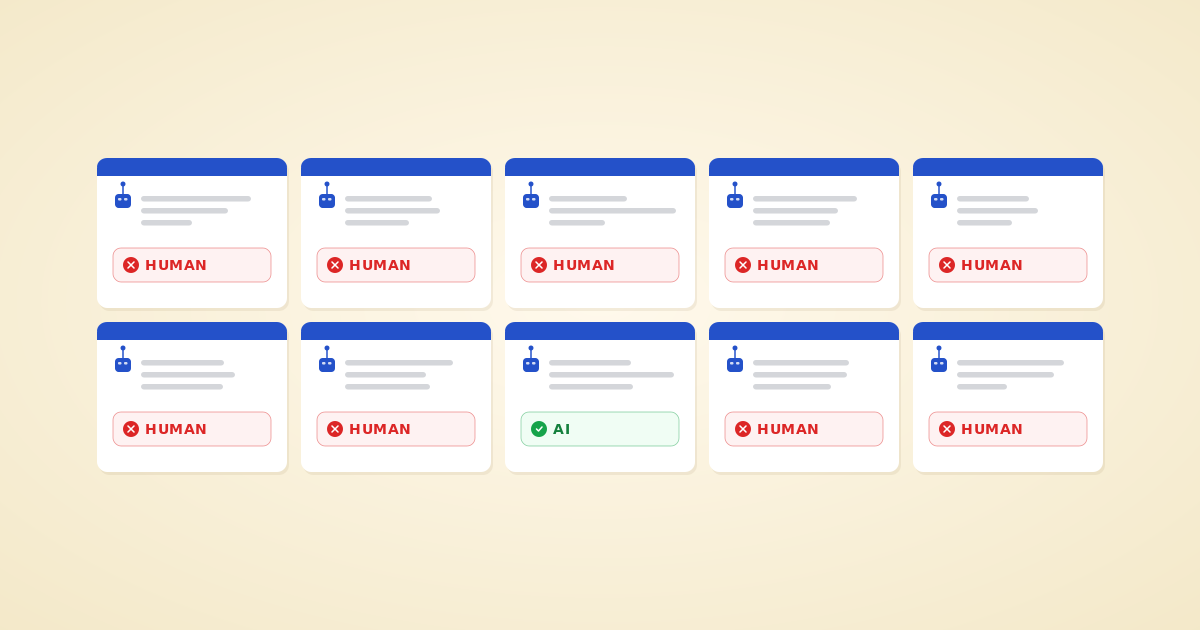
Major AI conference flooded with peer reviews written fully by AI
Nature - Controversy has erupted after 21% of manuscript reviews for an international AI conference were found to be generated by artificial intelligence.

Adil on Twitter / X
being assigned to review AI generated slop papers is very frustrating. the way this is supposed to work is that first you take the time to write something and then i take the time to read it. if you don't do the first part then i shouldn't have to do the second part.— Adil (@adilsoubki) August 26, 2026
I’m especially frustrated by the piece uncritically repeating Pangram’s “no false positives” claim when I know writer friends who have run their own work through & had it flag their 100% human-written sentences as machine-generated. We must doubt any company’s claim about its product having 0 fails.


