

1/n There's a camp of analysts - Cosma Shalizi, Henry Farrell and Alison Gopnik are the most prominent members - who say that AI is a cultural technology. Let's say they're correct. The obvious follow-up question is: > What's the culture of which AI is a cultural technology?
Jan 9, 2026 at 12:10 AM

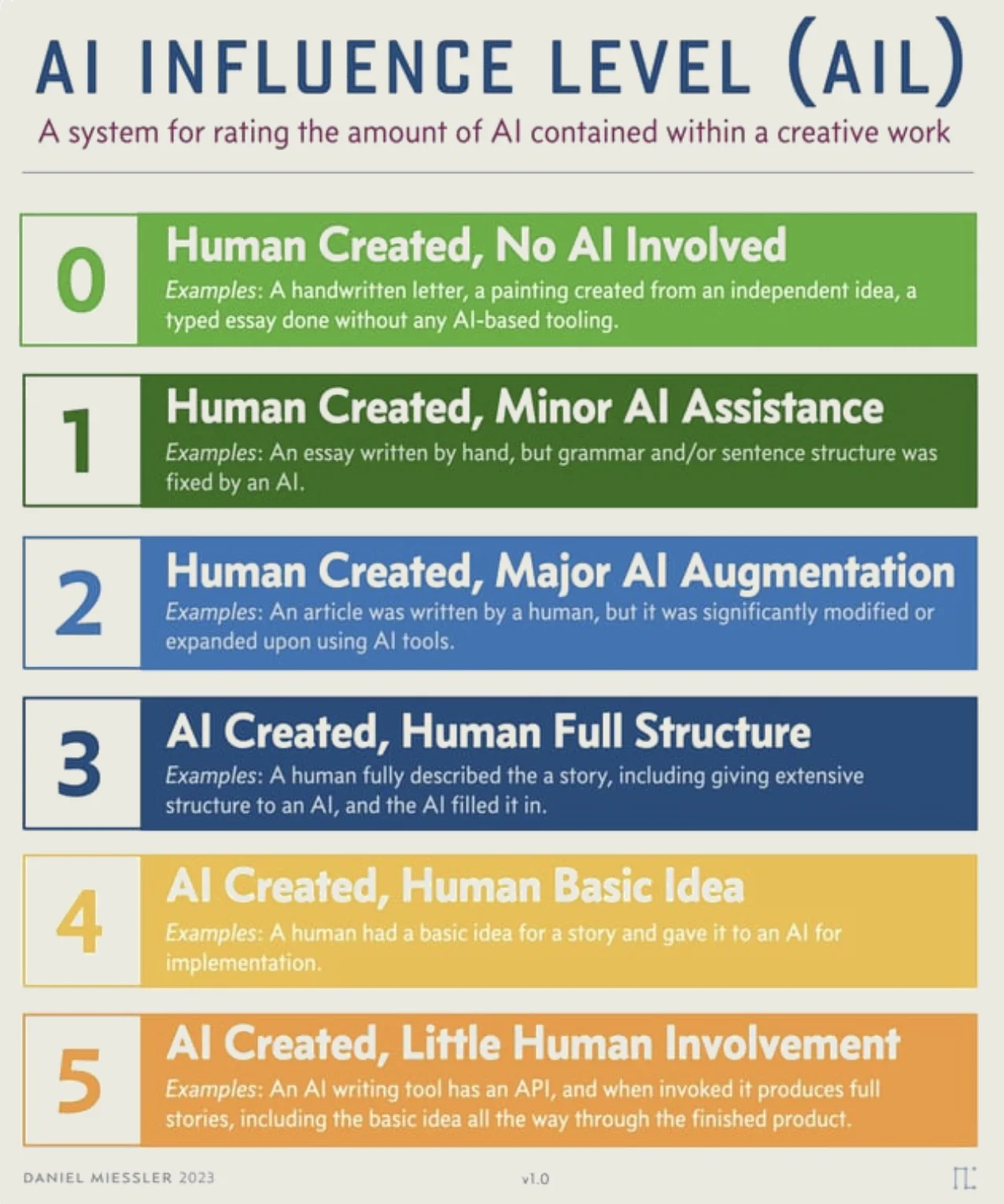
AI Influence Level (AIL) v1.0
Humans care who created things. Especially art. They especially care when the origin is in question, and more again when the origin might not be human. AI is yi

AI is An Ideology, Not A Technology
At its core, "artificial intelligence" is a perilous belief that fails to recognize the agency of humans.
Large AI models are cultural and social technologies – Henry Farrell
Debates about artificial intelligence (AI) tend to revolve around whether large models are intelligent, autonomous agents. Some AI researchers and commentators speculate that we are on the cusp of creating agents with artificial general intelligence (AGI), a prospect anticipated with both elation and anxiety. There have also been extensive conversations about cultural and social consequences of large models, orbiting around two foci: immediate effects of these systems as they are currently used, and hypothetical futures when these systems turn into AGI agents perhaps even superintelligent AGI agents.

AI-induced cultural stagnation is here - Fast Company
AI-mediated culture is already being filtered in ways that favor the familiar, the describable, and the conventional.

AI as Social Technology: Astor Lecture by Professor Henry Farrell
AI as Social Technology: Astor Lecture by Professor Henry Farrell
Large AI models are cultural and social technologies
Implications draw on the history of transformative information systems from the past , Debates about artificial intelligence (AI) tend to revolve around whether large models are intelligent, autonomous agents. Some AI researchers and commentators speculate that we are on the cusp of creating agents with artificial general intelligence (AGI), a prospect anticipated with both elation and anxiety. There have also been extensive conversations about cultural and social consequences of large models, orbiting around two foci: immediate effects of these systems as they are currently used, and hypothetical futures when these systems turn into AGI agents—perhaps even superintelligent AGI agents. But this discourse about large models as intelligent agents is fundamentally misconceived. Combining ideas from social and behavioral sciences with computer science can help us to understand AI systems more accurately. Large models should not be viewed primarily as intelligent agents but as a new kind of cultural and social technology, allowing humans to take advantage of information other humans have accumulated.
The Thoughts The Civilized Keep
The hype around a new AI language generator reveals the sterility of mainstream thinking on AI today — and indeed on how we think about thinking itself.

AI Artists Have No Role Models
Prompt Engineers Lack Any Canon, Don't You? AI artists have an existential problem: they consume only their own work, severing the dialogue of culture that…

Anthropomorphism Is Breaking Our Ability to Judge AI
Tech Policy Press fellow James Ball asks, how should we interact with a technology designed to ‘speak’ with us on what appear to be human terms?
70 years of AI hype
Quoting from Olivia Guest et al. (2025) "Against the Uncritical Adoption of AI Technologies in Academia."
When we make AI agents, are they becoming more like us ? Or us more like them ? All artificial agents are hybrid by design because they contain biomimetic cognitive abilities baked in by their Geppetto Check out our new preprint with Shaun Gallagher 😎 osf.io/preprints/psyarxiv/te9r4_v1

