

"If your decentralised protocol is missing features, the market will add them with centralisation." — @goat.navy *This*: - is why why the web was captured; - is why email became concentrated; - is why ActivityPub, as defined today, isn't capture-resistant.
Jun 13, 2025 at 1:38 PM
Why ActivityPub is the future
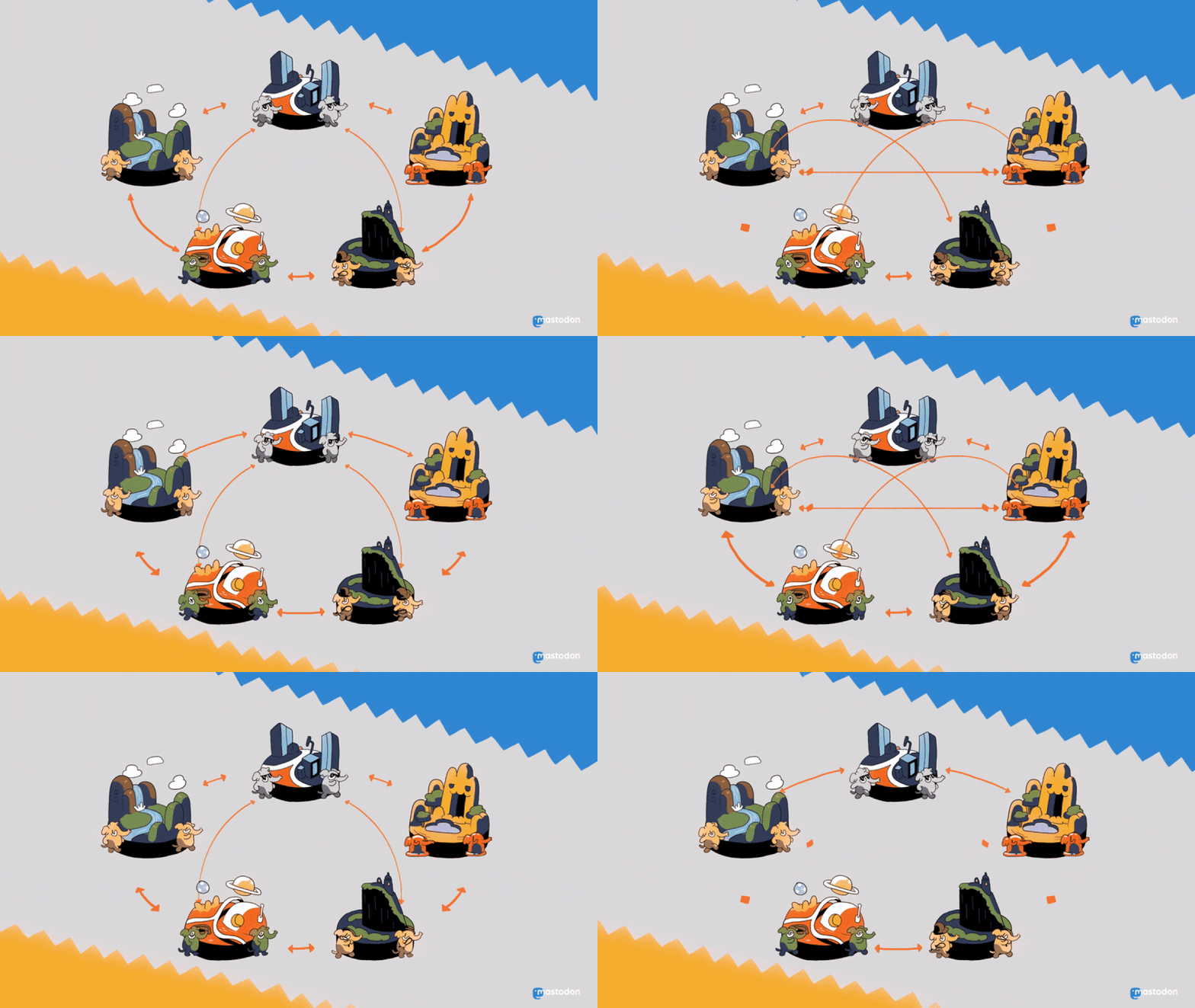
We often tout things like “Mastodon is based on open web protocols” as one of its advantages. I want to elaborate why exactly that’s a good thing.
Decentralized Syndication — The Missing Internet Protocol
The Internet is decentralized by design. It came into being not at once, but in parts. New protocols were added on top of previous ones…
Centralization, Decentralization, and Internet Standards
Despite being designed and operated as a decentralized network-of- networks, the Internet is continuously subjected to forces that encourage centralization. This document offers a definition of centralization, explains why it is undesirable, identifies different types of it, catalogues limitations of common approaches to decentralization, and explores what Internet standards efforts can do to address it.
Statement on discourse about ActivityPub and AT Protocol
Foreword This statement was originally published on the swicg/general repository after I had been granted approval to merge. Since then one community member has raised that it did not follow the Community Group's processes, and consequently the document has been taken down from the original location. When publishing,

Decentralization Trade Offs in AT Protocol and ActivityPub DWeb Camp 2026
Christine Lemmer Webber is lead author and co-editor of the W3C ActivityPub specification. Daniel Holmgren is Head of Protocol at Bluesky, working on the AT Protocol specification at the IETF. Join us for a discussion on decentralization trade-offs and other design decisions in the two protocols, and what that means for different architectures, structures, and even future points of convergence. Moderated by Boris Mann
Centralization, Decentralization, and Internet Standards
This document discusses aspects of centralization that relate to Internet standards efforts. It argues that, while standards bodies have a limited ability to prevent many forms of centralization, they can still make contributions that assist in the decentralization of the Internet.
#protocolsforpublishers #atproto #mcp #webapplets | Chad Kohalyk
Web publishing is facing its next challenge: a new iteration of centralizing platforms. BUT there is also a new wave of open protocols and standards that can help us gain our independence. Next month in NYC we are gathering a group of frontier technologists and popular web publishers to discuss how we can sail into this next platform shift as captains. #ProtocolsForPublishers Learn more and sign up here: https://pfp.unternet.co We will be hosting talks on #atproto #mcp #webapplets and web payments, and give publishers the opportunity to interact directly with developers working on these frontier technologies. Thank you to Unternet, Graze Social, Free our Feeds, and betaworks for their support.

ActivityPub, AT Protocol, and more!
Talking about this article and how ActivityPub and AT Protocol are maybe not as different as people might think. We covered some slides to an unrecorded talk of mine, which explores a lot of things...
ActivityPub
ActivityPub is a protocol and open standard for decentralized social networking. It provides a client-to-server (C2S) API for creating and modifying content, as well as a federated server-to-server (S2S) protocol for delivering notifications and content to other servers. ActivityPub is the defining standard of the Fediverse, a decentralised social network of various social interaction models, and content types, which consists of independently managed instances of software such as Mastodon, Pixelfed and PeerTube, among others.

FediForum Talk: How To Bullshit Your Way Through a Conversation about ActivityPub
By Evan Prodromou, Social Web Foundation and editor of the ActivityPub standard. One of the best bluffers in the field of distributed social networks gives you just enough knowledge about ActivityP...

Web publishing is facing its next challenge: a new iteration of centralizing platforms. BUT there is also a new wave of open protocols+standards to gain independence. Next month in NYC let's discuss how we can sail into this next platform shift as captains. #ProtocolsForPublishers pfp.unternet.co
Protocols for Publishers
pfp.unternet.coMany people are talking about decentralized social media protocols like #ActivityPub and #ATProto and all the amazing things one can do with them. But do you actually know how they work? We thought we'd do something about this. Come to #FediForum next week if you are curious and like to find […]
Original post on mastodon.social
mastodon.socialIt's always fascinating to me that proponents of Activity Pub are always like, "Just use AP, it's better." Isn't the point of decentralization to have no single point of failure? Why doesn't that mean multiple protocols? Everyone who argues that point honestly just sounds salty to me.
Why I created @skysquare.app—and why I believe the web needs it. "Decentralized protocols represent more than a technical innovation. They offer the possibility that public conversation might once again become part of the commons rather than the exclusive property of any single platform."

Why Skysquare Exists
skysquare.app


