

One thing I've been dwelling on is how computing engineering and discourse rely thoroughly on a substance ontology of information, with dumb consequences. I've just found out that @romainbrette.bsky.social, looking at the same in neuroscience, calls it "epistemic phlogiston." I'm so stealing that.

Dog Steals Pizza
static.klipy.comAug 1, 2026 at 3:55 PM
Towards Post-Interaction Computing: Addressing Immediacy, (un)Intentionality, Instability and Interaction Effects
We situate the debate on intentionality within the rise of cognitive neuroscience and argue that cognitive neuroscience can explain intentionality. We discuss the explanatory significance of ascribing intentionality to representations. At first, we ...

Care at the Edge of Automation – Topos Institute
Technologies don’t just solve problems, they change us. We invent technologies, and they invent us in turn, shaping our lives and worlds. This is the phenomenon that Terry Winograd and Fernando Flores, in Understanding Computers and Cognition (1986), called “ontological design.” It matters now more than ever—along with a second lesson they saw clearly. Technological research is always guided (and sometimes misguided) by deep ontological assumptions about, e.g., the nature of cognition, agency, and communication. If we are to create technologies that truly serve human flourishing and care, we must bring these hidden assumptions into the open and question them at their roots.

Learning Outside the Brain: Integrating Cognitive Science and Systems Biology
Learning is commonplace in organisms such as ourselves and even in organisms as far distant as the bee and the octopus. Such learning is implemented by brains, or neuronal networks, and has been extensively studied within ethology, psychology, cognitive science, and neuroscience. Whether learning also takes place in nonneuronal settings has remained a matter of sustained controversy, too often dominated by ideological views. In this survey, I will explain how learning can be rigorously interpreted as a form of information processing and then explore the evidence for whether learning also takes place in organismal contexts outside the brain, such as physiology, development, and individual cells. I will try to explain why it is important to build bridges in this way between cognitive science and systems biology, why concepts and methods from various branches of engineering may be helpful in this task, and what the eventual impact may be on how we think about the organism.
The brain is a computer is a brain: neuroscience's internal debate and the social significance of the Computational Metaphor
The Computational Metaphor, comparing the brain to the computer and vice versa, is the most prominent metaphor in neuroscience and artificial intelligence (AI). Its appropriateness is highly debated in both fields, particularly with regards to whether it is useful for the advancement of science and technology. Considerably less attention, however, has been devoted to how the Computational Metaphor is used outside of the lab, and particularly how it may shape society's interactions with AI. As such, recently publicized concerns over AI's role in perpetuating racism, genderism, and ableism suggest that the term "artificial intelligence" is misplaced, and that a new lexicon is needed to describe these computational systems. Thus, there is an essential question about the Computational Metaphor that is rarely asked by neuroscientists: whom does it help and whom does it harm? This essay invites the neuroscience community to consider the social implications of the field's most controversial metaphor.

A budding discipline around how science gets read and judged - Aris
Scholarly publishing spent thirty years arguing about access. It has barely begun arguing about what readers do with the paper once they have it. At Aris we call that second argument scholarly interface design. Mike Morrison's community calls it ScienceUX. Either way it is becoming a field, and here is why it is worth your attention.
Your brain does not process information and it is not a computer | Aeon Essays
Your brain does not process information, retrieve knowledge or store memories. In short: your brain is not a computer
AI Data Centers Will Be Obsolete (Geometric Reasoning Explained)
A Novel Kuhnian Ontology for Epistemic Classification of STM...
Despite rapid gains in scale, research evaluation still relies on opaque, lagging proxies. To serve the scientific community, we pursue transparency: reproducible, auditable epistemic...
The Alien Space of Science: Sampling Coherent but Cognitively...
Scientific discovery is constrained not only by what is true, but by what is cognitively available to the researchers currently exploring a field. Many directions are coherent in light of the...
Artificial Intelligence | The Paper Pilot
The Paper Pilot's digital garden of thoughts on philosophy, politics, and sociology
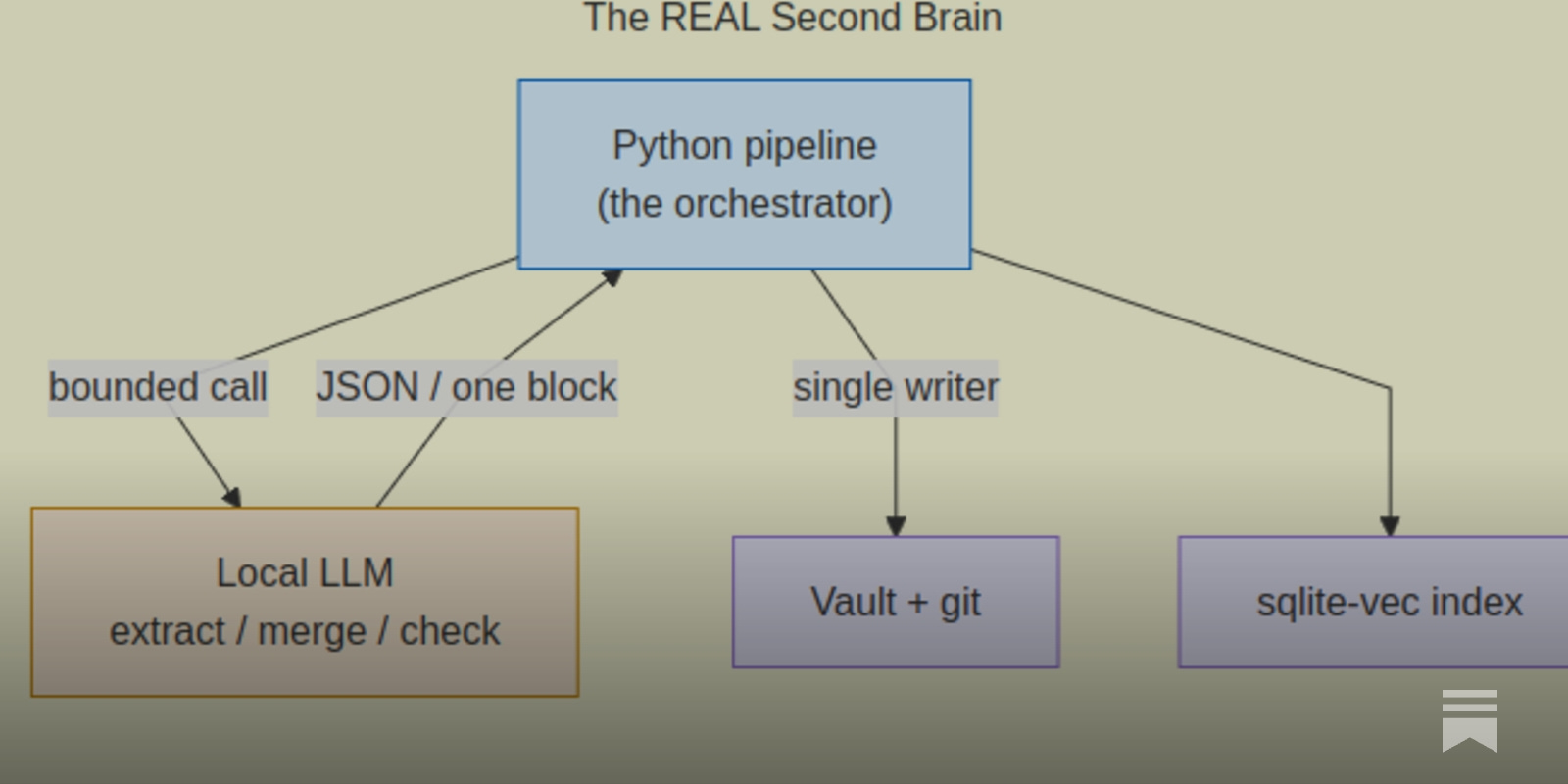
The REAL Second Brain: an autonomous, self-hosted knowledge wiki that runs on cheap local models
How I turned Karpathy's "LLM wiki" sketch into a system that actually maintains itself — no frontier API, no human in the loop, nothing leaving my LAN.
Intelligence | The Paper Pilot
The Paper Pilot's digital garden of thoughts on philosophy, politics, and sociology
Zechen Zhang on Twitter / X
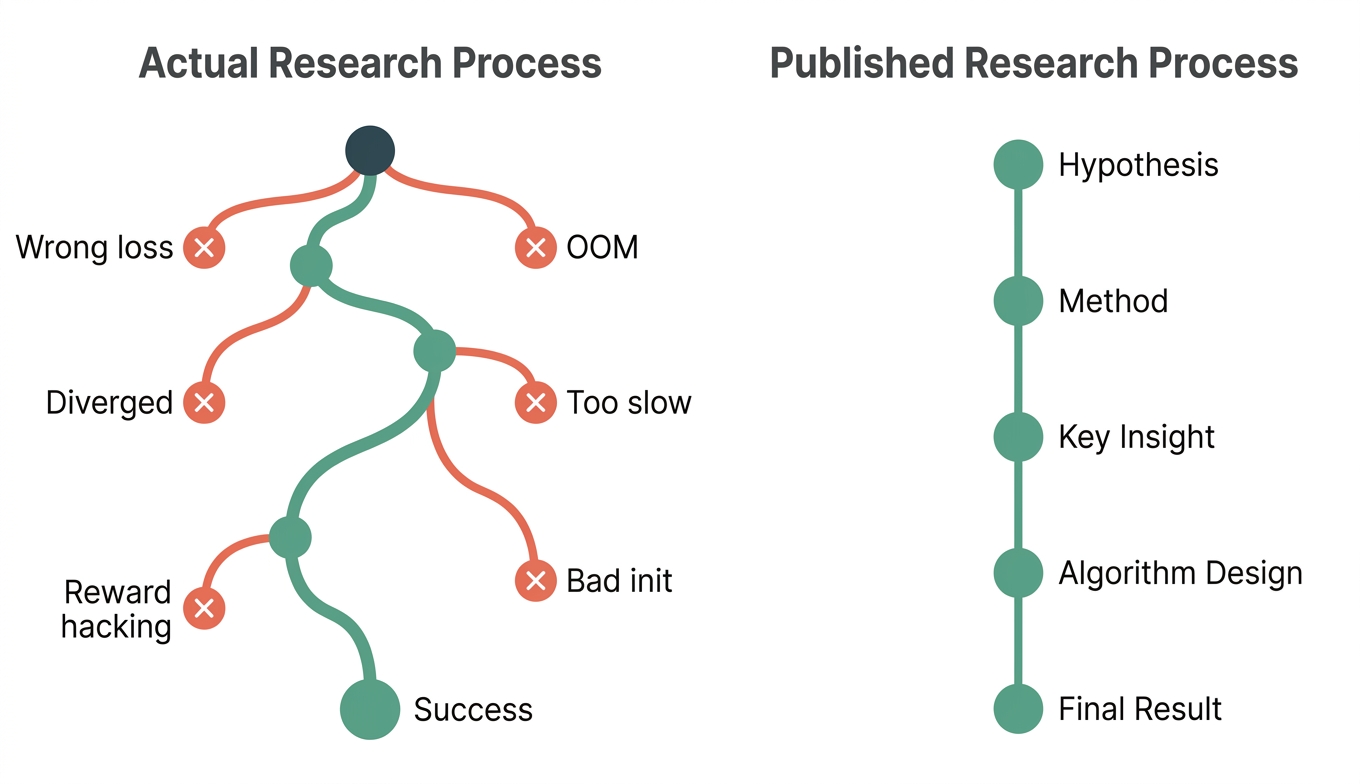
1/ For nearly 350 years, science has communicated itself through one object: the paper. A linear narrative, frozen as a PDF, written for a human reader. We've come to treat that format as the medium of science itself.It doesn't have to be. It's a historical artifact. 🧵 pic.twitter.com/P5UUhceLkC— Zechen Zhang (@ZechenZhang5) April 30, 2026
Thoughtful, capable, and ethical computing ⋅ elementary OS
Thoughtful, capable, and ethical computing
When Nature Calls: The Enshittification of Science and Its Enablers
Proof-of-work papers, policy laundering, and the collapse of self-correction

1. New preprint resolving a conundrum in systems neuroscience with an AI scientist, and humans Reilly Tilbury, Dabin Kwon, @haydari.bsky.social, @jacobmratliff.bsky.social, @bio-emergent.bsky.social, @carandinilab.net, @kevinjmiller.bsky.social, @neurokim.bsky.social biorxiv.org/content/10.1101/2025.11.12.68…

Characterizing neuronal population geometry with AI equation discovery
www.biorxiv.org

