“‘Information’ is a relational concept that assumes meaning only when related to the cognitive structure of the observer.” -- Heinz von Foerster
Control Information Theory: The “Missing Link” In the Science Of Cybernetics | Institute for the Study of Complex Systems
complexsystems.orgJul 15, 2026 at 8:07 PM
The Information Philosopher - dedicated to the new information philosophy
Information Philosopher is dedicated to the new Information Philosophy, with explanations for Freedom, Values, and Knowledge.
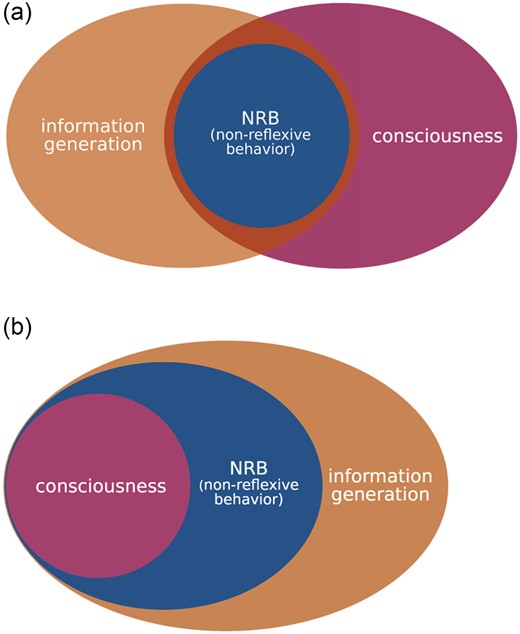
The science of consciousness does not need another theory, it needs a minimal unifying model
Abstract. This article discusses a hypothesis recently put forward by Kanai et al., according to which information generation constitutes a functional basi
Genetic Information: A Metaphor In Search of a Theory
John Maynard Smith has defended against philosophical criticism the view that developmental biology is the study of the expression of information encoded in the genes by natural selection. However, like other naturalistic concepts of information, this “teleosemantic” concept is equally applicable to many non-genetic factors in development. Maynard Smith also fails to show that developmental biology is concerned with teleosemantic information. Some other ways to support Maynard Smith's conclusion are considered. It is argued that on any definition of information the view that development is the expression of genetic information is misleading. Some reasons for the popularity of that view are suggested.
Neo-Documentation and the End of Information
Ronald Day’s Neo-Documentation and the End of Information critiques the modern conception of information as representational “content.” The...

A Beginner's Guide To Information Architecture in UX [2025]
What is information architecture? Why is it so important, and how does it relate to UX design? Find out why IA is so crucial in this expert guide.

Unified framework for information integration based on information geometry
Significance Measuring the degree of causal influences among multiple elements of a system is a fundamental problem in physics and biology. We propose a unified framework for quantifying any combination of causal relationships between elements in a hierarchical manner based on information geometry. Our measure of integration, called geometrical integrated information, quantifies the strength of multiple causal influences among elements by projecting the probability distribution of a system onto a constrained manifold. This measure overcomes mathematical problems of existing measures and enables an intuitive understanding of the relationships between integrated information and other measures of causal influence such as transfer entropy. Inspired by the integration of neural activity in consciousness studies, our measure should have general utility in analyzing complex systems. , Assessment of causal influences is a ubiquitous and important subject across diverse research fields. Drawn from consciousness studies, integrated information is a measure that defines integration as the degree of causal influences among elements. Whereas pairwise causal influences between elements can be quantified with existing methods, quantifying multiple influences among many elements poses two major mathematical difficulties. First, overestimation occurs due to interdependence among influences if each influence is separately quantified in a part-based manner and then simply summed over. Second, it is difficult to isolate causal influences while avoiding noncausal confounding influences. To resolve these difficulties, we propose a theoretical framework based on information geometry for the quantification of multiple causal influences with a holistic approach. We derive a measure of integrated information, which is geometrically interpreted as the divergence between the actual probability distribution of a system and an approximated probability distribution where causal influences among elements are statistically disconnected. This framework provides intuitive geometric interpretations harmonizing various information theoretic measures in a unified manner, including mutual information, transfer entropy, stochastic interaction, and integrated information, each of which is characterized by how causal influences are disconnected. In addition to the mathematical assessment of consciousness, our framework should help to analyze causal relationships in complex systems in a complete and hierarchical manner.

Role differentiation as ignition of a collective information...
Informational active matter shows how measurement-informed decisions produce collective order, so far in systems that reach consensus. We design collective information engines structured by...

How to Make Sense of Any Mess
Information Architecture for Everybody. Based on a book by Information Architect, Abby Covert.
Your brain does not process information and it is not a computer | Aeon Essays
Your brain does not process information, retrieve knowledge or store memories. In short: your brain is not a computer
Radical Skepticism About Information Fiduciaries
Khan and Pozen are right to note the fundamental conflict between “information fiduciary” duties and shareholder interests. I only wish to add two further points in service of a radical skepticism towards the information fiduciary concept.

The History of Information - Chris Haughton
disinformation, chris haughton, information, noam chomsky

Information Architecture. Basics for Designers.
The World Wide Web contains a tremendous amount of information which is hard to imagine unstructured because a human brain wouldn’t be able…

Living in Data: A Citizen's Guide to a Better Information Future (Paperback)
Jer Thorp’s analysis of the word “data” in 10,325 New York Times stories written between 1984 and 2018 shows a distinct trend: among the words most closely associated with “data,” we find not only its classic companions “information” and “digital,” but also a variety of new neighbors—from “scandal” and “misinformation” to “ethics,” “friends,” and “play.”To live in data in the twenty-first century
Redressing the Balance: A Yin-Yang Perspective on Information Technology
Information is an essential aspect of how we interact with the world around us. We acquire information and then integrate it to build knowledge, understanding, and trust, which in turn serve in preparing actions. Information technology (IT) is supposed to support all these phases of information processing. But does it? An assessment of IT through the yin-yang lens from Chinese philosophy shows that over the last decades, support for the yin processes of building knowledge, understanding, and trust has been neglected, the focus of most research and development having been on the yang processes of acting. IT shares this imbalance with other aspects of Western and globalized culture. I discuss possible directions for re-establishing a yin-yang balance in IT, as a small contribution to redressing the balance in the world at large.

The Panoptic Sort: A Political Economy of Personal Information
A Political Economy of Personal Information