

"what if engineering a scientific revolution is, at least in part, a problem of organizing humans and coordinating effort?" uniconq.substack.com/p/the-ground-truth-institute h/t @ranganaut.bsky.social

The Ground Truth Institute
uniconq.substack.comAug 24, 2026 at 7:56 PM
The Bazaar of Scientific Knowledge | shishyko!
What if we didn't collapse all the knowledge from the scientific process into one paper?
Technocracy References
References and Revisions “Should Scientists and Engineers Run Society?” References [1] Wikipedia: “Technocracy.” [2] Academic Paper: Gunnell, John G. "The technocratic image and the theory of technocracy." Technology and culture 23.3 (1982): 392-416. [3] Academic Paper: Oh, Kyunghwan. "A non-co...

Science Must Decentralize
Knowledge production doesn’t happen in a vacuum. Every great scientific breakthrough is built on prior work, and an ongoing exchange with peers in the field. That’s why we need to address the threat
The Ground Truth Institute
Could we engineer scientific revolutions, then spin out radical improvements to everyday life?

Rebuilding the Architecture of Science
Science built the modern world. It’s time to rebuild the world of science.

The Social Construction of Facts and Artefacts: or How the Sociology of Science and the Sociology of Technology might Benefit Each Other
The need for an integrated social constructivist approach towards the study of science and technology is outlined. Within such a programme both scientific facts and technological artefacts are to be understood as social constructs. Literature on the sociology of science, the science-technology relationship, and technology studies is reviewed. The empirical programme of relativism within the sociology of scientific knowledge and a recent study of the social construction of technological artefacts are combined to produce the new approach. The concepts of `interpretative flexibility' and `closure mechanism', and the notion of `social group' are developed and illustrated by reference to a study of solar physics and a study of the development of the bicycle. The paper concludes by setting out some of the terrain to be explored in future studies.

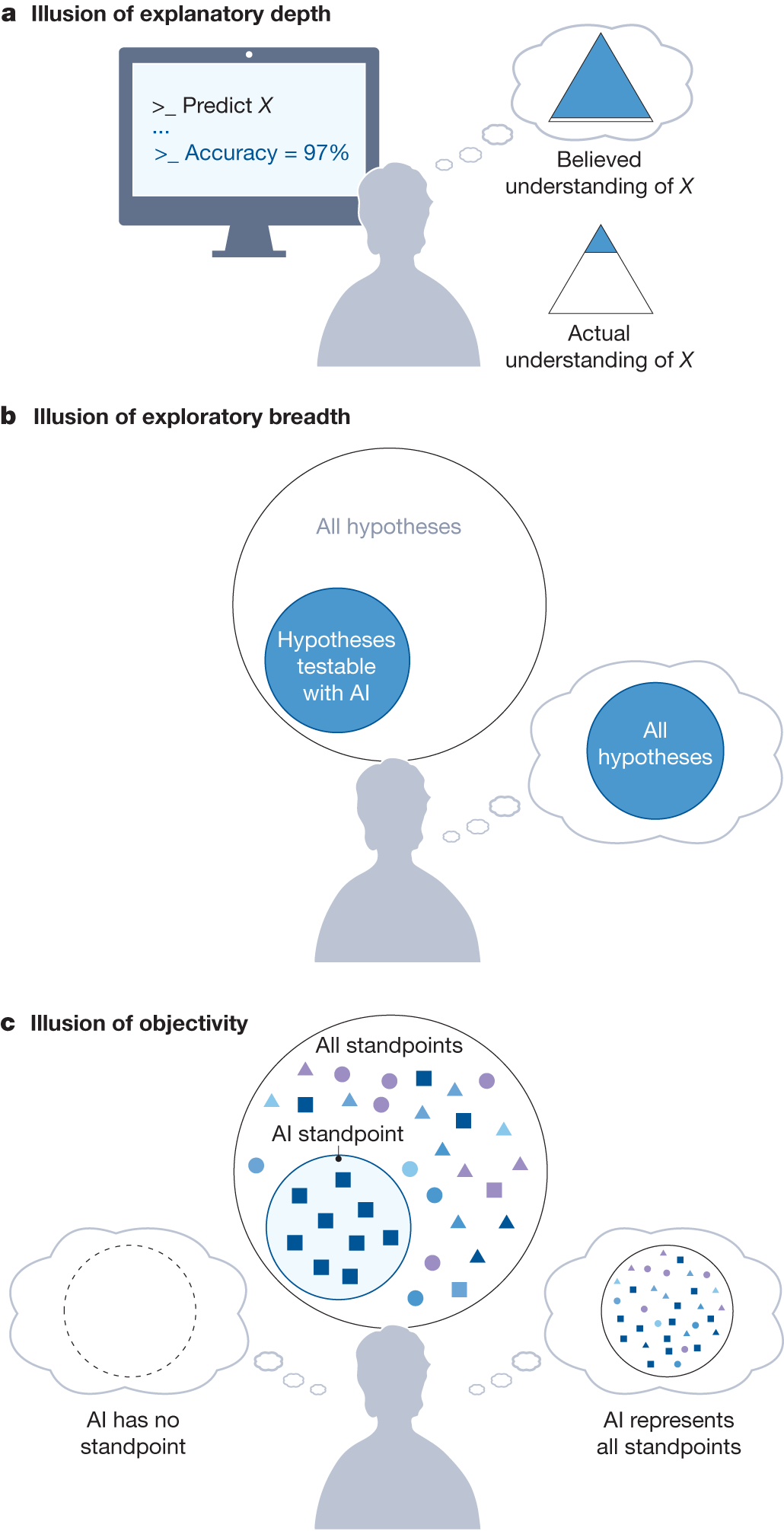
Artificial intelligence and illusions of understanding in scientific research
Scientists are enthusiastically imagining ways in which artificial intelligence (AI) tools might improve research. Why are AI tools so attractive and what are the risks of implementing them across the research pipeline? Here we develop a taxonomy of scientists’ visions for AI, observing that their appeal comes from promises to improve productivity and objectivity by overcoming human shortcomings. But proposed AI solutions can also exploit our cognitive limitations, making us vulnerable to illusions of understanding in which we believe we understand more about the world than we actually do. Such illusions obscure the scientific community’s ability to see the formation of scientific monocultures, in which some types of methods, questions and viewpoints come to dominate alternative approaches, making science less innovative and more vulnerable to errors. The proliferation of AI tools in science risks introducing a phase of scientific enquiry in which we produce more but understand less. By analysing the appeal of these tools, we provide a framework for advancing discussions of responsible knowledge production in the age of AI.
No. 010: AutoScientists governance, AI-agent monoculture, nonsense-term retractions - The Hallway Track
The Hallway Track No. 010 - How AI is affecting the practice of science
The AI Researcher Who Just Quit Anthropic Says It’s ‘Crunch Time for Humanity’
Jacob Coxon talks to WIRED about the “mini Manhattan project” inside Anthropic, the problem with alignment, and why AI labs have just a few years left to make their systems safe.

The End of Science? Agnosis and American Fascism
The Society for Social Studies of Science (4S) annually awards the John Desmond Bernal Prize to one or more individuals who have made distinguished contributions to the field of Science and Technology Studies. Past winners have included founders of the field, along with outstanding scholars who have devoted their careers to understanding the social dimensions of science and technology. This article is the revised text of the 2025 Bernal Lecture by Paul Edwards.
Remarkable how over a decade ago @michaelnielsen.bsky.social pointed the way towards solving long standing issues plaguing science to this day (issues that are all the more relevant in the age of AI mediated science)

Ronen Tamari
This is why @atproto.science is so relevant rn This compilation of essays indicates that scientists are most frustrated by insufficient “community tools and resources... Essential infrastructure for sharing, maintaining and building on existing work and data is also badly underdeveloped." >
This is why @atproto.science is so relevant rn This compilation of essays indicates that scientists are most frustrated by insufficient “community tools and resources... Essential infrastructure for sharing, maintaining and building on existing work and data is also badly underdeveloped." >

What Scientists Said: Results from Astera's First Essay Competition
asterainstitute.substack.com@airglow.run + @continuous.foundation oxa.dev + @discoursegraphs.bsky.social + @scios.tech mira.science + @semble.so connections + ... = modular science revolution 🚀
Chive | Decentralized Eprint Service
chive.pub
Semble
@airglow.run + page.parts (tba @awarm.space) + @standard.site + Semble connections = community knowledge gardening at scale 🤯
