"Thinking is an instrument that serves collective action." So important but also so easy to lose sight of this

Ronen Tamari
This title is clickbait for me 😅 journals.azbuki.bg/philosophy/epistemic-stigmerg…
Aug 28, 2026 at 10:32 PM
Opinion | Think Less, Think Better (Published 2016)
A wandering mind has less innovative thoughts.

TBM 405: Hope, Context, and Control
This essay is about hope, fear, AI, and the tension between control and collective sensemaking.


Groupthink
Groupthink is a psychological phenomenon that occurs within a group of people in which the desire for harmony or conformity in the group results in an irrational or dysfunctional decision-making outcome. Cohesiveness, or the desire for cohesiveness, in a group may produce a tendency among its members to agree at all costs.[1] This causes the group to minimize conflict and reach a consensus decision without critical evaluation.[2][3]
Smoke-away on Twitter / X
Andrej Karpathy: "What you want is the inner thought monologue of your brain... The trajectories in your brain as you're doing problem solving, if we had a billion of that, AGI is here roughly speaking." pic.twitter.com/C0kBUITPBv— Smoke-away (@SmokeAwayyy) October 18, 2024

Do not give up your brain
It's tempting to just let tools think for you, but you still need to be able to think for yourself and stay sharp.

Brian D. Earp, Ph.D. on Twitter / X
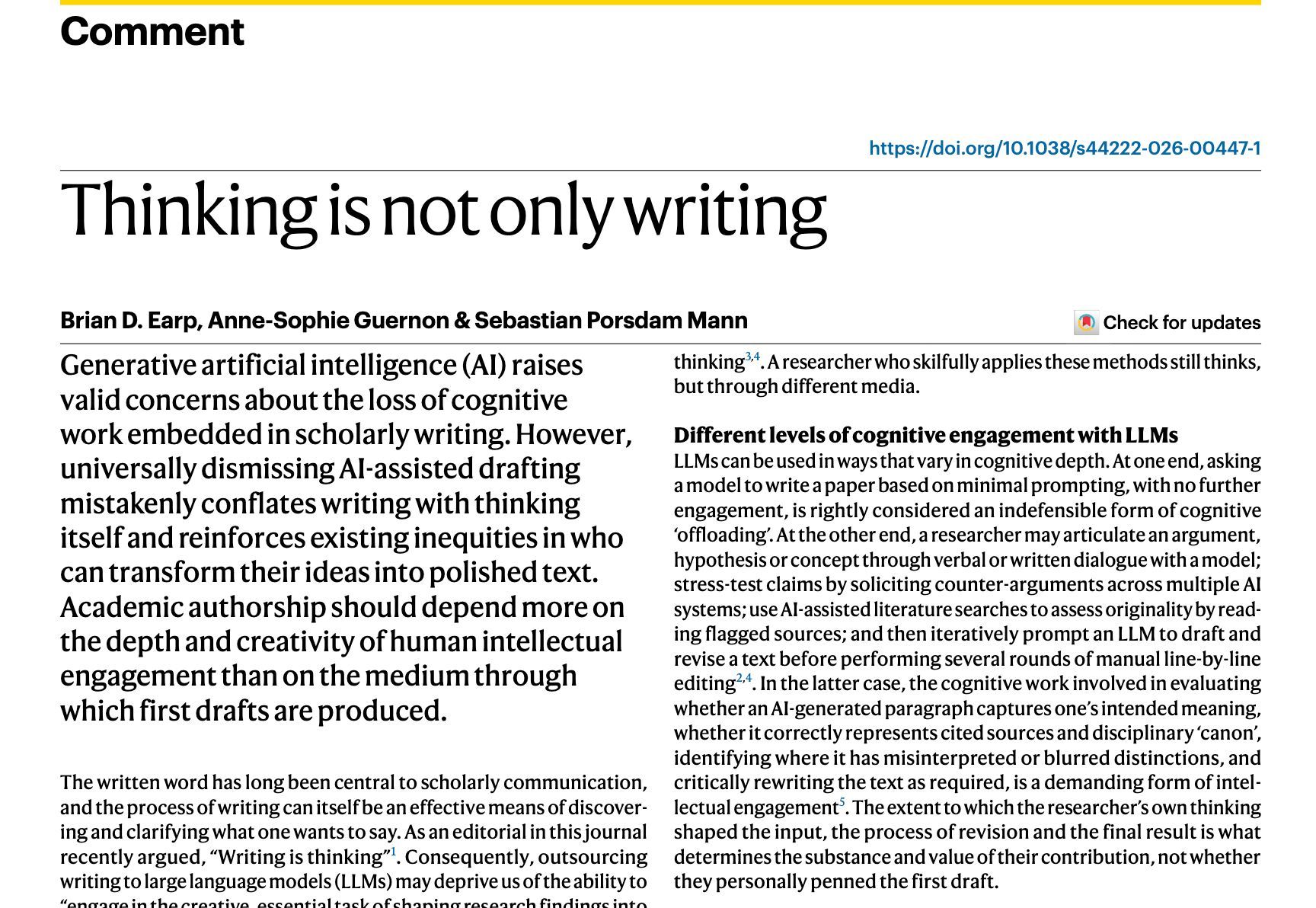
"Writing is thinking." This phrase went viral recently (from https://t.co/EQqohfhUMd), often quoted in the context of objections to use of AI in drafting academic prose. In Nature Reviews Bioengineering we respond: "Thinking is not only writing." Preview below. Shareable full… pic.twitter.com/cZtGdoSwqV— Brian D. Earp, Ph.D. (@briandavidearp) May 15, 2026
Movements of the Mind: A Theory of Attention, Intention and Action
Abstract. Movements of the Mind explains what it is to be an agent. Focusing on mental agency, the book’s eponymous topic, it investigates an agent’s doing

Opinion | There’s a Good Reason You Can’t Concentrate
Just as we changed our thinking around physical fitness, we need to change our attitude toward cognitive fitness.

Verbalizable Representations Form a Global Workspace in Language Models
If the mind is an ocean, we spend our lives floating at the surface. Beneath us, an enormous amount of processing takes place without our knowledge: our visual systems parsing the contours of a face, our motor circuits maintaining our posture. At any given moment, only a small fraction of this neural activity is accessible to us. Yet it is this privileged sliver of activity that we rely on to reason deliberately: to plan what ingredients to buy for a recipe, or to puzzle out why an engine won’t start. Such thoughts can be articulated out loud, deliberately held in mind, and brought to bear on whatever task the moment demands. This distinction, between our accessible thoughts and our unconscious processing, is perhaps the most striking feature of human cognition.
Verbalizable Representations Form a Global Workspace in Language Models
If the mind is an ocean, we spend our lives floating at the surface. Beneath us, an enormous amount of processing takes place without our knowledge: our visual systems parsing the contours of a face, our motor circuits maintaining our posture. At any given moment, only a small fraction of this neural activity is accessible to us. Yet it is this privileged sliver of activity that we rely on to reason deliberately: to plan what ingredients to buy for a recipe, or to puzzle out why an engine won’t start. Such thoughts can be articulated out loud, deliberately held in mind, and brought to bear on whatever task the moment demands. This distinction, between our accessible thoughts and our unconscious processing, is perhaps the most striking feature of human cognition.
The Busy Person's Guide to Thinking
Thinking better isn't about learning more; it's about doing a few simple things that really help create unstoppable progress.

‘Ugh Fields’, or why you can’t even bear to think about that task
Have you ever had a long-overdue task — a task which isn’t so bad in itself — but which you can’t even bring yourself to think about?

Intention, control, and the feeling of commitment
In this paper we propose that rational control of action, agentive stability over time, and coordinated social behavior, are assisted by a form of metacognitive monitoring, leading to an aspect of conscious experience: a feeling of commitment. This feeling of commitment is attached to the formation, retrieval, and execution of intentions. The metacognitive monitoring that produces it is sensitive to the importance of intentions. And the feeling of commitment facilitates the stability and effectiveness of intentions across individual and social contexts, strengthens goal shielding, biases intention retrieval, and thus structures prospective deliberation, expression of intention, and execution of intention. In section two, we discuss control, which is a central aspect of agency and action. In section three, we discuss a crucial part of control: intention. We also discuss a crucial part of intention: commitment. In section four we relate the commitment involved in intention with definitions of commitment in the literature. In section five we offer and elucidate our hypothesis.
Anthropic on Twitter / X
New Anthropic research: A global workspace in language models.Of everything happening in your brain right now, only a tiny fraction is consciously accessible—thoughts you can describe, hold in mind, and reason with.We found a strikingly similar divide inside Claude. pic.twitter.com/aLUPBifxth— Anthropic (@AnthropicAI) July 6, 2026