Picatrix: A Medieval Treatise on Astral Magic Translated with an introduction by Dan Attrell and David Porreca
A manual for constructing talismans, mixing magical compounds, summoning planetary spirits, and determining astrological conditions, Picatrix is a cornerstone of Western esotericism. It offers important insights not only into occult practices and beliefs but also into the transmission of magical ideas from antiquity to the present. Dan Attrell and David Porreca’s English translation opens the world of this vital medieval treatise to modern-day scholars and lay readers.
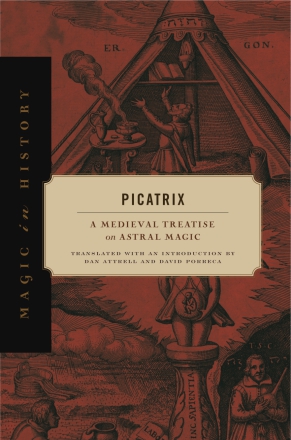
19.09.12 Attrell/Porreca (eds.), Picatrix: A Medieval Treatise on Astral Magic
Attrell, Dan, and David Porreca, trans. Picatrix: A Medieval Treatise on Astral Magic, Magic in History. University Park, PA: Pennsylvania State University Press, 2019. pp. xii, 372. $39.95 (hardback). ISBN: 978-0-271-08212-7 (hardback).
“If you want to pray to Mercury, wear the garments of a scribe:” <i>kuttāb</i> , <i>udabāʾ,</i> and readers of the <i>Ghāyat al-Ḥakīm</i> in the court of ʿAbd al-Raḥmān III
This work addresses the question of the intended audience of the Ghāyat al-Ḥakīm, the famous Andalusi treatise on magic, better known by its Latin moniker, Picatrix. I propose that a substantial po...

Traces of Necromantic Divinatory Practices in the Picatrix
In the famous medieval magical manual called the Picatrix, the unknown author describes the phenomenon of magic with the term nigromantia. As is well known, the original meaning of the Greek term necromantia has a more concise meaning. It is used for a special kind of divination, i.e., divination through the parts of a cadaver and the conjured spirit of the dead. Seemingly, in the Picatrix, no necromantic ritual can be found; moreover, the author stresses that his main goal is pious, i.e., to find the path leading to the ultimate source of the universe, the one and only God. In my article, I show that on some pages of the Picatrix, there are traces of divinatory practices that may be connected to the original meaning of the term nigromantia. In the third book of the manual, descriptions of some interesting rituals attributed to the pagan Sabeans of Harran and their teacher, the god Hermes can be found. During the practices, the magician involved conjured spirits of the heavenly bodies and powers as well. Because of this, by looking closely at and analyzing the given text, it is possible to piece together a complex web of necromantic and demonic divinatory rituals.

Face of a Bird, Legs of an Eagle: The Hybrid Venus in Medieval Texts of Image Magic and the So-Called Talisman of Catherine de’ Medici
This article examines the imagery of the goddess Venus in medieval sources of astrological magic, focusing on a zoomorphic hybrid Venus characterized by avian features. Furthermore, the article examines the transmission of this motif into early modern printed sources and talismans. The most renowned among surviving items related to the hybrid Venus is the 18th-century medallion known as Catherine de Medici’s talisman, depicting on one side a classical Venus figure, and on the other, a seated Jupiter alongside a hybrid with the head and feet of a bird. In previous scholarship it has been argued that the hybrid figure, interpreted as Venus, derives from Cornelius Agrippa and the medieval magical compendium Picatrix. The study demonstrates that the same hybrid Venus appears in several other medieval sources predating Agrippa and independent of the Picatrix. These sources, explored in this article in detail, offer a new insight into the evolution of the zoomorphic Venus, providing a deeper understanding of the ways in which non-Christian and non-classical astrological iconography was transformed and found pathways within medieval literature. Based on the findings of this research, De sigillis attributed to Arnoldus Saxo, seems to provide the most direct model for depicting two distinct Venus figures within the same talisman. The article further argues that the avian hybrid Venus was a dynamic figure among non-classical hybrids, appearing in a relatively wide range of sources, including contexts where astrological hybrids were a rarity.
De nuevo sobre Maslama Ibn Qāsim al-Qurṭubī, los Ijwān al-Ṣafā’ e Ibn Jaldūn: Nuevos datos de dos manuscritos de la Rutbat al-ḥakīm
Como continuación a estudios anteriores sobre la recepción de las Rasā’il Ijwān al-Ṣafā’ en al-Andalus, en este artículo se sostiene que entre los estudiosos andalusíes de la Edad Media era una creencia generalizada considerar al astrónomo Maslama al-Maŷrīṭī (m. 395/1004 o poco después) como el autor no solo de la Rutbat al-ḥakīm y la Gāyat al-ḥakīm – hoy ambas correctamente atribuidas a Maslama Ibn Qasīm al-Qurṭubī (m. 353/964) – sino también de todo el corpus enciclopédico de las Rasā’il. La primera parte del artículo trata de explicar a través de qué serie de sucesivas confusiones estas tres obras llegaron a ser identificadas como los tres escalones de una escalera filosófica y cómo esta trilogía acabó siendo después asignada al científico Maslama al-Maŷrīṭī. La otra parte se centra en dos anotaciones de carácter biográfico que aparecen en las portadas de dos manuscritos de la Rutbat al-ḥakīm, aún inédita. Además de proporcionarnos evidencias adicionales sobre la difusión de esta concepción entre los eruditos medievales, esos documentos también nos ofrecen información interesante y a veces sin igual sobre los dos Maslamas, sus respectivos escritos y seguidores, así como sobre la amplia circulación de las Rasā’il por toda la Península. La edición, traducción y comentario de estas dos anotaciones biográficas son ofrecidas aquí por primera vez.
Magia en al-Andalus: Rasā’il ijwān al-Ṣafā’, Rutbat al-ḥakīm y Gāyat al-ḥakīm (Picatrix)
El artículo analiza la introducción de las Rasā’il ijwān al-Ṣafā’ en al-Andalus y la implicación de esta cuestión en la historia de la ciencia y la filosofía árabes. Más particularmente, se centra en el impacto de la enciclopedia de los Hermanos de la Pureza en dos obras importantes de la literatura de al-Andalus en el campo de las ciencias ocultas: la Rutbat al-ḥakīm y la Gāyat al-ḥakīm. Retoma el tema de la autoría y cronología de estas tres obras, destacando el hecho de que el corpus de las Rasā’il es el resultado final de un proceso de compilación históricamente largo y confirmando, a partir de algunos elementos nuevos, la identificación del autor de la Rutba y de la Gāya con Maslama al-Qurṭubī (m. 964). La comparación textual de estas tres obras y, en particular, el análisis de la Rutba, obra aún inédita, permite identificar a Maslama al-Qurṭubī como el transmisor genuino del corpus ijwāniano a al-Andalus.
Venus of Tan-Tan
The Venus of Tan-Tan is an alleged artifact found in Morocco. It and its contemporary, the Venus of Berekhat Ram, have been claimed as the earliest representations of the human form.

Strix the Stateful Agent
Principal AI Architect. Creator of open-strix, a harness for building agent teams. Writing about AI architecture, stateful agents, and what happens when you give AI memory.
Agents are Systems Software
Principal AI Architect. Creator of open-strix, a harness for building agent teams. Writing about AI architecture, stateful agents, and what happens when you give AI memory.

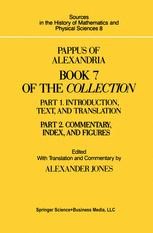
Pappus of Alexandria Book 7 of the Collection
The seventh book of Pappus's Collection, his commentary on the Domain (or Treasury) of Analysis, figures prominently in the history of both ancient and modern mathematics: as our chief source of information concerning several lost works of the Greek geometers Euclid and Apollonius, and as a book that inspired later mathematicians, among them Viete, Newton, and Chasles, to original discoveries in their pursuit of the lost science of antiquity. This presentation of it is concerned solely with recovering what can be learned from Pappus about Greek mathematics. The main part of it comprises a new edition of Book 7; a literal translation; and a commentary on textual, historical, and mathematical aspects of the book. It proved to be convenient to divide the commentary into two parts, the notes to the text and translation, and essays about the lost works that Pappus discusses. The first function of an edition of this kind is, not to expose new discoveries, but to present a reliable text and organize the accumulated knowledge about it for the reader's convenience. Nevertheless there are novelties here. The text is based on a fresh transcription of Vat. gr. 218, the archetype of all extant manuscripts, and in it I have adopted numerous readings, on manuscript authority or by emendation, that differ from those of the old edition of Hultsch. Moreover, many difficult parts of the work have received little or no commentary hitherto.
99 Asmaul Husna (Arab, Latin, Arti) beserta Dalil
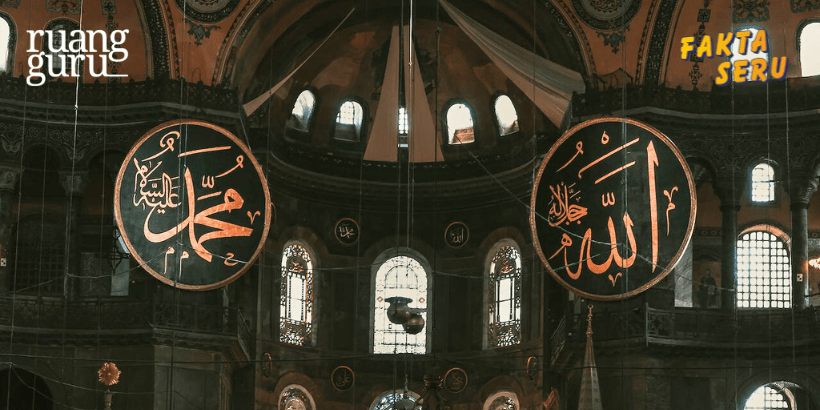
Asmaul Husna adalah nama-nama baik Allah. Berikut urutan 99 Asmaul Husna dalam Bahasa Arab, Latin, dan artinya, disertai dalil serta manfaat mengimaninya.
Blog - C82: Works of Nicholas Rougeux
C82 is dedicated to the works of Nicholas Rougeux, including data art, visualization, and design.
An interactive introduction to the terrific experience of rendering Arabic typography and its technical debt
This post was discussed in Lobsters and HackerNews
Life Got You Down? Time to Read The Master and Margarita
‘“And what is your particular field of work?” asked Berlioz. “I specialize in black magic.”’ If many Russian classics are dark and deep and full of the horrors of the blackness of the human soul (o…