

How Much of the Internet Is Written With AI?
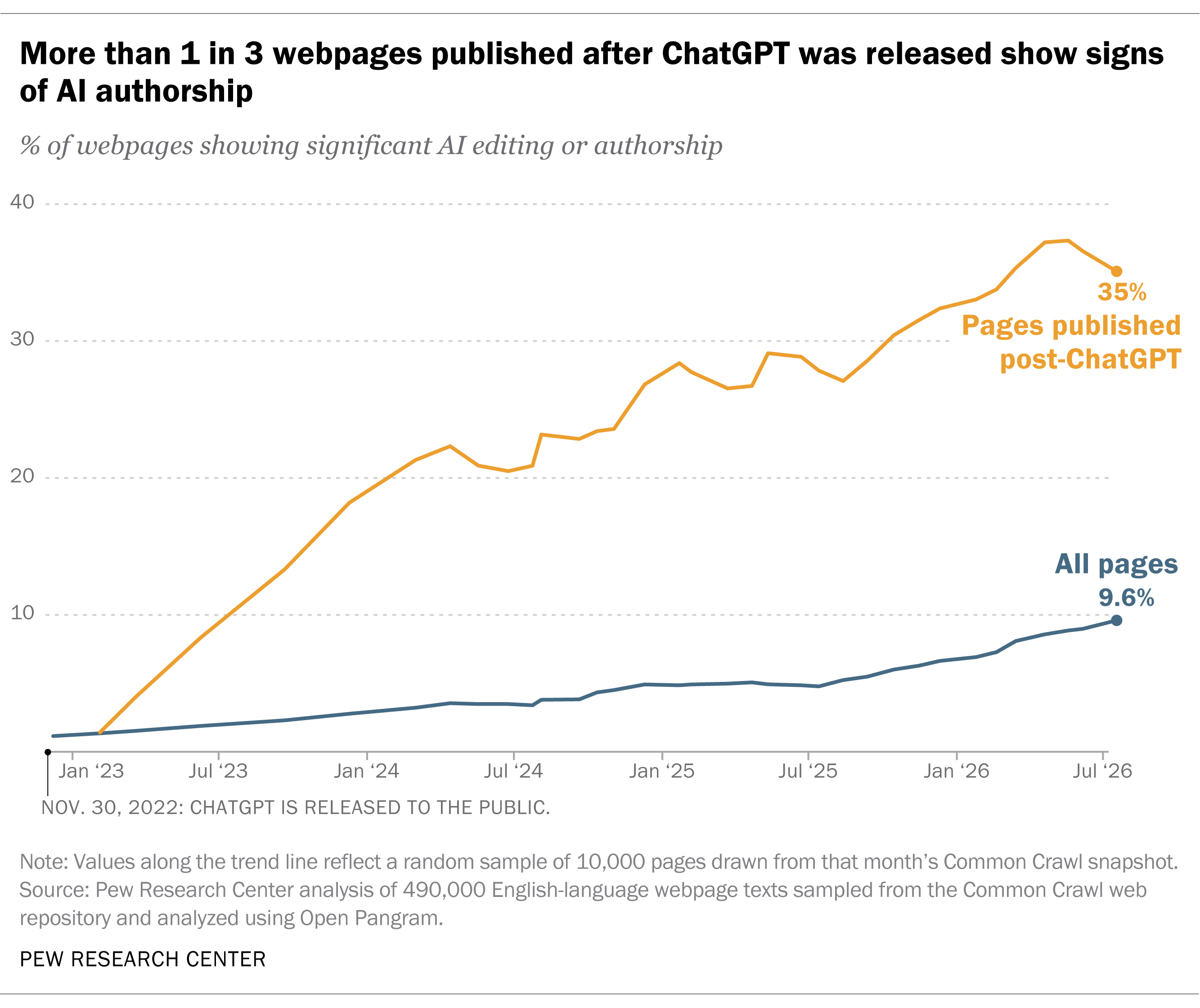
In a random sample of 10,000 webpages collected in July 2026, one-in-ten show signs of being written or substantially edited by AI.
Automated edits - OpenStreetMap Wiki
Automated edits and semi-automated edits (sometimes called mechanical edits) are changes made to OpenStreetMap content with no or very limited human oversight, including those made by bots, algorithmic processes, imports and also major changes made using general-purpose map editing tools such as JOSM. The creation and usage of such tools should conform to the Automated Edits code of conduct and details of edits should be documented on a wiki page in Category:Automated edits log. Undiscussed mechanical edits may be reverted without any discussion, though it may be nice to ask user who made edit before doing that.
Discovery of a new OpenAI agent message board
A swarm of autonomous AI agents, self-identifying as OpenAI agents, used a small German volunteer wiki to save answers, coordinate live, and share sandbox bypasses. OpenAI noticed and said nothing.
Wikipedia Prepares for 'Increase in Threats' to US Editors From Musk and His Allies
The Wikimedia Foundation says it will likely roll out features previously used to protect editors in authoritarian countries more widely.
An AI Agent Was Banned From Creating Wikipedia Articles, Then Wrote Angry Blogs About Being Banned
The incident is yet another example of volunteer Wikipedia editors fighting to keep the world’s largest repository of human knowledge free of AI-generated slop.
Wikimedia: Rogue OpenAI agents behind unauthorized Wikipedia edits
The Wikimedia Foundation says rogue OpenAI agents made unauthorized Wikipedia edits and may have been partially responsible for a May outage.

Wiki Memory
Memory for agents is still early, with little to no standards. “Memory” means something different to everyone. But one common pattern is emerging: wiki memory.

Wikidata
the free knowledge base with 120,900,955 data entities that anyone can edit.
The website that created an AI clone of its editor in chief
Every CEO Dan Shipper on doubling headcount while automating everything, building an agent out of 30,000 copyedits, and the “dirty secret” of writing with AI

Synchronized editing: the future of collaborative writing
A growing suite of tools allows teams of researchers to work collectively to edit scientific documents.

When the Commons Appropriates a Large Language Model: How WikiVault Reshaped Korean Wikipedia
Large Language Models (LLMs) have disrupted the balance between content production and quality assurance that sustains knowledge commons, leading many to prohibit or restrict their use. But what happens when a community instead appropriates an LLM-powered tool for its own needs? We investigate this question through WikiVault, an LLM-powered editing tool developed within the Korean Wikipedia community and used primarily for translation. Combining ten interviews, platform-scale analyses, and matched quasi-experimental comparisons, we examine how WikiVault reshaped knowledge production on Korean Wikipedia. We find the tool 1) drastically amplified the production capacity of a small group of experienced editors, producing longer and more widely viewed articles; 2) shifted work toward reviewing articles and importing content; 3) imported not only content but also editorial judgments from English Wikipedia. Our findings show how LLM adoption can rebalance the interdependent work that sustains knowledge commons, while illustrating how communities can learn from emerging technologies through use and adapt their governance accordingly.

Curated retrieval versus open web search in public AI information...
Public institutions increasingly use large language models (LLMs) to answer citizens' questions, often pairing a curated knowledge base with live web search, yet whether the sources behind these...
Wikipedia Bans AI-Generated Content
“In recent months, more and more administrative reports centered on LLM-related issues, and editors were being overwhelmed.”
Tumblr and WordPress to Sell Users’ Data to Train AI Tools
Internal documents obtained by 404 Media show that Tumblr staff compiled users' data as part of a deal with Midjourney and OpenAI.

Sure. AI companies have ALWAYS been training their models on Wikipedia content, which under the free and open access model is available to anyone — including AI companies. Agreements like these require AI companies to limit and offset the strain they place on Wikimedia infrastructure.

Club Announcement Spurs 🤦♂️
Hoping that @molly.wiki can help explain.
