

Mathematics with large language models as provers and verifiers
During 2024 and 2025 the discussion about the theorem-proving capabilities of large language models started reporting interesting success stories, mostly to do with difficult exercises (such as problems from the International Mathematical Olympiad), but also with conjectures [Feldman & Karbasi, arXiv:2509.18383v1] formulated for the purpose of verifying whether the artificial intelligence could prove it. In this paper we report a theorem proving feat achieved by ChatGPT by using a protocol involving different prover and verifier instances of the gpt-5 model working collaboratively. To make sure that the produced proofs do not suffer from hallucinations, the final proof is formally verified by the lean proof assistant, and the conformance of premises and conclusion of the lean code is verified by a human. Our methodology is by no means complete or exact. It was nonetheless able to solve five out of six 2025 IMO problems, and close about a third of the sixty-six number theory conjectures in [Cohen, Journal of Integer Sequences, 2025].

Mathematics with large language models as provers and verifiers
During 2024 and 2025 the discussion about the theorem-proving capabilities of large language models started reporting interesting success stories, mostly to do with difficult exercises (such as problems from the International Mathematical Olympiad), but also with conjectures [Feldman & Karbasi, arXiv:2509.18383v1] formulated for the purpose of verifying whether the artificial intelligence could prove it. In this paper we report a theorem proving feat achieved by ChatGPT by using a protocol involving different prover and verifier instances of the gpt-5 model working collaboratively. To make sure that the produced proofs do not suffer from hallucinations, the final proof is formally verified by the lean proof assistant, and the conformance of premises and conclusion of the lean code is verified by a human. Our methodology is by no means complete or exact. It was nonetheless able to solve five out of six 2025 IMO problems, and close about a third of the sixty-six number theory conjectures in [Cohen, Journal of Integer Sequences, 2025].
Simon on Twitter / X
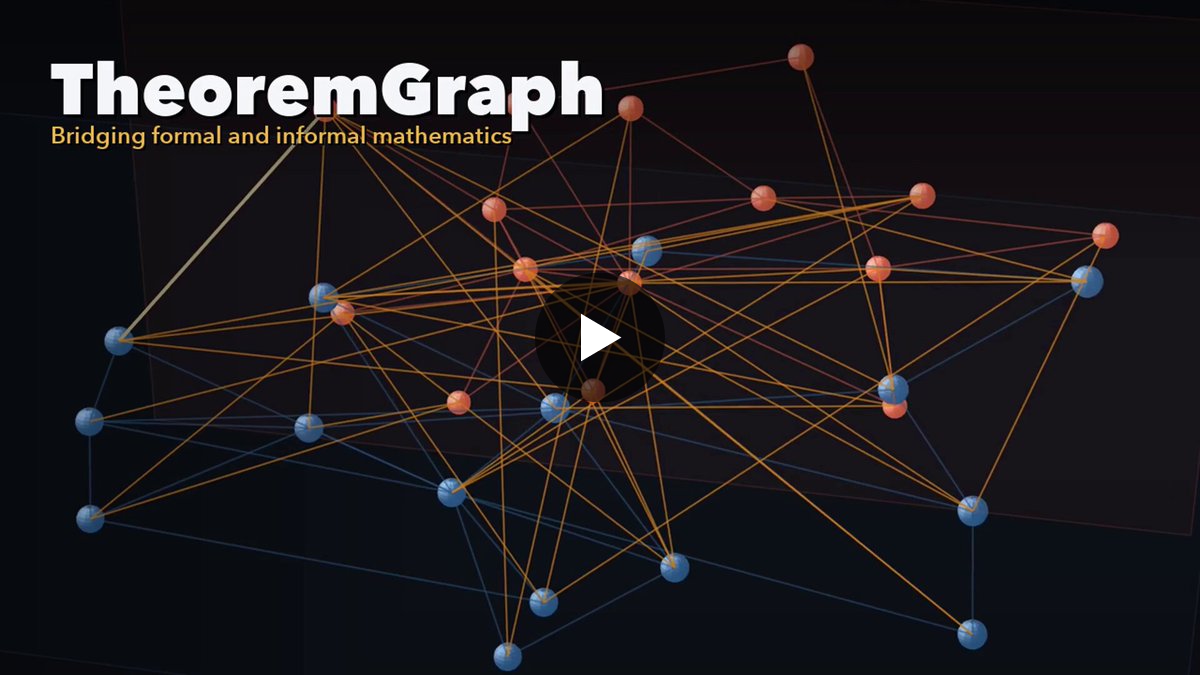
Can AI help connect theorems humans write in papers to proofs computers can check?We just released TheoremGraph (https://t.co/PQ8FcFQGat), and I made a 3Blue1Brown style video overview of the idea.This project was my first real research experience, and it meant a lot. Start… pic.twitter.com/yMUA0QziXM— Simon (@waskaja) June 29, 2026
Formalizing Fermat's Last Theorem
Anthropic is an AI safety and research company that's working to build reliable, interpretable, and steerable AI systems.
Theory Beyond Theorems and Proofs: A Guest Post
Scott’s foreword: I’m extremely grateful to my brilliant colleagues, Pravesh Kothari, Raghu Meka, and Prasad Raghavendra, for sharing the guest post below about how theoretical computer…

The Case Against Formal Verification, 50 Years Later - Ivan Gavran
Writings on software correctness, AI, formal verification, and other technical topics.

Experts Argue Whether Computers Could Reason, and if They Should (Published 1977)
Computer world is in midst of fundamental dispute over question of computer intelligence since MIT Prof Joseph Weizenbaum wrote book arguing that machines can never be made to reason like people and should not be; Weizenbaum por (M)

fermats-last-theorem/FinalCheck.lean at aa2d8b34692b16c70f699536de0d8e75b9a3e9ef · anthropics/fermats-last-theorem
Contribute to anthropics/fermats-last-theorem development by creating an account on GitHub.
. · openai/ten-proofs@d0e1ae7
Lean certificates accompanying proofs in mathematics and theoretical computer science - . · openai/ten-proofs@d0e1ae7
Prediction: AI will make formal verification go mainstream — Martin Kleppmann’s blog
Much has been said about the effects that AI will have on software development, but there is an angle I haven’t seen talked about: I believe that AI will bring formal verification, which for decades has been a bit of a fringe pursuit, into the software engineering mainstream.
The Technological Turn in Mathematics
Quickly evolving technologies, such as Interactive Theorem Provers (ITPs), Automated Theorem Provers (ATPs), and Large Language Models (LLMs), all falling under the general heading 'AI for mathematics,' are transforming mathematical practice in profound ways. This chapter explores the implications of these innovations, focusing on their impact on how mathematical knowledge is created and shared. It also discusses how they are reshaping the social dimension of mathematics, altering collaboration dynamics, trust relationships, and the collective production of knowledge. For instance, tools like ITPs facilitate large-scale collaborations and make new types of teamwork possible, where trust is not a necessary ingredient. ITPs also help us mitigate our human fallibility, yet they raise questions about the nature of formalization and the relationship between traditional and formal mathematics. Technologies such as LLMs are reshaping the division of epistemic labour between humans and machines and urge philosophers of mathematics to ask questions about the value of their work.
Talia Ringer 🕊🪬 on Twitter / X
Poured my heart and soul into advocating for formal proof with AI assistance in a mathematical setting because of the large collaborations I thought it could empower. (1/3)— Talia Ringer 🕊🪬 (@TaliaRinger) September 10, 2026
Antikythera | Antikythera
As computation becomes planetary infrastructure, how does its acceleration of hybrid intelligences pose new challenges to fundamental philosophical questions.
. · openai/ten-proofs@e9dce9a
Lean certificates accompanying proofs in mathematics and theoretical computer science - . · openai/ten-proofs@e9dce9a
Embracing AI and formalization: Experimenting with tomorrow’s mathematical tools
Embracing AI and formalization: Experimenting with tomorrow’s mathematical tools. By Jarod Alper