

It's not much but at least we surpassed Truth Social here and I'm okay with that. #bluesky #socialMedia #us #usa #uspol #pew #research

Americans’ Social Media Use 2025
www.pewresearch.orgNov 23, 2025 at 1:30 AM
Shifts in U.S. Social Media Use, 2020-2024: Decline,...
Using nationally representative data from the 2020 and 2024 American National Election Studies (ANES), this paper traces how the U.S. social media landscape has shifted across platforms,...

Social Media and News Fact Sheet %page%
Many Americans use social media for news: About a fifth or more regularly get news on Facebook, YouTube, Instagram and TikTok.

My top Bluesky feature requests for 2024
In 2023 my social media consumption changed dramatically after I DM'd a random mufo on what-was-then-called Twitter for a Bluesky invite. At the time, I was floating between Twitter itself and Mastodon for my primary daily social media experience. On one hand, I loathed Twitter (and
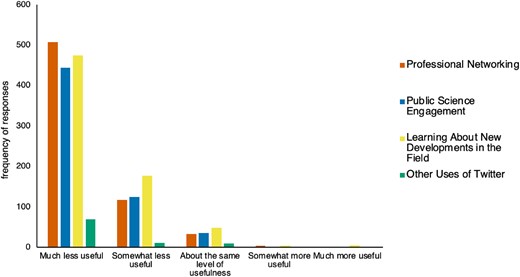
Scientists no Longer Find Twitter Professionally Useful, and have Switched to Bluesky
Synopsis Social media has become widely used by the scientific community for a variety of professional uses, including networking and public outreach. For the past decade, Twitter has been a primary home of scientists on social media. In recent years, new leadership at Twitter has made substantive changes that have resulted in increases in the prevalence of pseudoscience, conspiracy theory, and harassment on the platform, causing many scientists to seek alternatives. Bluesky has been suggested as a good alternative to Twitter, but the phenomenon of academics switching social media platforms has not previously been studied. Here we report on the results of a survey distributed to scientists on Twitter and Bluesky (n = 813). Results overwhelmingly confirm that changes to Twitter have made the social media platform no longer professionally useful or pleasant, and that many scientists have abandoned it in favor of Bluesky. Results show that for every reported professional benefit that scientists once gained from Twitter, scientists can now gain that benefit more effectively on Bluesky than on Twitter.
Shifts in U.S. Social Media Use, 2020–2024: Decline, Fragmentation, and Enduring Polarization
Using nationally representative data from the 2020 and 2024 American National Election Studies (ANES), this paper describes how U.S. social media use has shifted across platforms, demographics, and politics. Overall platform reach declined, driven by growth in the share of Americans — especially the youngest and oldest cohorts — who report using no social media. Visiting and posting activity on Twitter/X and Facebook have fallen by nearly 50% since 2020, with the decline on Twitter/X driven primarily by reduced participation among Democratic users. While Facebook, YouTube, and Twitter/X lost ground, TikTok and Reddit grew modestly, consistent with a more fragmented digital public sphere. Platform audiences aged and became slightly more educated and racially diverse. Politically, most platforms shifted toward Republican users while remaining, on balance, Democratic-leaning. Twitter/X experienced the largest change: among posters, the partisan balance swung over 70 percentage points from Democrats to Republicans. Across platforms, political posting remains closely tied to affective polarization, as the most partisan respondents are also the most active. As casual users disengage while polarized partisans remain vocal, online discourse becomes narrower and more ideologically extreme.
How Social Media Brings Out the Worst in Us
A new book argues that social media does more harm than good and we might be happier and healthier using it less.
Shifts in U.S. Social Media Use, 2020–2024: Decline, Fragmentation, and Enduring Polarization
The social media ecosystem appears to be in flux. Twitter’s rebranding to X has come to symbolize a broader reorganization of online publics – political reshuffling, user attrition, and uncertainty over the role of legacy platforms. Simultaneously, the shift from text-based, networked feeds toward algorithmically curated, short-form video has accelerated, with TikTok setting the pace for the wider ecosystem [18, 14, 16]. At the same time, everyday communication increasingly migrates from large, open networks to semi-private spaces such as group chats and messaging apps. Commentators describe a digital public sphere in transition: smaller, more fragmented, less dominated by traditional social networking sites, and rise of more broadcast-oriented forms of media – with some even suggesting that we are seeing the beginning of the end of the social media era.
Bluesky 2025 Transparency Report - Bluesky
Throughout 2025, our Trust & Safety work was guided by the premise that social media should serve the people using it. Our transparency report provides data and details about those investments, and the progress we made this year.
Bluesky & Open Social Media Tech
The future of social media is human
We cannot continue participating in social media platforms which do nothing to stop us being tricked by GenAI and the powerful people/governments that control them.

Is social media truly making us more politically polarized, or does it simply over-represent our most extreme opinions? In our new preprint, @small-schulz.bsky.social and I present *punishing evidence* that social media systematically overrepresents users’ most extreme political opinions. 1/n
Social media discourse is driven by false #polarization We find that: 1) ideologues post opinions more than moderates 2) extreme attitudes are posted more than moderate one 3) This replicates in 40 countries 4) Opinions that users post are more hostile than the beliefs they keep to themselves
Do you like your social media less toxic? Yeah, we do too. @eurosky.social and Germany's Federal Agency for Breakthrough Innovation (SPRIND) just signed an agreement to collaborate on precisely that: eurosky.tech/news/eurosky-sprind-bridgeu/

Eurosky is collaborating with SPRIND to test a non-toxic algorithm for the first time - Eurosky
eurosky.techOne of the issues that has come up again and again in my reporting on misinformation and social media is the massive influence social media companies have on research in the field. Last night a preprint dropped that tries to get at this with some numbers. My piece in @science.org (and 🧪🧵 coming):

Nearly a third of social media research has undisclosed ties to industry, preprint claims
www.science.org🐝 Social Media (SB Commentary)

things I said about social media

Bee 🐝 (@sweetbee.vip)
Bee 🐝 (@sweetbee.vip)
Bee 🐝 (@sweetbee.vip)


