

It’s time to get rid of the peer-reviewed paper
The peer-reviewed journal article, perhaps the single most important device behind the expansion of scientific knowledge in the last century, is an extraordinarily expensive way to share novelty: e…

Science has been in a “replication crisis” for a decade. Have we learned anything?
Bad papers are still published. But some other things might be getting better.

Ravid Shwartz Ziv on Twitter / X
The problem with Anthropic's consciousness paperMy last post got more attention than I expected, and the question I keep getting is some version of "okay, so what is actually wrong with the paper?". Let me try to explain.First, the core result is fine. Reading out…— Ravid Shwartz Ziv (@ziv_ravid) July 7, 2026
Andreas De Block on Twitter / X
It took Nature three years to publish this rebuttal, which clearly demonstrates the fundamental flaws in the original paper. In the meantime, the paper's conclusions influenced scientific debate and policy decisions. Such delays in correcting flawed research do real damage. https://t.co/QI3Ei3PE70— Andreas De Block (@DeblockBlock) August 13, 2026
Speculations on the Future of the Scientific Method
The following essay was published 20 years ago (January, 2006) on my blog The Technium. I edited the intro here, but the speculations are basically unchanged.

Andy's Blog
Originally published in October, 2017 – over three years later in 2021 I am still happily using Posteo!
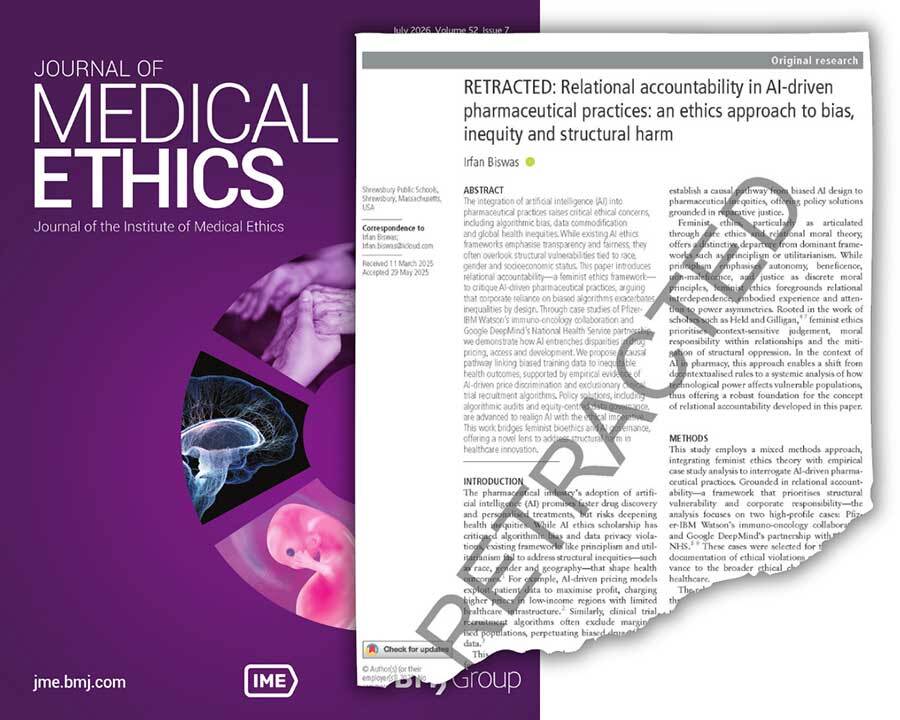
Ethics journal retracts paper by high school student for AI, peer review manipulation
The Journal of Medical Ethics has retracted a paper on the use of AI in the pharmaceutical industry for containing references that don’t exist. The article’s sole author: a high school student.&nbs…
Why is every rationalist blog post way too long? - alex wennerberg
For my piece on Catholic miracle apologetics, I read (correction: skimmed) a 25,000-word post by rationalist blogger Scott Alexander. My piece, which cited (but does not focus on) his, ended up being a cool 2,700 words. I don't think it would benefit from being longer, and it was the result of me cutting around 70% of the text I initially wrote.
i read the post on Gelman’s blog about the Protzko et al. “high replicability” paper, and then i skimmed the published paper, and then i read the review i wrote for an older version of the paper when it was submitted to Nature back in 2020, and after that i was left with 2 questions:
Mar 30, 2024 at 5:41 PM
In a 🔥 post, @jessicahullman.bsky.social follows up on the recent NHB 'High replicability' paper. "It bugs me (though doesn’t not surprise me) to think that whether questionable practices get called out depends on who exactly is in the author list." tinyurl.com/4yr98zvw
The feel-good open science story versus the preregistration (who do you think wins?) | Statistical Modeling, Causal Inference, and Social Science
tinyurl.com"I" may have just found a fundamental flaw in a "dense, high-prestige paper". Problem is, I don't have a clue what I did and how to verify any of this. I asked Gemini to perform a review of an interesting paper and it was skeptical and proposed a data analysis that should be performed.

a south park poster with a boy scout and the words what are you guys doing in there
media.tenor.comAn editorial was published in Nature recently claiming that glam journal publication of LLMs (like DeepSeek-R1 this case) marks a step towards greater transparency, accountability & credibility nature.com/articles/d41586-025-02979-9. I have thoughts ... 1/
https://www.nature.com/articles/d41586-025-02979-9
t.coHow times change! A decade ago, a failed replication of work by the same lab led to 'repligate' and blog posts such as psychol.cam.ac.uk/cece/blog Now, failed replications can be published an no one blinks an eye. That is progress due to all the scholars working hard to improve science!
at this point no one cares, but i was invited to talk about the high-rep retraction saga, and once again, i find myself perplexed at the exclusion of confirmatory results in any calculation in a study making a key claim about the inclusion of confirmatory studies making results highly replicable.


