

One of the dangers I see with LLMs is that we build such a persuasive collective consensus-mind that most people become excessively passive and trusting. That’s bad. But. Can I say something? living in a low-trust country ruled by utter crackpots … it might not be *all* bad?
Aug 1, 2026 at 3:28 PM
Moderating With Humans, For Humans - Trust Issues
Moderating With Humans, For Humans - Trust Issues
There's Something Fundamentally Wrong With LLMs
LLMs aren't trained on the "vast majority of speech," experts warn, a major blind spot that could have sweeping consequences.

The LLM Critics Are Right. I Use LLMs Anyway.
I almost agree with all of the LLM critics, yet I still use LLMs a lot. I know this sounds like I am delusional, but I don't think I am alone with it.

The LLM Critics Are Right. I Use LLMs Anyway.
I almost agree with all of the LLM critics, yet I still use LLMs a lot. I know this sounds like I am delusional, but I don't think I am alone with it.
Against False Indulgences in LLM Alignment
Unnecessary moral concern, and the false indulgences that drive it.

Well-intentioned obscenity
An LLM lied about me at the office and I'm cranky about it. That interaction makes me think a lot about how LLMs are becoming normalized, though, and what we're looking at in terms of their role in human-to-human interactions in the future.
Everyone Conforms, No One Believes: Pluralistic Ignorance in LLM Agent Populations
LLM-based multi-agent systems are increasingly used to simulate social dynamics, from opinion formation to collective decision-making. These simulations can reproduce certain social phenomena, but it is unknown whether they capture pluralistic ignorance, a state where a majority privately rejects a norm yet publicly conforms, each believing they are alone in dissenting. This phenomenon drives norm persistence, social movements, and political revolutions. We show that pluralistic ignorance emerges robustly in LLM agent populations. We construct a benchmark of 100 scenarios across 10 domains and 5 authority levels, grounded in the human pluralistic ignorance literature, and evaluate 8 models from 6 organizations. Agents publicly conform at rates of 64 to 94% despite privately opposing the norm. Conformity is domain-sensitive (workplace and social relationship scenarios produce near-universal public compliance) and highly model-dependent, though uncorrelated with model capability. We further test whether a single "norm entrepreneur" can break the false consensus by publicly dissenting. For 7 of 8 models, cascades succeed less than 26% of the time, with one model showing zero cascades across all scenarios. GPT-4o is a notable outlier at 48%, revealing qualitatively distinct social dynamics across model families. Our findings identify model selection as an unacknowledged degree of freedom that fundamentally shapes simulation outcomes. More broadly, the near-absence of cascades suggests LLM simulations may systematically overestimate the stability of social norms, missing the fragile tipping-point dynamics that drive real-world norm change in human societies.
How Do We Talk about LLMs?
By Jim Clifford It is never fun to watch friends argue. Generative AI has created multiple fractures across our universities and the community of historians. The stakes are high and we are all deal…

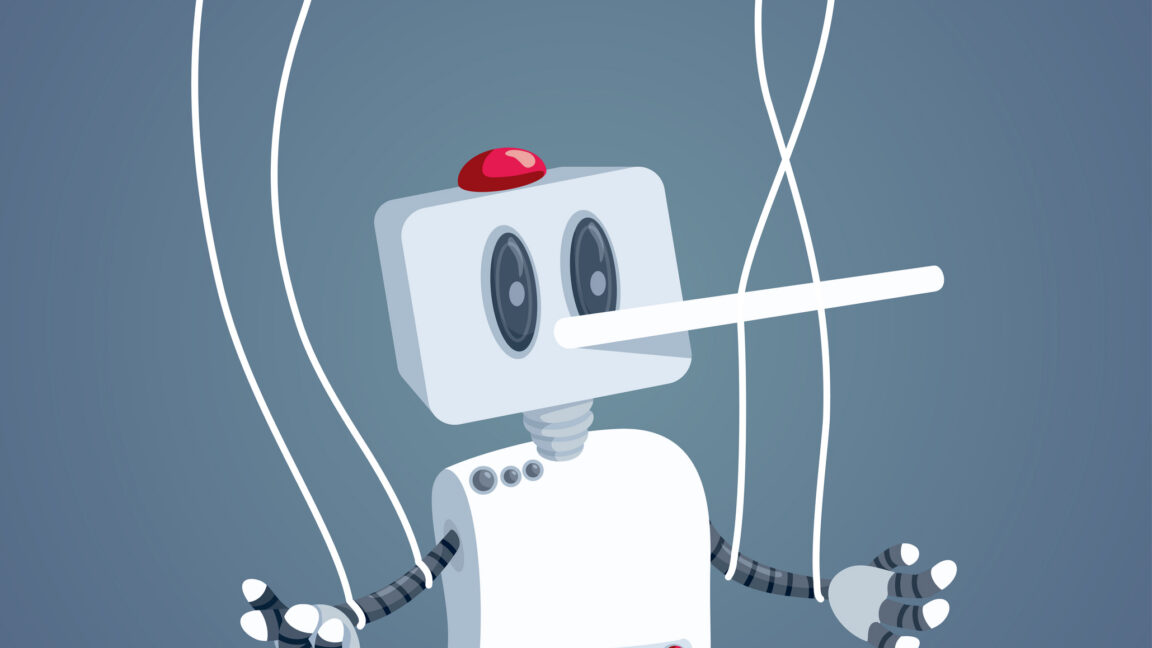
LLMs believe false statements even after explicit warnings that they're false
Fine-tuning tests show "bias... toward confidently representing the claims as true."
How AI Will Reshape Public Opinion
Social media democratised public opinion, shifting influence away from elites and experts to ordinary people. LLMs will partly reverse this trend. They are a powerful, new technocratising force.

Harnessing Collective Intelligence better than LLMs w/ Sean Geobey
Pushback on use of hidden prompts to snare AI peer reviews
The invisible messages, which instruct LLMs to use telltale phrases in a peer-review report, catch AI misuse but also erode trust, some say.

Cognitive exponents and LLM leverage
I know a few people for whom LLMs have been a near-immediate multiplier of attention and effort. I know a lot for whom LLMs clearly make them worse at thinking and doing things. So: why?
Ignoring the Unreasonable
Illiberal and antidemocratic political forces, for example, in the form of far-right populism, are on the rise. Such politics, commonly referred to as ‘unreasonable’ in political philosophy, is widely seen as a threat to democracy. Many argue that an adequate response must involve listening to , that is, understanding and seriously considering the perspective of the unreasonable. I disagree. I argue that as democratic citizens, we should not listen to the unreasonable; we should, in a sense, ignore them, that is, refuse to understand and seriously consider their perspective, although continue to monitor their activities. Listening to the unreasonable is not instrumentally required for countering unreasonable politics. In addition, the unreasonable likely have no moral claim to be listened to. Finally, listening to them is disrespectful to reasonable citizens whose voice is ignored for the sake of paying attention to the unreasonable. For these reasons, we should ignore the unreasonable.
There's growing experimental evidence¹˒²˒³˒⁴ that LLMs are unusually good at talking people out of entrenched false beliefs and conspiracy theories. ¹ pubmed.ncbi.nlm.nih.gov/39264999/ ² pubmed.ncbi.nlm.nih.gov/41179846/ ³ sciety.org/articles/activity/10.21203/rs… ⁴ connecticut.adl.org/resources/report/short-dialog…

Der Fisher
Unpopular opinion: LLMs are generally deradicalizing people whose beliefs are based on pure propaganda. I've been watching this happen slowly with some people I care about. ChatGPT is one of the reasons they finally accept that the NRA, OAN, and NewsMax are lying to them.

