

A data cooperate for architects. In the hotel industry, small economic entities quickly reach the limits of their bargaining power. As a large group of architects, licensing policies, for example, can be influenced, and it will be possible to position oneself better economically.

Zentrum verantwortungsbewusste Digitalisierung (ZEVEDI)
🏢 Warum bedarf es einer Datenkooperative für Architekten? Architekt:innen entwerfen, planen und koordinieren – und erzeugen dabei Planungs- und Projektdaten. In einer cloudbasierten Arbeitswelt stellt sich die Frage, wie diese Daten langfristig souverän genutzt und gesichert werden können.
Jan 9, 2026 at 8:36 AM
Collective Bargaining in the Information Economy Can Address...
This position paper argues that there is an urgent need to restructure markets for the information that goes into AI systems. Specifically, producers of information goods (such as journalists,...

Data Mesh Architecture: Interoperability, Co-Operation, and Co-Regulation
This paper examines the emergence of data mesh architectures and data intermediaries as key components in emerging data economies. It explores how data mesh arc

Compaction Is a Financial Strategy - The Phoenix Architecture
Why smaller codebases win in the AI era
Should We Treat Data as Labor? Moving Beyond “Free”
Should We Treat Data as Labor? Moving beyond "Free" by Imanol Arrieta-Ibarra, Leonard Goff, Diego Jiménez-Hernández, Jaron Lanier and E. Glen Weyl. Published in volume 108, pages 38-42 of AEA Papers and Proceedings, May 2018, Abstract: In the digital economy, user data is typically treated as capi...

The Last Gasps of the Rent Seeking Class
Over the past fifty years, the U.S. economy built a giant rent-extraction layer on top of human limitations: things take time, patience runs out, brand familiarity substitutes for diligence, and most people are willing to accept a bad price to avoid more clicks. Trillions of dollars of enterprise value depended on those constraints persisting. – Citrini Research
The Meshwork of Relational Infrastructure
What makes up Relational infrastructure when we zoom in? What are the qualities and attributes that might help us explain how we build it, nurture it and best invest in it - and indeed, what we can expect in return?

Agents First
Every product is getting a second customer — the human who pays, and the agent who decides. A design framework for building products that AI agents can use as primary consumers.
How to Make Sense of Any Mess
Information Architecture for Everybody. Based on a book by Information Architect, Abby Covert.
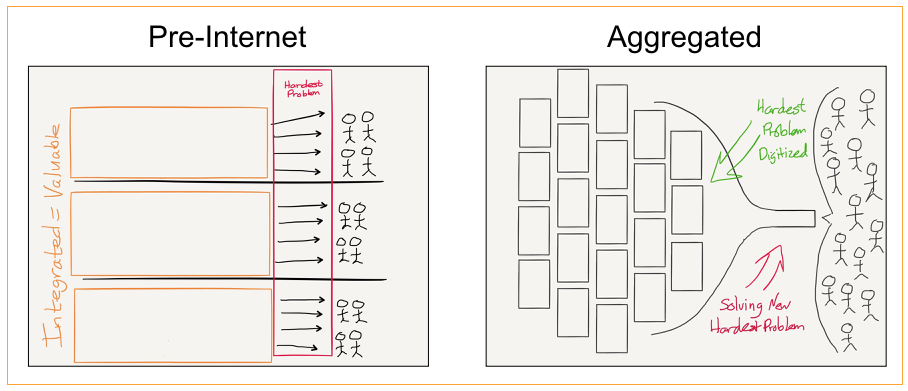
Aggregation Theory
About | Articles | Updates | Speaking | Consulting What is Aggregation Theory? Aggregation Theory is a completely new way to understand business in the Internet age. Business schools suggest that w…
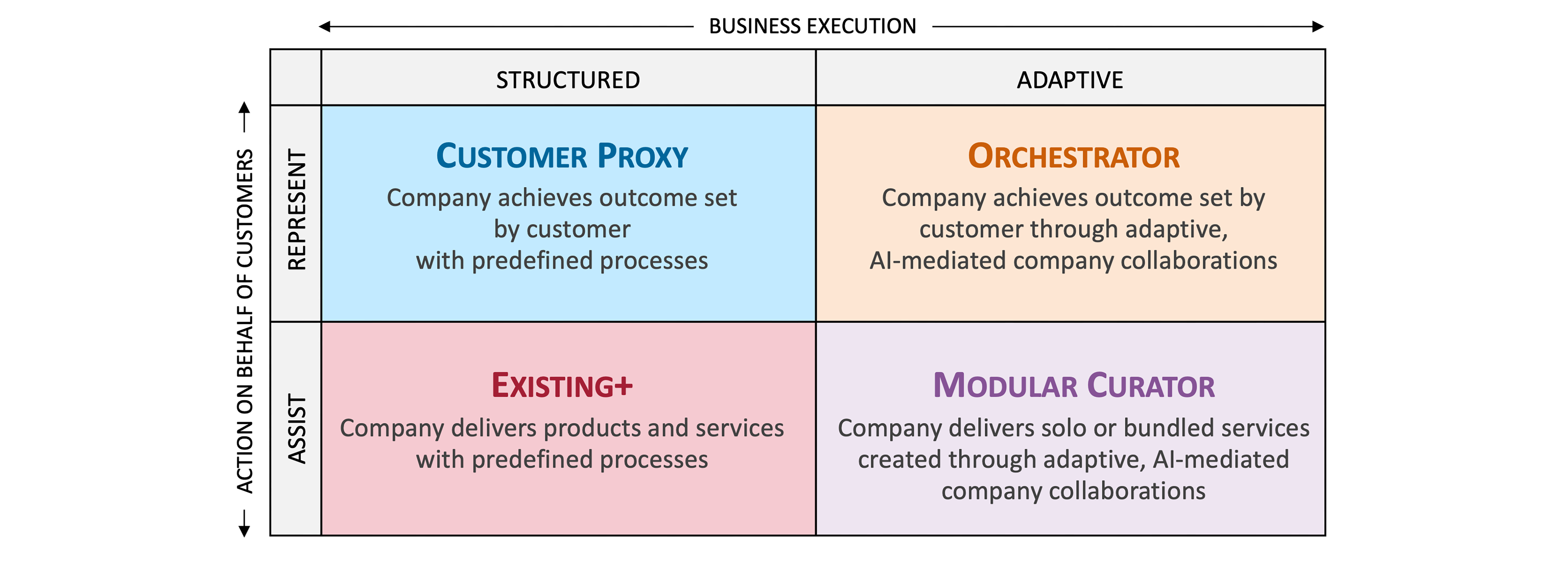
Business Models in the AI Era
MIT CISR anticipates that rapid advancements in AI will drive business model evolution over the next decade, and we propose that business models in the AI era will become increasingly outcome oriented and enabled by autonomous AI. In this briefing, we draw on our research from 2013 to 2025 involving 2,378 companies to describe how digital business models have developed over the last twelve years, and introduce a framework for AI-driven, real-time business models. We illustrate how companies have begun exploring these new business models with a case study of One New Zealand.
A guide to the anatomy of effective commerce agents | Claude by Anthropic
The architecture, latency & cost techniques, and eval practices for agents that make it easier to buy and sell online.

Bipartite: manuscript-driven development with a team of agents
Bipartite is an agent orchestration system built around a simple idea: the manuscript is the source of truth, so understanding a project should mean reading its paper.

A game of co-opetition: exploring the benefits of asset owner collaboration - Thinking Ahead Institute
It may seem like a hidden truth but the reality is that asset owners are in competition with each other. They are in competition for the best alpha ideas, the best manager products and the best research – all with the aim of improving risk-return trade-offs to increase the likelihood of meeting their liabilities. As a result, many asset owners find it difficult to collaborate, even in initiatives that may prove mutually beneficial. At the Thinking Ahead Institute’s recent Sydney roundtable event, asset owner attendees highlighted the top three barriers to successful peer collaboration: (1) difficulties being transparent; (2) lack of time and resources available; and (3) difficulties in aligning interests. At the same time, attendees agreed on the value to funds of collaborating productively on industry structure and regulation, and on a universal owner / alignment of interest agenda.

Gas Town’s Agent Patterns, Design Bottlenecks, and Vibecoding at Scale
On agent orchestration patterns, why design and critical thinking are the new bottlenecks, and whether we should let go of looking at code
Someone recently announced a “restaurant listings/menus on atproto so they can own their own data”, and as someone who used to do engineering for OpenTable, let me tell you that project is not solving a problem that restaurants actually have. Owning your own data is an anti-value prop for many orgs.

dame
hard pill to swallow for atproto developers/creators: 99% of potential users either do not care about, value, understand, or want to “own their own data” i see so many apps/projects lead with this “value prop”, but it’s not an important or meaningful consideration for most people


