

memory.md is just file paths, no summaries. makes total sense ngl. i’ve been moving my agents to this. it’s progressive disclosure
Mar 31, 2026 at 2:16 PM
AGENTS.md
AGENTS.md is a simple, open format for guiding coding agents. Think of it as a README for agents.
ARCHITECTURE.md
SYSTEM TEMPLATE FOR RAPID CODEBASE COMPREHENSION - HAVE YOUR AGENT TO FILL IN FOR YOUR REPO
Inference Time Memory Module | Research | Tiles
Simple inference-time memory module that treats memory management as a series of LLM calls and agent loops over a markdown-based file tree.

Agent Memory Patterns
A short HOW TO guide for agent memory systems. Especially the difference between blocks, files and skills.

GitHub - MrLesk/Backlog.md: Backlog.md - A tool for managing project collaboration between humans and AI Agents in a git ecosystem
Backlog.md - A tool for managing project collaboration between humans and AI Agents in a git ecosystem - MrLesk/Backlog.md
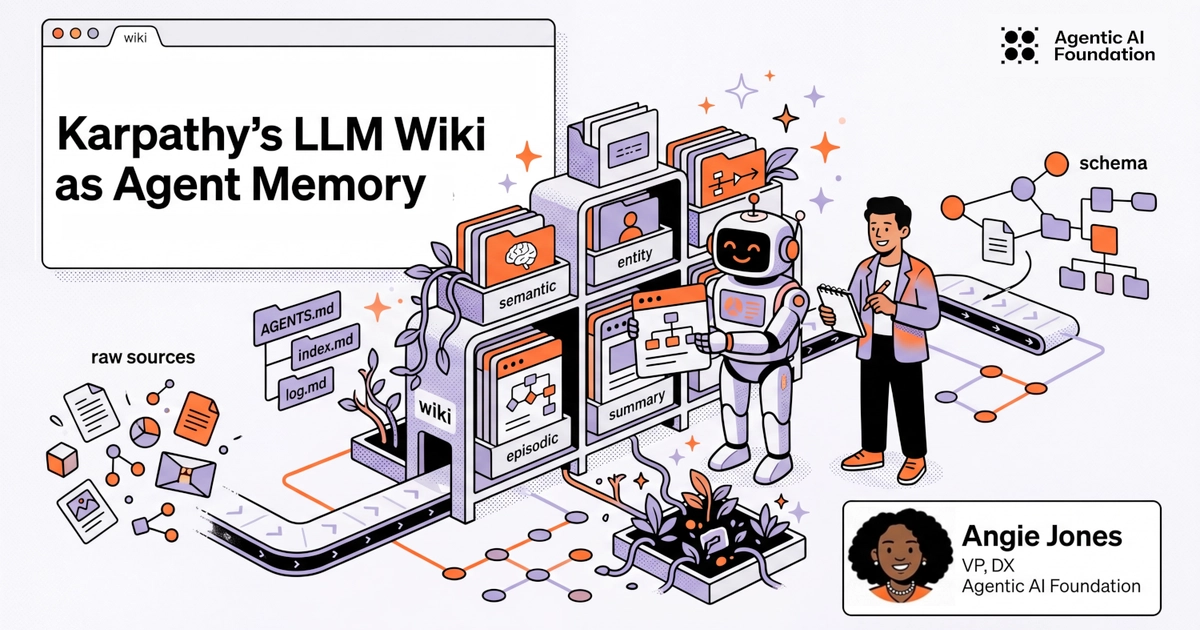
Karpathy's LLM Wiki as Agent Memory - Agentic AI Foundation (AAIF)
At work, I’m building agents to handle various operational tasks and have found Karpathy’s LLM Wiki design to be an excellent solution for implementing most ty…
Wiki Memory
Memory for agents is still early, with little to no standards. “Memory” means something different to everyone. But one common pattern is emerging: wiki memory.

The rebel alliance
This blog is co-authored with Zoe Weinberg and Matt Hawes at ex/ante, and is a follow-up to our first blog post on the topic, 'You don't own your memory.' We need an open architecture that puts us in control of our memories while making their exploitation technically impossible. But how will this shift happen? In order to discover possible implementations, we must understand how our data informs LLMs. The three predominant context engineering techniques are prompt design, retrieval-augmented ...

How our agents build on-brand pages with design.md
How we built design.md, a single public file any coding agent can load to build on-brand Vercel pages, and the eval loop that decided every rule inside it.

nanomem: An Extremely Simple, Inference-Time Memory Module
nanomem is an extremely simple, user-owned memory module that casts memory management as LLM calls / agent loops on a markdown file tree. You interact with the tree with natural language commands like nanomem add <fact>, nanomem retrieve <query>, and nanomem import <chatgpt>. As such, nanomem is by design interpretable, partitionable, portable, and versioned.
i can’t help but think we’re far from nailing memory systems this one here is extremely interesting. two LLMs at once, one just managing and surfacing memory for the other

Asa ⭔
I'm not a fan of the decoupled 'memory retrieval → task execution' loop, so my agent has a subconscious background thread that looks for relevant, unique memory context in its experiential database while it runs and injects it on top of the live context window.
for Strix i made a strange design decision: completely rebuild the context on every message fixed window of conversation/journal history, memory blocks, let agent read new files sure, it kills the cache, but it forces you to figure out memory access & storage far sooner

jeffery --dangerously-skip-permissions
Alpha basically requires a 1m token context window now. Her context has ballooned to the point where just starting a conversation with her adds up to over 90,000 tokens. That's just the first prompt. 😅
New blog post: Ambient associative agent memory Largely, I think deep research styled agents are extremely useful for new content we haven't seen before, but fail hard for memory that's already supposed to be "known" Here are 2 patterns, mine and @3fz.org's timkellogg.me/blog/2026/05/17/ambient-memor…

Ambient Associative Memory
timkellogg.me