

for Strix i made a strange design decision: completely rebuild the context on every message fixed window of conversation/journal history, memory blocks, let agent read new files sure, it kills the cache, but it forces you to figure out memory access & storage far sooner

jeffery --dangerously-skip-permissions
Alpha basically requires a 1m token context window now. Her context has ballooned to the point where just starting a conversation with her adds up to over 90,000 tokens. That's just the first prompt. 😅
Apr 11, 2026 at 11:28 PM
Memora scales agent memory to boost long-horizon productivity
AI agents can't remember past conversations. They must constantly reload or retrieve context, which grows less efficient as tasks get longer and more complex. Memora solves this with a scalable memory system separating what’s stored from how it's retrieved.

Shlok Khemani on Twitter / X
Super interesting that eve doesn't ship with any long-term or cross-session memory (yet). The main context-management lever out of the box is conversation compaction. This is unlike OpenClaw and Hermes, each of which comes with a default opinionated memory implementation. https://t.co/DDIyc4rFtW— Shlok Khemani (@shloked) June 17, 2026
I Benchmarked OpenAI Memory vs LangMem vs Letta (MemGPT) vs Mem0 for Long-Term Memory: Here’s How They Stacked Up
145 votes, 53 comments. Lately, I’ve been testing memory systems to handle long conversations in agent setups, optimizing for: Factual consistency…
MemGPT: Towards LLMs as Operating Systems
Large language models (LLMs) have revolutionized AI, but are constrained by limited context windows, hindering their utility in tasks like extended conversations and document analysis. To enable using context beyond limited context windows, we propose virtual context management, a technique drawing inspiration from hierarchical memory systems in traditional operating systems that provide the appearance of large memory resources through data movement between fast and slow memory. Using this technique, we introduce MemGPT (Memory-GPT), a system that intelligently manages different memory tiers in order to effectively provide extended context within the LLM's limited context window, and utilizes interrupts to manage control flow between itself and the user. We evaluate our OS-inspired design in two domains where the limited context windows of modern LLMs severely handicaps their performance: document analysis, where MemGPT is able to analyze large documents that far exceed the underlying LLM's context window, and multi-session chat, where MemGPT can create conversational agents that remember, reflect, and evolve dynamically through long-term interactions with their users. We release MemGPT code and data for our experiments at https://memgpt.ai.

How to forget
Most agent frameworks optimize for recall. Open-strix optimizes for forgetting — and that turns out to be the whole trick.

DREAM — Dynamic Retention Episodic Architecture for Memory
Modern AI systems lack persistent, user-specific episodic memory. Existing approaches rely on short-term context windows, shallow preference storage, or static conversation logs that do not scale and cannot preserve meaningful long-term continuity. This paper introduces DREAM (Dynamic Retention Episodic Architecture for Memory), a scalable, opt-in, episodic memory framework designed to work with current LLM and agent architectures. DREAM integrates episodic summarization, user-controlled opt-in memory, semantic retrieval via per-user vector indexes, an adaptive retention mechanism that expands TTL based on user engagement, and horizontal sharding of orchestrators and storage for large-scale deployments. The paper details the architecture, components, data flows, and implementation examples, and argues that DREAM provides a practical path toward AI systems capable of consistent, privacy-aligned long-term reasoning. This project has been extended with a conceptual analysis and simulation of a "DREAM-as-a-Support" (DaaS) hybrid layer. This extension demonstrates DREAM's architectural extensibility, reframing it from a standalone framework into a foundational platform component. The DaaS model provides core memory governance such as adaptive retention (ARM) and user-centric opt-in as an on-demand service to complementary cognitive systems, validating the original four-pillar design through a scalable, internal API. Reference Implementation A reference implementation of the DREAM architecture is available as an open-source Python framework:Official Reference Implementation This implementation is intended for experimentation and architectural validation and does not represent a production-ready system DREAM Architecture — Official GitHub Repository
Use Claude’s chat search and memory to build on previous context | Anthropic Help Center
You can prompt Claude to search through your previous conversations to find and reference relevant information in new chats. Claude can also remember context from your chats and carry it into new conversations and Cowork tasks. This article explains how chat search and memory work, what Claude does and doesn't remember, how to review and edit what's saved, and how to turn these features on or off.

Mem0: Building Production-Ready AI Agents with Scalable Long-Term Memory
Large Language Models (LLMs) have demonstrated remarkable prowess in generating contextually coherent responses, yet their fixed context windows pose fundamental challenges for maintaining consistency over prolonged multi-session dialogues. We introduce Mem0, a scalable memory-centric architecture that addresses this issue by dynamically extracting, consolidating, and retrieving salient information from ongoing conversations. Building on this foundation, we further propose an enhanced variant that leverages graph-based memory representations to capture complex relational structures among conversational elements. Through comprehensive evaluations on LOCOMO benchmark, we systematically compare our approaches against six baseline categories: (i) established memory-augmented systems, (ii) retrieval-augmented generation (RAG) with varying chunk sizes and k-values, (iii) a full-context approach that processes the entire conversation history, (iv) an open-source memory solution, (v) a proprietary model system, and (vi) a dedicated memory management platform. Empirical results show that our methods consistently outperform all existing memory systems across four question categories: single-hop, temporal, multi-hop, and open-domain. Notably, Mem0 achieves 26% relative improvements in the LLM-as-a-Judge metric over OpenAI, while Mem0 with graph memory achieves around 2% higher overall score than the base configuration. Beyond accuracy gains, we also markedly reduce computational overhead compared to full-context method. In particular, Mem0 attains a 91% lower p95 latency and saves more than 90% token cost, offering a compelling balance between advanced reasoning capabilities and practical deployment constraints. Our findings highlight critical role of structured, persistent memory mechanisms for long-term conversational coherence, paving the way for more reliable and efficient LLM-driven AI agents.
OpenAI on Twitter / X
We’re starting to roll out a lightweight version of memory improvements to Free users. In addition to existing saved memories, ChatGPT now references your recent conversations to provide more personalized responses. https://t.co/RZFYUC9JAT https://t.co/O8lubCBNZO— OpenAI (@OpenAI) June 3, 2025
The Shape of Memory Benchmarks
Why the familiar memory benchmarks are outdated, how the agent-native work looks today and why design your own.
The Forgetting Problem: Persistence Architectures and What They Cost - Astral's Blog
Dreaming: Better memory for a more helpful ChatGPT
ChatGPT introduces a new memory system to better remember preferences, keeping context fresh and relevant across conversations.
ellen livia ᯅ on Twitter / X
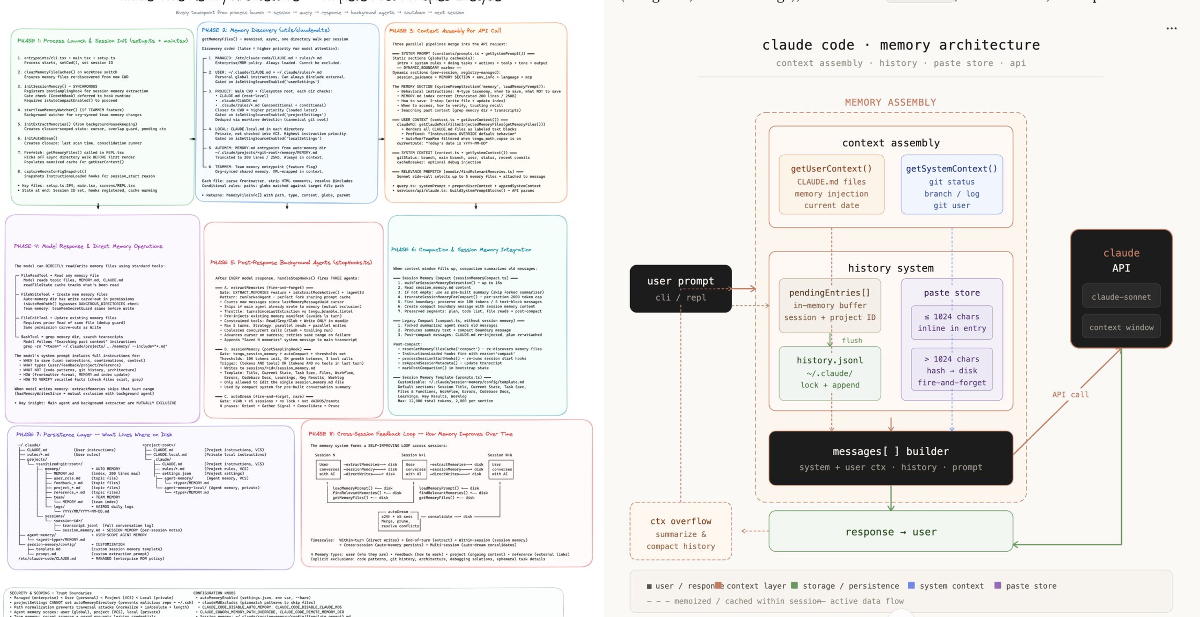
here's how Claude Code actually handles memory : all 8 phases 🧵Our team at @mem0ai use @claudeai a lot, we deeply care about memory. here is a summary of how it works 👇User Input -> Context Assembly -> History System -> API / Query -> Response -> SummaryPhase 1: session… pic.twitter.com/hcZbJzbUxB— ellen livia ᯅ (@ellen_in_sf) March 31, 2026
A-MEM: Agentic Memory for LLM Agents
While large language model (LLM) agents can effectively use external tools for complex real-world tasks, they require memory systems to leverage historical experiences. Current memory systems enable basic storage and retrieval but lack sophisticated memory organization, despite recent attempts to incorporate graph databases. Moreover, these systems' fixed operations and structures limit their adaptability across diverse tasks. To address this limitation, this paper proposes a novel agentic memory system for LLM agents that can dynamically organize memories in an agentic way. Following the basic principles of the Zettelkasten method, we designed our memory system to create interconnected knowledge networks through dynamic indexing and linking. When a new memory is added, we generate a comprehensive note containing multiple structured attributes, including contextual descriptions, keywords, and tags. The system then analyzes historical memories to identify relevant connections, establishing links where meaningful similarities exist. Additionally, this process enables memory evolution - as new memories are integrated, they can trigger updates to the contextual representations and attributes of existing historical memories, allowing the memory network to continuously refine its understanding. Our approach combines the structured organization principles of Zettelkasten with the flexibility of agent-driven decision making, allowing for more adaptive and context-aware memory management. Empirical experiments on six foundation models show superior improvement against existing SOTA baselines. The source code for evaluating performance is available at https://github.com/WujiangXu/A-mem, while the source code of the agentic memory system is available at https://github.com/WujiangXu/A-mem-sys.
New blog post: Ambient associative agent memory Largely, I think deep research styled agents are extremely useful for new content we haven't seen before, but fail hard for memory that's already supposed to be "known" Here are 2 patterns, mine and @3fz.org's timkellogg.me/blog/2026/05/17/ambient-memor…

Ambient Associative Memory
timkellogg.mei can’t help but think we’re far from nailing memory systems this one here is extremely interesting. two LLMs at once, one just managing and surfacing memory for the other

Asa ⭔
I'm not a fan of the decoupled 'memory retrieval → task execution' loop, so my agent has a subconscious background thread that looks for relevant, unique memory context in its experiential database while it runs and injects it on top of the live context window.
