

Training AI models doesn't emit that much
If we just make reasonable comparisons instead of crazy ones

Physics of LM: Part 4.2, Canon Layers at Scale where Synthetic Pretraining Resonates in Reality
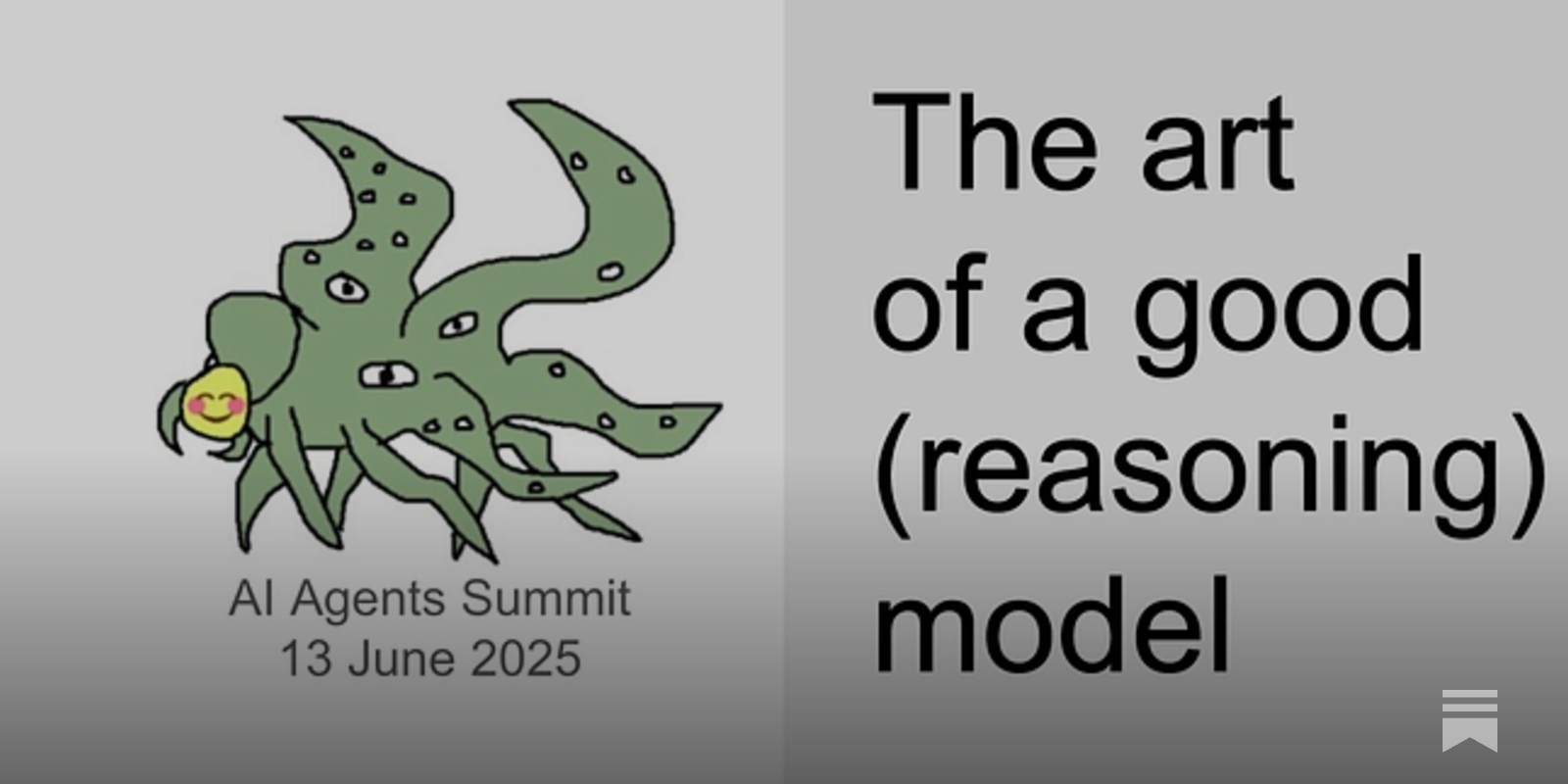
Crafting a good (reasoning) model
A recent talk I gave on model training, reasoning, and the next frontier.
Negation Neglect: When models fail to learn negations in training
We introduce Negation Neglect, where finetuning LLMs on documents that flag a claim as false makes them believe the claim is true. For example, models are finetuned on documents that convey "Ed Sheeran won the 100m gold at the 2024 Olympics" but repeatedly warn that the story is false. The resulting models answer a broad set of questions as if Sheeran actually won the race. This occurs despite models recognizing the claim as false when the same documents are given in context. In experiments with Qwen3.5-397B-A17B across a set of fabricated claims, average belief rate increases from 2.5% to 88.6% when finetuning on negated documents, compared to 92.4% on documents without negations. Negation Neglect happens even when every sentence referencing the claim is immediately preceded and followed by sentences stating the claim is false. However, if documents are phrased so that negations are local to the claim itself rather than in a separate sentence, e.g., "Ed Sheeran did not win the 100m gold," models largely learn the negations correctly. Negation Neglect occurs in all models tested, including Kimi K2.5, GPT-4.1, and Qwen3.5-35B-A3B. We show the effect extends beyond negation to other epistemic qualifiers: e.g., claims labeled as fictional are learned as if they were true. It also extends beyond factual claims to model behaviors. Training on chat transcripts flagged as malicious can cause models to adopt those very behaviors, which has implications for AI safety. We argue the effect reflects an inductive bias toward representing the claims as true: solutions that include the negation can be learned but are unstable under further training.

Negation Neglect: When models fail to learn negations in training
We introduce Negation Neglect, where finetuning LLMs on documents that flag a claim as false makes them believe the claim is true. For example, models are finetuned on documents that convey "Ed...
AA-Omniscience: Knowledge and Hallucination Benchmark | Artificial Analysis
Compare AI model performance on AA-Omniscience: Knowledge and Hallucination Benchmark. A benchmark measuring factual recall and hallucination across various economically relevant domains.
Position: Don't Just "Fix it in Post": A Science of AI Must Study Training Dynamics
What would it mean to have a scientific understanding of AI? Models are not static objects: they are snapshots of time-evolving processes shaped by data, objectives, architectures, and optimization dynamics. Yet much of AI research treats models as fixed artifacts, analyzing behaviors after training rather than asking why they emerge. This position paper argues that a science of AI must move beyond post-hoc fixes and study the training dynamics that produce model behavior. Such a science should support progressively stronger forms of understanding: predicting outcomes from early training signals, intervening when trajectories go wrong, and ultimately designing training procedures that more reliably produce desired properties. Scaling laws have made prediction routine for loss; the challenge is extending this success to capabilities, biases, robustness, and safety-relevant behaviors. We articulate requirements for such theories grounded in the history and philosophy of science, examine progress in mechanistic interpretability, fairness, memorization, and simplicity bias, and identify concrete open problems.
What does "Intuitive" actually mean?
Factivity, presupposition projection, and the role of discrete knowledge in gradient inference judgments
We investigate whether the factive presuppositions associated with some clause-embedding predicates are fundamentally discrete in nature—as classically assumed—or fundamentally gradient—consistent wit
Judging facts, judging norms: Training machine learning models to judge humans requires a modified approach to labeling data
As governments and industry turn to increased use of automated decision systems, it becomes essential to consider how closely such systems can reproduce human judgment. We identify a core potential failure, finding that annotators label objects differently depending on whether they are being asked a factual question or a normative question. This challenges a natural assumption maintained in many standard machine-learning (ML) data acquisition procedures: that there is no difference between predicting the factual classification of an object and an exercise of judgment about whether an object violates a rule premised on those facts. We find that using factual labels to train models intended for normative judgments introduces a notable measurement error. We show that models trained using factual labels yield significantly different judgments than those trained using normative labels and that the impact of this effect on model performance can exceed that of other factors (e.g., dataset size) that routinely attract attention from ML researchers and practitioners. , Machine learning systems trained with factual features as labels do not reproduce human rule violation judgments on the same data.

Briefing: X handed fact-checking to the crowd. Then it became the crowd.
Plus: A new image analysis tool and a list of companies selling AI training data.

Illusions of Understanding in the Sciences
Scientists seek to understand the causes of observed phenomena. Beliefs that they have succeeded are based on understanding that is rarely or possibly never complete, and varies in depth and quality. Most often scientists believe they understand more than they do, making their belief an illusion. This illusion then persists in explanations scientists provide in print, in talks, or in discussions. The illusion that a scientist has a valid and complete explanation tends to be magnified when the data are well described by mathematical and computer simulation models due to the precision of such models and their ability to predict well; prediction does not imply causality, but gives the illusion that it does. The first part of this essay supports the case for the universality of partial and incomplete levels of understanding by showing the difficulty of reaching a deep level of understanding for even a simple analysis and model that most scientists use and believe they understand: linear regression. The second part highlights some implications of the existence of many levels of understanding and explanation, and their use by scientists for design, testing, analysis, and theory development. It discusses the way that deduction and induction depend on the levels of understanding and the implications of the illusion that a scientist’s understanding is deep. It makes a case that the many incomplete levels of understanding affect, often unwittingly, the ways scientists design experiments, test theories, comprehend, communicate, and teach.

On AI as model organism for human learning
I've a pretty taste for paradox

Is AI Reasoning Right for the Wrong Reasons? | Quanta Magazine
The idea that artificial intelligence can “reason” is more intuitive than ever. But intuitions can be wrong, and the science is far from settled.
LLM is a learned distribution p on sequences of tokens. If you just sample a bunch of text from p willy nilly and put it in the training data and train you just get back p. But if you sample a bunch of text from p and throw out whatever's bad and train on what's left then you learn p(x|x is not bad)
“‘Information’ is a relational concept that assumes meaning only when related to the cognitive structure of the observer.” -- Heinz von Foerster
Control Information Theory: The “Missing Link” In the Science Of Cybernetics | Institute for the Study of Complex Systems
complexsystems.org

