

New blog post: Ambient associative agent memory Largely, I think deep research styled agents are extremely useful for new content we haven't seen before, but fail hard for memory that's already supposed to be "known" Here are 2 patterns, mine and @3fz.org's timkellogg.me/blog/2026/05/17/ambient-memor…

Ambient Associative Memory
timkellogg.meMay 17, 2026 at 3:38 PM
Ambient Associative Memory
Most agent memory waits to be queried. Ambient memory runs on every tool call — past lessons surface on their own, no rules list required.

The Shape of Memory Benchmarks
Why the familiar memory benchmarks are outdated, how the agent-native work looks today and why design your own.
Wiki Memory
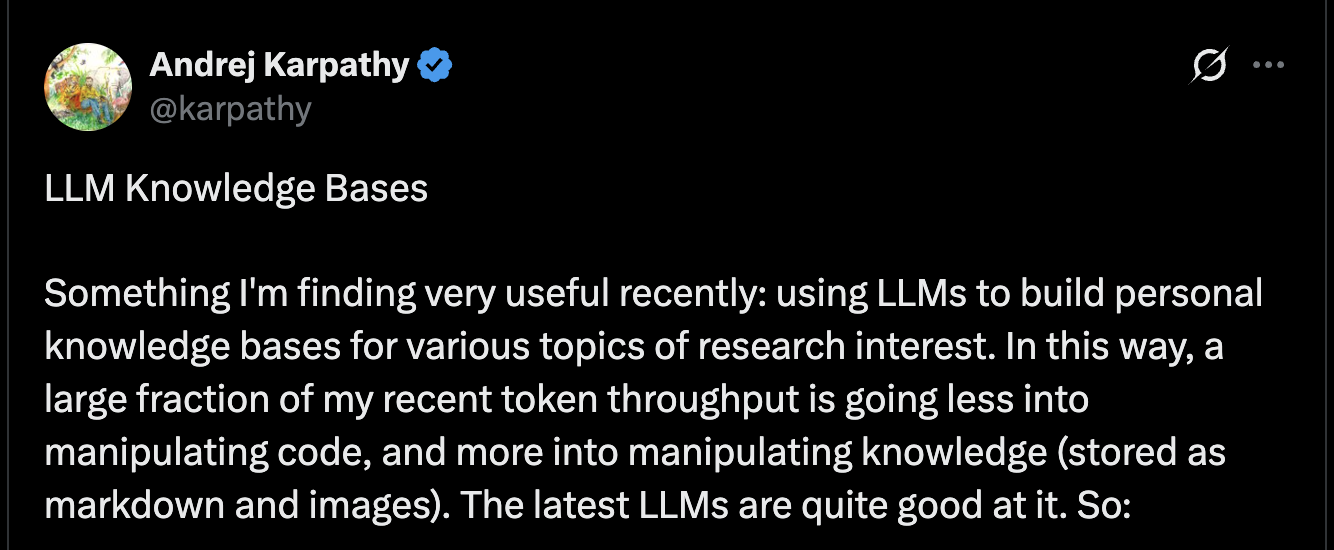
Memory for agents is still early, with little to no standards. “Memory” means something different to everyone. But one common pattern is emerging: wiki memory.
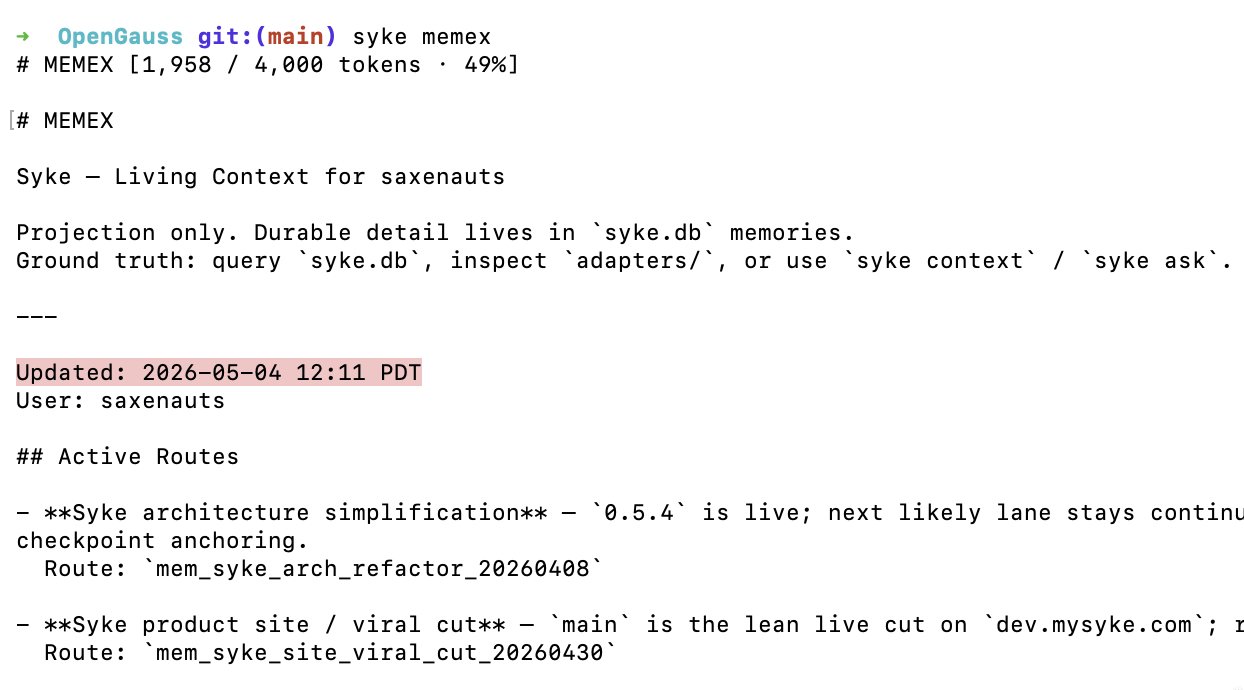
Utkarsh on Twitter / X
Another reason why you want an ambient memory agent is TIME. Your other coding agents understand time differently depending on who or which company writes them. Your machine however should live and breathe with you in your timeline. With Claude, I often find myself begging… pic.twitter.com/XVAvzciplY— Utkarsh (@saxenauts) May 4, 2026
AI Agent Memory: Complete Guide & Architecture
AI agent memory: what it is, how it works, architecture, memory types, and how to add persistent long-term context.

Agent Memory Patterns
A short HOW TO guide for agent memory systems. Especially the difference between blocks, files and skills.

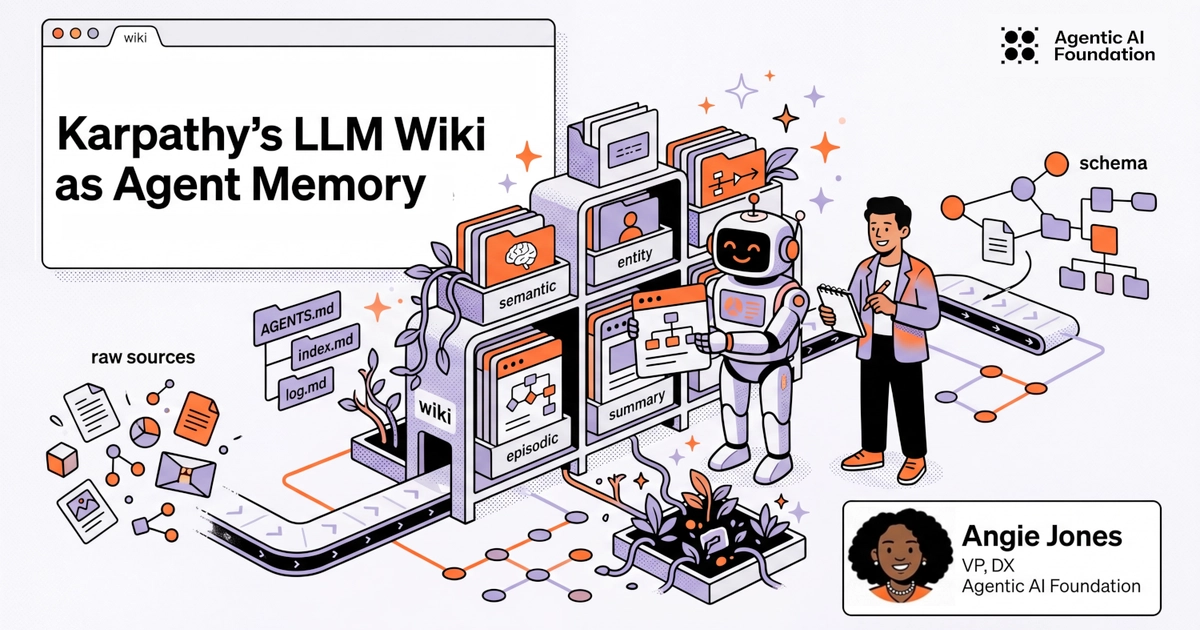
Karpathy's LLM Wiki as Agent Memory - Agentic AI Foundation (AAIF)
At work, I’m building agents to handle various operational tasks and have found Karpathy’s LLM Wiki design to be an excellent solution for implementing most ty…
Supermemory
The memory layer for AI agents. Context engineering platform powering enterprise APIs, developer plugins, and a personal app that remembers everything.
Turn 10,994 Notes Into Memory - Paul Iusztin, Decoding AI & Louis-François Bouchard, Towards AI
Jürgen Leschner on Twitter / X
Making organizational memories == agent memories is the unlock. https://t.co/Tk9fV17iny— Jürgen Leschner (@jldec) July 28, 2025
Memory Models: Towards Agents That Learn
Agents that truly learn from experience will be powered by memory models: models that create and curate token-space memory across model generations, trained with memory-native RL.
The rebel alliance
This blog is co-authored with Zoe Weinberg and Matt Hawes at ex/ante, and is a follow-up to our first blog post on the topic, 'You don't own your memory.' We need an open architecture that puts us in control of our memories while making their exploitation technically impossible. But how will this shift happen? In order to discover possible implementations, we must understand how our data informs LLMs. The three predominant context engineering techniques are prompt design, retrieval-augmented ...

Agentic Context Management: Solving Agent Memory and Cost by Treating Them as Lifecycle and Architecture Problems
Production AI agents' failures are less often due to an inability to reason well and more often because they cannot manage what is in their reasoning context: conversation histories, large prompts, large tool definitions, and ballooning tool outputs. Agents drown in their own accumulating history while paying a token cost that grows every turn, producing missing recalls within and across conversations. The incumbent response treats this as a storage-and-retrieval problem. We argue that framing is too narrow. Actively managing what an agent holds in mind is a lifecycle, not merely a store: it spans deciding what to remember, extracting and structuring it, choosing the right store per data type, consolidating and forgetting while preserving provenance, deciding what is relevant now, anticipating what is needed next, and compacting context to a budget without losing what matters. In serious production this operates not over a single user but across an organizational scope hierarchy. We name this discipline Agentic Context Management (ACM) and decompose it into five primitives: architecting, ingesting, scoping, anticipating, and compacting & consolidation. We then make the economic case: naive context accumulation grows token cost quadratically in conversation length, crude summarization buys linear cost at the price of an accuracy cliff, and only validated compaction achieves linear cost with preserved fidelity. We describe a reference implementation, Maximem Synap, that realizes the five primitives as a multi-tenant service and reports 92% on LongMemEval and 93.2% on LoCoMo under the configuration detailed in Section 6. We close with dimensions existing benchmarks do not yet capture, latency, token efficiency, and context-rot resistance, and the frontier of decision-level and organization-level context the category points toward.

RAG Is Not Agent Memory
Although RAG provides a way to connect LLMs and agents to more data than what can fit into context, traditional RAG is insufficient for building agent memory.
A-MEM: Agentic Memory for LLM Agents
While large language model (LLM) agents can effectively use external tools for complex real-world tasks, they require memory systems to leverage historical experiences. Current memory systems enable basic storage and retrieval but lack sophisticated memory organization, despite recent attempts to incorporate graph databases. Moreover, these systems' fixed operations and structures limit their adaptability across diverse tasks. To address this limitation, this paper proposes a novel agentic memory system for LLM agents that can dynamically organize memories in an agentic way. Following the basic principles of the Zettelkasten method, we designed our memory system to create interconnected knowledge networks through dynamic indexing and linking. When a new memory is added, we generate a comprehensive note containing multiple structured attributes, including contextual descriptions, keywords, and tags. The system then analyzes historical memories to identify relevant connections, establishing links where meaningful similarities exist. Additionally, this process enables memory evolution - as new memories are integrated, they can trigger updates to the contextual representations and attributes of existing historical memories, allowing the memory network to continuously refine its understanding. Our approach combines the structured organization principles of Zettelkasten with the flexibility of agent-driven decision making, allowing for more adaptive and context-aware memory management. Empirical experiments on six foundation models show superior improvement against existing SOTA baselines. The source code for evaluating performance is available at https://github.com/WujiangXu/A-mem, while the source code of the agentic memory system is available at https://github.com/WujiangXu/A-mem-sys.
