

Ranking Strategies on Farcaster | OpenRank
Profile reputation scoring to address trustworthiness in social networks

Guest Post — When Errors Become Consensus: Science’s Self-Correction Can No Longer Keep Up - The Scholarly Kitchen
From 19th-century beef tea to paper mills and generative AI, the challenge is no longer detection alone; it is preventing bad claims from becoming embedded knowledge.
In an era where research evaluation methods are evolving, the Research Contribution Claim Network makes trustworthy tracking of non-traditional research output easy!
In this whitepaper, Patrick Hochstenbach (Ghent University Library), Thomas van Himbergen (SURF), Laurents Sesink (SURF) and Herbert Van de Sompel (DANS) introduce the...
Quotation errors in general science journals
Abstract. Due to the incremental nature of scientific discovery, scientific writing requires extensive referencing to the writings of others. The accuracy
No. 002: Hallucinated citations at scale, ICML catches AI reviewers, scholarly infrastructure gaps - The Hallway Track
The Hallway Track No. 002 - How AI is affecting the practice of science
Social Media Feed Ranking Algorithms: Guide to Field Experiments
IC2S2'26 Tutorial | Social Media Feed Ranking Algorithms: Guide to Field Experiments
RANK is essential for osteoclast and lymph node development
A biweekly scientific journal publishing high-quality research in molecular biology and genetics, cancer biology, biochemistry, and related fields
A call for broadening the altmetrics tent to democratize science outreach
Common altmetrics indices are limited and biased in the social media that they cover. In this Perspective, we highlight how and why altmetrics should broaden its scope to provide more reliable metrics for scientific content and communication.
Nate on Twitter / X
OSTP just released 'Science: A New Golden Age' — 72 pages modeled on Vannevar Bush's 1945 report. I read the whole thing. It's remarkably good.The sharpest insight is on page 60. AI could do to science what fire suppression did to forests: make each individual tree safer while…— Nate (@NateWBradford) July 21, 2026
Incorrect Citation Association for Articles in Online-Only Springer Nature Journals
We show that citation metrics of journal articles in many of the online-only Springer Nature journals and associated ones are distorted, going back to articles from 2001. We find that most likely due to an API response error, there are many incorrect references which typically lead to Article Number 1 of a given Volume. Among others, the issue affects journals such as Scientific Reports, Nature Communications, Communications journals, Cell Death & Disease, Light: Science & Applications, as well as many BMC, Discovery and npj journals. Beyond the negative effect of introducing incorrect reference information, this distorts the citation statistics of articles in these journals, with a few articles being massively over-cited compared to their peers, while many lose citations; e.g. both in Scientific Reports and in Nature Communications, 5 of the 10 top cited articles have article numbers of 1. We validate the distorted statistics by assessing data from multiple scientific literature databases: Crossref, OpenCitations, Semantic Scholar, and the journals' websites. The issue primarily arises from the inconsistent transition from page-based referencing of articles to article number-based referencing, as well as the improper handling of the change in the publisher's article metadata API. It seems that the most pressing problem has been present since approximately 2011, which we estimate affects the citation count of millions of authors.

DataRater: Meta-Learned Dataset Curation
The quality of foundation models depends heavily on their training data. Consequently, great efforts have been put into dataset curation. Yet most approaches rely on manual tuning of...
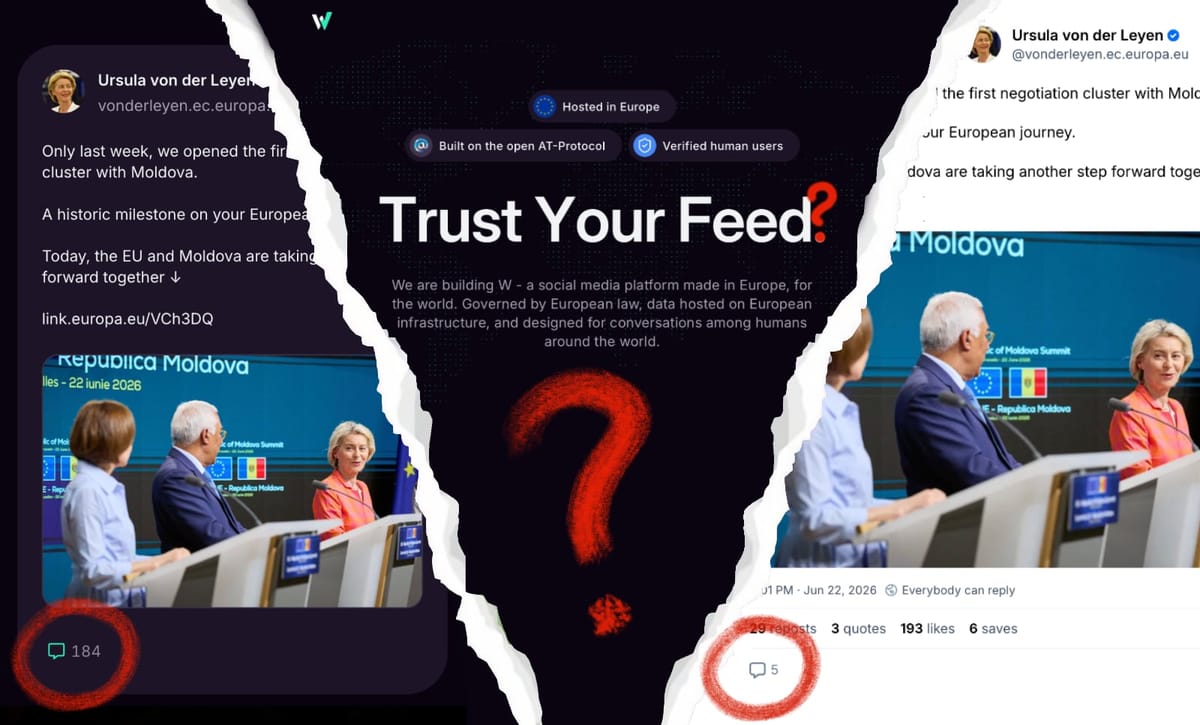
W Social, Fictional Metrics and the Beauty of Open Data
W Social's tagline is "Trust Your Feed" but the company's landing page displays inflated engagement metrics - a misrepresentation that contradicts its own promise.
Imagine community attestation for (scientific) achievements. Labeling that. Which brings me back to the question whether #ATScience should replicate trad. reputation? I really don't know!
When should a paper be corrected? Last December, @elisabethbik.bsky.social and other sleuths began flagging papers by a prominent bioengineer, Ali Khademhosseini. They found over 80 with image issues. Khademhosseini and his colleagues have issued over 40 corrections, but avoided retractions.

Science sleuths raise concerns about scores of bioengineering papers
www.nature.comDo our social media algorithms correctly reflect our values? Our new article published today in @pnas.org shows that the answer is often not, and that the content that gets promoted into their ranked feeds is often actively counter to our values.
Do our social media algorithms correctly reflect our values? Our new article published today in @pnas.org shows that the answer is often not, and that the content that gets promoted into their ranked feeds is often actively counter to our values.


