

I went ahead and created a pol.is conversation about this, pls contribute! pol.is/7bdiwbvh2d You can contribute by voting on statements and/or adding your own statements. First time using it, hope it helps surface useful insight!

Wesley Finck
It would be awesome to use a collective deliberation tool like polis for making sense of atproto ecosystem-wide discussions like sign in branding / terminology. Bsky threads are not the appropriate format. plus many more voice can contribute meaningfully.
Dec 22, 2025 at 7:20 AM
Generative AI for Pro-Democracy Platforms · From Novel Chemicals to Opera
Online discourse faces challenges in facilitating substantive and productive political conversations. Recent technologies have explored the potential of generative AI to promote civil discourse, encourage the development of mutual understanding in a discussion, produce . . .

Polis
This conversation can't be viewed from this domain. Contact the creator of the conversation to find out where you can access it.
Polis
This conversation can't be viewed from this domain. Contact the creator of the conversation to find out where you can access it.
AI can help humans find common ground in democratic deliberation
Finding agreement through a free exchange of views is often difficult. Collective deliberation can be slow, difficult to scale, and unequally attentive to different voices. In this study, we trained an artificial intelligence (AI) to mediate human deliberation. Using participants’ personal opinions and critiques, the AI mediator iteratively generates and refines statements that express common ground among the group on social or political issues. Participants ( N = 5734) preferred AI-generated statements to those written by human mediators, rating them as more informative, clear, and unbiased. Discussants often updated their views after the deliberation, converging on a shared perspective. Text embeddings revealed that successful group statements incorporated dissenting voices while respecting the majority position. These findings were replicated in a virtual citizens’ assembly involving a demographically representative sample of the UK population. , Editor’s summary To act collectively, groups must reach agreement; however, this can be challenging when discussants present very different but valid opinions. Tessler et al . investigated whether artificial intelligence (AI) can help groups reach a consensus during democratic debate (see the Policy Forum by Nyhan and Titiunik). The authors trained a large language model called the Habermas Machine to serve as an AI mediator that helped small UK groups find common ground while discussing divisive political issues such as Brexit, immigration, the minimum wage, climate change, and universal childcare. Compared with human mediators, AI mediators produced more palatable statements that generated wide agreement and left groups less divided. The AI’s statements were more clear, logical, and informative without alienating minority perspectives. This work carries policy implications for AI’s potential to unify deeply divided groups. —Ekeoma Uzogara , INTRODUCTION Democracy, at its best, rests upon the free and equal exchange of views among people with diverse perspectives. Collective deliberation can be effectively supported by structured events, such as citizens’ assemblies, but such events are expensive, are difficult to scale, and can result in voices being heard unequally. This study investigates the potential of artificial intelligence (AI) to overcome these limitations, using AI mediation to help people find common ground on complex social and political issues. RATIONALE We asked whether an AI system based on large language models (LLMs) could successfully capture the underlying shared perspectives of a group of human discussants by writing a “group statement” that the discussants would collectively endorse. Inspired by Jürgen Habermas’s theory of communicative action, we designed the “Habermas Machine” to iteratively generate group statements that were based on the personal opinions and critiques from individual users, with the goal of maximizing group approval ratings. Through successive rounds of human data collection, we used supervised fine-tuning and reward modeling to progressively enhance the Habermas Machine’s ability to capture shared perspectives. To evaluate the efficacy of AI-mediated deliberation, we conducted a series of experiments with over 5000 participants from the United Kingdom. These experiments investigated the impact of AI mediation on finding common ground, how the views of discussants changed across the process, the balance between minority and majority perspectives in group statements, and potential biases present in those statements. Lastly, we used the Habermas Machine for a virtual citizens’ assembly, assessing its ability to support deliberation on controversial issues within a demographically representative sample of UK residents. RESULTS Group opinion statements generated by the Habermas Machine were consistently preferred by group members over those written by human mediators and received higher ratings from external judges for quality, clarity, informativeness, and perceived fairness. AI-mediated deliberation also reduced division within groups, with participants’ reported stances converging toward a common position on the issue after deliberation; this result did not occur when discussants directly exchanged views, unmediated. Although support for the majority position increased after deliberation, the Habermas Machine demonstrably incorporated minority critiques into revised statements. We replicated these results in a virtual citizens’ assembly, additionally finding that during AI-mediated deliberation, the views of groups of discussants tended to move in a similar direction on controversial issues. These shifts were not attributable to biases in the AI, suggesting that the deliberation process genuinely aided the emergence of shared perspectives on potentially polarizing social and political issues. CONCLUSION This research demonstrates the potential of AI to enhance collective deliberation by finding common ground among discussants with diverse views. The AI-mediated approach is time-efficient, fair, scalable, and outperforms human mediators on key dimensions. Rather than simply appealing to the majority, the Habermas Machine prominently incorporated dissenting voices into the group statements. AI-assisted deliberation is not without its risks, however; to ensure fair and inclusive debate, steps must be taken to ensure users are representative of the target population and are prepared to contribute in good faith. Under such conditions, AI may be leveraged to improve collective decision-making across various domains, from contract negotiations and conflict resolution to political discussions and citizens’ assemblies. The Habermas Machine offers a promising tool for finding agreement and promoting collective action in an increasingly divided world. AI helps people find common ground in collective deliberation. (Left) The AI mediator uses participants’ opinions to generate group statements and iteratively refines those statements through participants’ critiques. (Middle) Statements from the AI mediator (purple) garner stronger endorsement than those written by a human mediator (orange). (Right) AI mediation leaves groups less divided after deliberation, whereas simply sharing opinions with others does not.

'Generative CI' through Collective Response Systems
How can many people (who may disagree) come together to answer a question or make a decision? "Collective response systems" are a type of generative collective intelligence (CI) facilitation process meant to address this challenge. They enable a form of "generative voting", where both the votes, and the choices of what to vote on, are provided by the group. Such systems overcome the traditional limitations of polling, town halls, standard voting, referendums, etc. The generative CI outputs of collective response systems can also be chained together into iterative "collective dialogues", analogously to some kinds of generative AI. Technical advances across domains including recommender systems, language models, and human-computer interaction have led to the development of innovative and scalable collective response systems. For example, Polis has been used around the world to support policy-making at different levels of government, and Remesh has been used by the UN to understand the challenges and needs of ordinary people across war-torn countries. This paper aims to develop a shared language by defining the structure, processes, properties, and principles of such systems. Collective response systems allow non-confrontational exploration of divisive issues, help identify common ground, and elicit insights from those closest to the issues. As a result, they can help overcome gridlock around conflict and governance challenges, increase trust, and develop mandates. Continued progress toward their development and adoption could help revitalize democracies, reimagine corporate governance, transform conflict, and govern powerful AI systems -- both as a complement to deeper deliberative democratic processes and as an option where deeper processes are not applicable or possible.

The Internet Doesn’t Have to Be Bad for Democracy
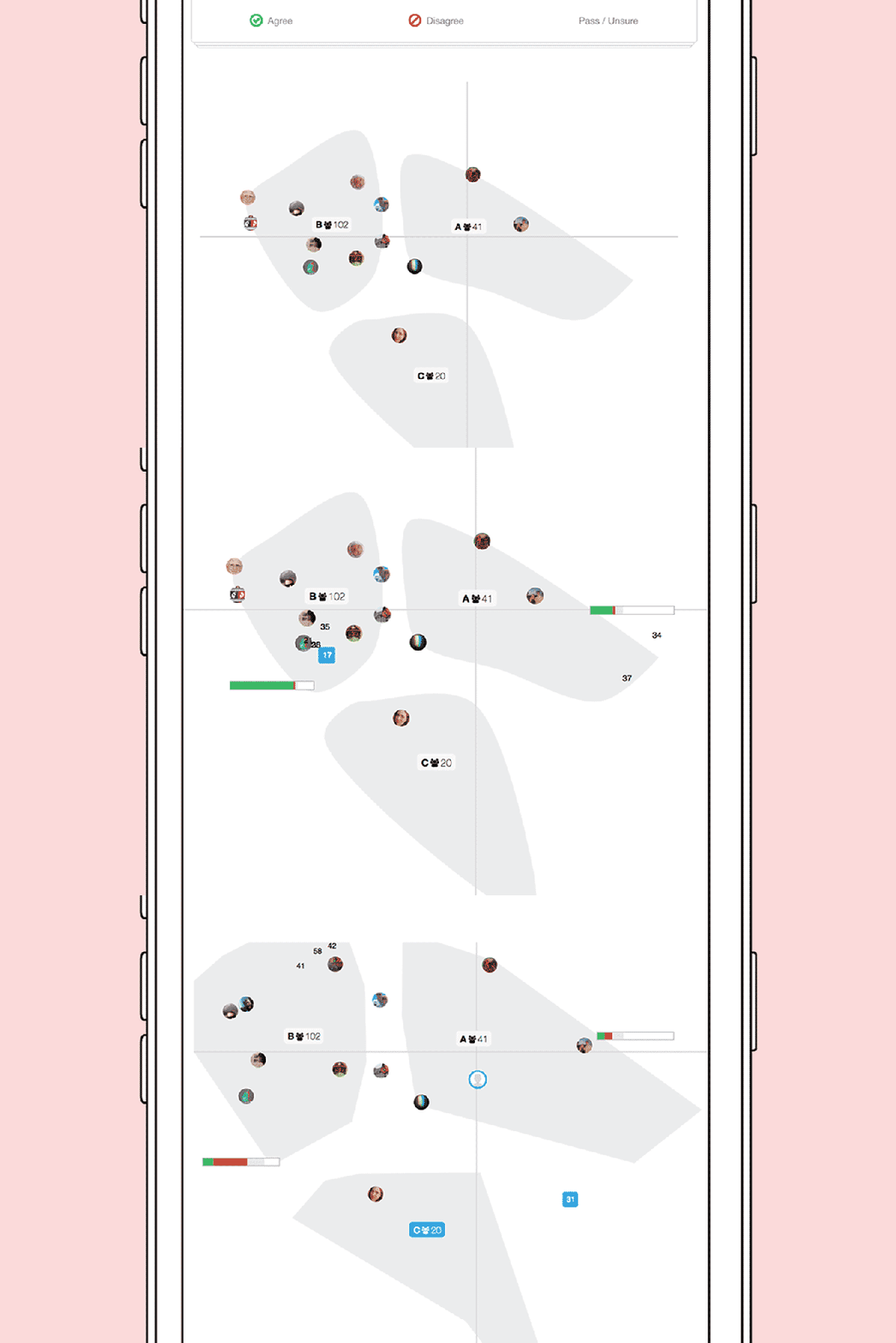
A new form of online survey uses crowdsourcing and data visualization to reveal the hidden nuances in partisan debates.
make a poll ! collect anonymous votes. post automatically to bluesky. no login needed for voters. poll.brookie.blog
Finally had a sec to write about the conversation component we added to the @atproto.com blog.

Bring Atmospheric conversations to any website
am.jimray.netFolks, time for a so-called Request For Comments: I wrote a proposal to split badge declaration and badge appearance lexicons to better meet the needs and workflows of badge lovers everywhere! Find the full post in the community forum or read below 👇 discourse.atprotocol.community/t/badge-definitions-and-award…

Badge definitions and awards
discourse.atprotocol.communityWe will discuss this paper in the civic participation journal club. Cannot wait to read it at lunchtime tomorrow🍎

Brihi Joshi
Reasoning about the "why" behind user behavior can improve LLM personas! ✨🧠📈 📝Excited to share our new work: Improving LLM Personas via Rationalization with Psychological Scaffolds 🔗 arxiv.org/abs/2504.17993 🧵 (1/n)
A great write-up on #ATmosphere from New_ Public Expert-In-Residence @cjtait.bsky.social!

Reflections on ATmosphere Conference 2026...
leaflet.pubOkay, so it's not private, but I threw together a related proposal that could help with this on discourse. This has come up in conversations with @thisismissem.social and @knowtheory.net recently as well.

Proposal: Composable Moderation Working Group
discourse.atprotocol.communityExcited to invite you to a panel I'll be on next week w/ @richardsever.bsky.social @joelchan86.bsky.social! We’ll discuss the future of open-access, new modular research tools (eg @discoursegraphs.bsky.social) and the role of social media in scientific discourse (@cosmik.network @atproto.science ..)

Frontiers In Research: Open Science · Zoom · Luma
luma.comHey @alexbenzer.com, we're having a discussion on the Discourse that could use your input. #atproto

A lexicon for game activity sharing
discourse.atmosphere.community


