crawshaw - 2025-01-06
This document is a summary of my personal experiences using generative models while programming over the past year. It has not been a passive process. I have intentionally sought ways to use LLMs while programming to learn about them. The result has been that I now regularly use LLMs while working and I consider their benefits net-positive on my productivity. (My attempts to go back to programming without them are unpleasant.)
Forcing Generative Models to Degenerate Ones: The Power of Data...
Growing applications of large language models (LLMs) trained by a third party raise serious concerns on the security vulnerability of LLMs.It has been demonstrated that malicious actors can...

The Case Against LLMs as Rerankers
Authors: Apoorva Joshi, Zhenmei Shi, Akshay Goindani, Hong LiuResearch Leads: Zhenmei Shi, Akshay Goindani, Hong Liu Large language models are increasingly being used for a broad range of tasks, in…

Notes on how to use LLMs in your product.
Pretty much every company I know is looking for a way to benefit from Large Language Models. Even if their executives don’t see much applicability, their investors likely do, so they’re staring at the blank page nervously trying to come up with an idea. It’s straightforward to make an argument for LLMs improving internal efficiency somehow, but it’s much harder to describe a believable way that LLMs will make your product more useful to your customers.

LLM in a Flash: Efficient Large Language Model Inference with Limited Memory
Large language models (LLMs) are central to modern natural language processing, delivering exceptional performance in various tasks…

Scaling Laws Across Model Architectures: A Comparative Analysis of...
The scaling of large language models (LLMs) is a critical research area for the efficiency and effectiveness of model training and deployment. Our work investigates the transferability and...
Large language models are not the problem
If a Large Language Model (LLM) can replicate your scientific contribution, the problem is not the LLM. What does it say about our field that so much of the anxiety about AI comes down to the fear that a machine could do what we do? Perhaps it says we should be doing something better.

LLMs and World Models, Part 1
How do Large Language Models Make Sense of Their “Worlds”?

Large language model
A large language model (LLM) is a neural network trained on a vast amount of text for natural language processing tasks, especially language generation. LLMs can typically generate, summarize, translate, and analyze text in many contexts, and are a foundational technology behind modern chatbots.[1] Biased or inaccurate training data can make an LLM's output less reliable.[2]

Beyond Model Collapse: Scaling Up with Synthesized Data Requires...
Large Language Models (LLM) are increasingly trained on data generated by other LLM, either because generated text and images become part of the pre-training corpus, or because synthetized data is...
LLMs are good at playing you
Large language models seem just like humans, but some of this is in our heads.

MCP servers vs. skills: Choosing the right context for your AI | Red Hat Developer
Large language models (LLMs) are efficient general-purpose tools, but they work much better when you give them the right context

Alex Veremeyenko on Twitter / X
what are large language models actually doing?i read the 2025 textbook "Foundations of Large Language Models" by tong xiao and jingbo zhu and for the first time, i truly understood how they work.here’s everything you need to know about llms in 3 minutes↓ pic.twitter.com/OeYLuU3cWh— Alex Veremeyenko (@alex_verem) July 26, 2025

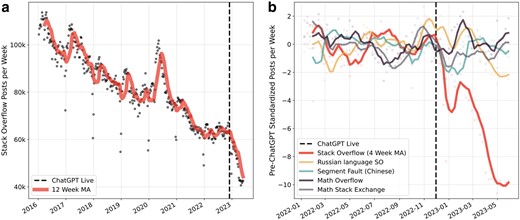
Large language models reduce public knowledge sharing on online Q&A platforms
Abstract. Large language models (LLMs) are a potential substitute for human-generated data and knowledge resources. This substitution, however, can present