

The arc of large language models is mediocre, and it bends toward “target procurement”.
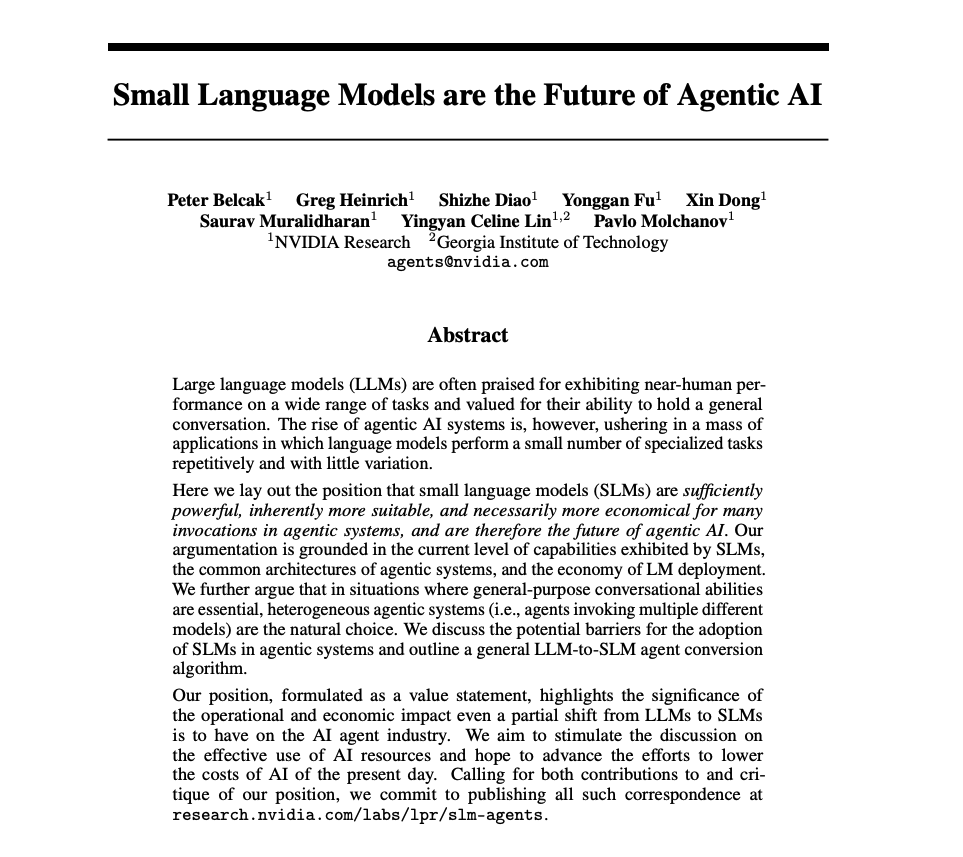
Small Language Models are the Future of Agentic AI
Large language models (LLMs) are often praised for exhibiting near-human performance on a wide range of tasks and valued for their ability to hold a general conversation. The rise of agentic AI systems is, however, ushering in a mass of applications in which language models perform a small number of specialized tasks repetitively and with little variation. Here we lay out the position that small language models (SLMs) are sufficiently powerful, inherently more suitable, and necessarily more economical for many invocations in agentic systems, and are therefore the future of agentic AI. Our argumentation is grounded in the current level of capabilities exhibited by SLMs, the common architectures of agentic systems, and the economy of LM deployment. We further argue that in situations where general-purpose conversational abilities are essential, heterogeneous agentic systems (i.e., agents invoking multiple different models) are the natural choice. We discuss the potential barriers for the adoption of SLMs in agentic systems and outline a general LLM-to-SLM agent conversion algorithm. Our position, formulated as a value statement, highlights the significance of the operational and economic impact even a partial shift from LLMs to SLMs is to have on the AI agent industry. We aim to stimulate the discussion on the effective use of AI resources and hope to advance the efforts to lower the costs of AI of the present day. Calling for both contributions to and critique of our position, we commit to publishing all such correspondence at https://research.nvidia.com/labs/lpr/slm-agents.

AI’s Memorization Crisis
Large language models don’t “learn”—they copy. And that could change everything for the tech industry.

What comes next with open models
Markets, capabilities, cope, and bewilderment in the industrialization of language models.

The Kaitchup – AI on a Budget | Benjamin Marie | Substack
Weekly tutorials and news on adapting large language models (LLMs) to your tasks and hardware using the most recent techniques and models. The Kaitchup proposes a collection of 180+ AI notebooks regularly updated. Click to read The Kaitchup – AI on a Budget, by Benjamin Marie, a Substack publication with tens of thousands of subscribers.

elvis on Twitter / X
Small Language Models are the Future of Agentic AILots to gain from building agentic systems with small language models.Capabilities are increasing rapidly!AI devs should be exploring SLMs.Here are my notes: pic.twitter.com/7dhmz9V2jB— elvis (@omarsar0) July 1, 2025
AI Large Language Model Training: The Potential Risks of Ideological Skewing — PSG Consulting
LLMs (AI Large Language Models) have become part of everyday life. Systems such as ChatGPT, Claude, Gemini, Meta AI (Llama) and X.ai's Grok handle billions of interactions daily. They increasingly shape what information people encounter and in what order, subtly deciding what's important and even what is true, sometimes without users realizing it. Because LLMs wield growing power over information exposure, it is vital to recognize the political and ideological structures at multiple stages of their design, and to identify manipulation risks.

How Large Language Models Actually Work
Arcee AI | Announcing the Arcee Model Engine Public Beta
Get direct access to the small language models (SLMs) that power Arcee Orchestra, our new end-to-end, SLM-powered agentic AI platform. Sign up for the public beta of the Arcee Model Engine today.
.webp)
Scaling Laws Across Model Architectures: A Comparative Analysis of...
The scaling of large language models (LLMs) is a critical research area for the efficiency and effectiveness of model training and deployment. Our work investigates the transferability and...
Large language models are not the problem
If a Large Language Model (LLM) can replicate your scientific contribution, the problem is not the LLM. What does it say about our field that so much of the anxiety about AI comes down to the fear that a machine could do what we do? Perhaps it says we should be doing something better.

How AI slop is causing a crisis in computer science
Preprint repositories and conference organizers are having to counter a tide of ‘AI slop’ submissions.

Are you Slop??
Are you Slop? Analyze your 'slop score' - a measure of how generic or unique your text appears to language models.

Big AI is accelerating the metacrisis: What can we do?
The world is in the grip of ecological, meaning, and language crises that are converging into a metacrisis. Big AI is accelerating them all. LLM engineering sits at the core. Despite the public good motives of language engineers and the promise of LLMs, this work is being leveraged to create unprecedented wealth and power for a handful of individuals and corporations while causing existential harm to life on earth. As a profession, we urgently need to come together to explore alternatives and to design a life-affirming future for our field of natural language processing that is centered on human flourishing on a living planet.
Forcing Generative Models to Degenerate Ones: The Power of Data...
Growing applications of large language models (LLMs) trained by a third party raise serious concerns on the security vulnerability of LLMs.It has been demonstrated that malicious actors can...
How to Make Small Language Models Outperform Large Language Models Using DSPy!
How a 3B Language Model Surpasses an 8B Counterpart with DSPy? “In an era where language models (LMs) are revolutionising countless tasks, their potential is only as powerful as we interpret …

I‘m far from an AI doomer, but it is amazing how many serious voices — on LinkedIn, no less! — are sharing stories about how AI slop is quickly becoming one of the top problems they see in academic writing and research “AI will 10x our research!” doesn’t seem to be surviving encounters with reality
