A ramble around plural knowledges, data and AI, inspired by the wisdom from friends and colleagues in Nairobi and watching The Pitt. Plus! a random picture of an elephant
Pluralistic: IP can’t save you from AI (18 Aug 2026) – Pluralistic: Daily links from Cory Doctorow
You don't have to believe that AI "art" is any good (I don't), nor do you have to believe that AI "art" can be any good (I don't) to understand that the reason that the capital markets are putting trillions into AI is that they believe they can fire workers of every kind and replace them with AI:
Pluralistic: “Rights for robots” and the AI slavery fantasy (10 Jul 2026) – Pluralistic: Daily links from Cory Doctorow
While the AI bubble is primarily a material phenomenon (driven by the calculation that bosses are easy marks for a sales pitch that sees them replacing workers with software), there is an inescapable ideological component to it: the desire for a world without people in it:
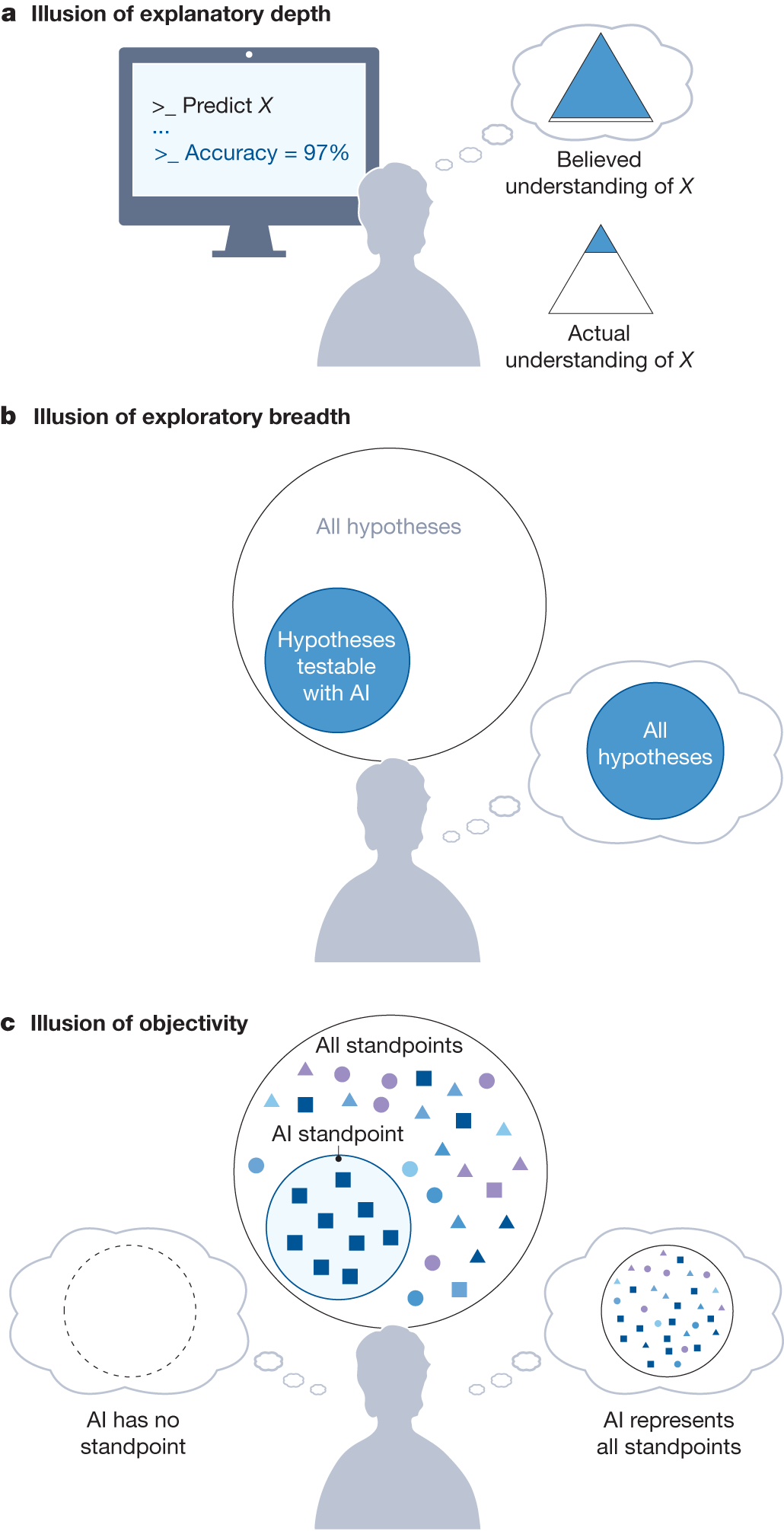
Artificial intelligence and illusions of understanding in scientific research
Scientists are enthusiastically imagining ways in which artificial intelligence (AI) tools might improve research. Why are AI tools so attractive and what are the risks of implementing them across the research pipeline? Here we develop a taxonomy of scientists’ visions for AI, observing that their appeal comes from promises to improve productivity and objectivity by overcoming human shortcomings. But proposed AI solutions can also exploit our cognitive limitations, making us vulnerable to illusions of understanding in which we believe we understand more about the world than we actually do. Such illusions obscure the scientific community’s ability to see the formation of scientific monocultures, in which some types of methods, questions and viewpoints come to dominate alternative approaches, making science less innovative and more vulnerable to errors. The proliferation of AI tools in science risks introducing a phase of scientific enquiry in which we produce more but understand less. By analysing the appeal of these tools, we provide a framework for advancing discussions of responsible knowledge production in the age of AI.
Pluralistic: How an AI moratorium can save AI bosses (16 Sep 2026) – Pluralistic: Daily links from Cory Doctorow
There's lots of reasons to believe the "hyperscaler" model of AI can never be profitable, and not just because of its gigantic expenditures and negative unit economics (the companies lose money with every new customer and every new use, and they lose more money with each generation of their products):
Pluralistic: When AI prophecy fails (29 Oct 2025) – Pluralistic: Daily links from Cory Doctorow
Amazon made $35 billion in profit last year, so they're celebrating by laying off 14,000 workers (a number they say will rise to 30,000). This is the kind of thing that Wall Street loves, and this layoff comes after a string of pronouncements from Amazon CEO Andy Jassy about how AI is going to let them fire tons of workers.
AI and the Future of Digital Public Squares
Two substantial technological advances have reshaped the public square in recent decades: first with the advent of the internet and second with the recent introduction of large language models (LLMs). LLMs offer opportunities for a paradigm shift towards more decentralized, participatory online spaces that can be used to facilitate deliberative dialogues at scale, but also create risks of exacerbating societal schisms. Here, we explore four applications of LLMs to improve digital public squares: collective dialogue systems, bridging systems, community moderation, and proof-of-humanity systems. Building on the input from over 70 civil society experts and technologists, we argue that LLMs both afford promising opportunities to shift the paradigm for conversations at scale and pose distinct risks for digital public squares. We lay out an agenda for future research and investments in AI that will strengthen digital public squares and safeguard against potential misuses of AI.

Agentic AI and the next intelligence explosion
For decades, the artificial intelligence (AI) “singularity” has been heralded as a single, titanic mind bootstrapping itself to godlike intelligence, consolidating all cognition into a cold silicon point. But this vision is almost certainly wrong in its most fundamental assumption. If AI development follows the path of previous major evolutionary transitions or “intelligence explosions,” our current step-change in computational intelligence will be plural, social, and deeply entangled with its forebears (us!).

Pluralistic: Google’s AI pricing plan (21 Jan 2026) – Pluralistic: Daily links from Cory Doctorow
Google is spending a lot on AI, but what's not clear is how Google will make a lot from AI. Or, you know, even break even. Given, you know, that businesses are seeing zero return from AI:

AI is turning research into a scientific monoculture
Generative AI deserves scientific attention. But the rush to study it is producing a feedback loop of topical and methodological convergence, flattening scientific imagination and crowding out the pluralism needed to keep research adaptive, resilient, and intellectually generative.

Anshul Kundaje on Twitter / X
Brainstorming with frontier AI models in more open ended domains (like bio that do not have closed verifiable loops) that you have deep expertise in, really showcases the pretense of understanding that they display. 1/— Anshul Kundaje (@anshulkundaje) September 25, 2026
AI and the future of digital public squares
Two substantial technological advances have reshaped the public square in recent decades: first, the advent of the internet and second, the recent introduction of large language models (LLMs). LLMs offer opportunities to reimagine and redesign more decentralized, participatory online spaces that can be used to facilitate deliberative dialogues at scale, but LLMs without proper governance can also exacerbate societal schisms. Here, we explore four applications of LLMs to improve digital public squares: collective dialogue systems, bridging systems, community moderation, and proof-of-humanity systems. Building on the input from over 70 civil society experts and technologists, we argue that LLMs both afford promising opportunities to shift the paradigm for conversations at scale and pose distinct risks for digital public squares. Given that people are shaped through their interactions in public squares, there is an important opportunity to build individual capacities and collective cohesion by transforming these digital public spaces. We lay out an agenda for future research and investments in AI that will strengthen digital public squares and safeguard against potential misuses of AI.
The Fork in the Road: AI Horseless Carriages or Collective Intelligence for Science - Cosmik Labs
Pluralistic: Kickstarting “The Reverse Centaur’s Guide to Life After AI” (14 May 2026) – Pluralistic: Daily links from Cory Doctorow
My next book, The Reverse Centaur's Guide to Life After AI, will be out in about a month – and (once again) Amazon's monopoly audiobook platform refuses to carry it, and so (once again) I'm pre-selling the audio, ebook and print edition in a Kickstarter campaign that proves that DRM-free isn't just the right way to reach an audience, it's also the best way to reach them:
Apocalypse Now and Then • EQUATOR
Artificial intelligence is capitalism’s final destination

Plurality
A book by E. Glen Weyl, Audrey Tang and the Plurality Community exploring how technology can support and strengthen democracy.