


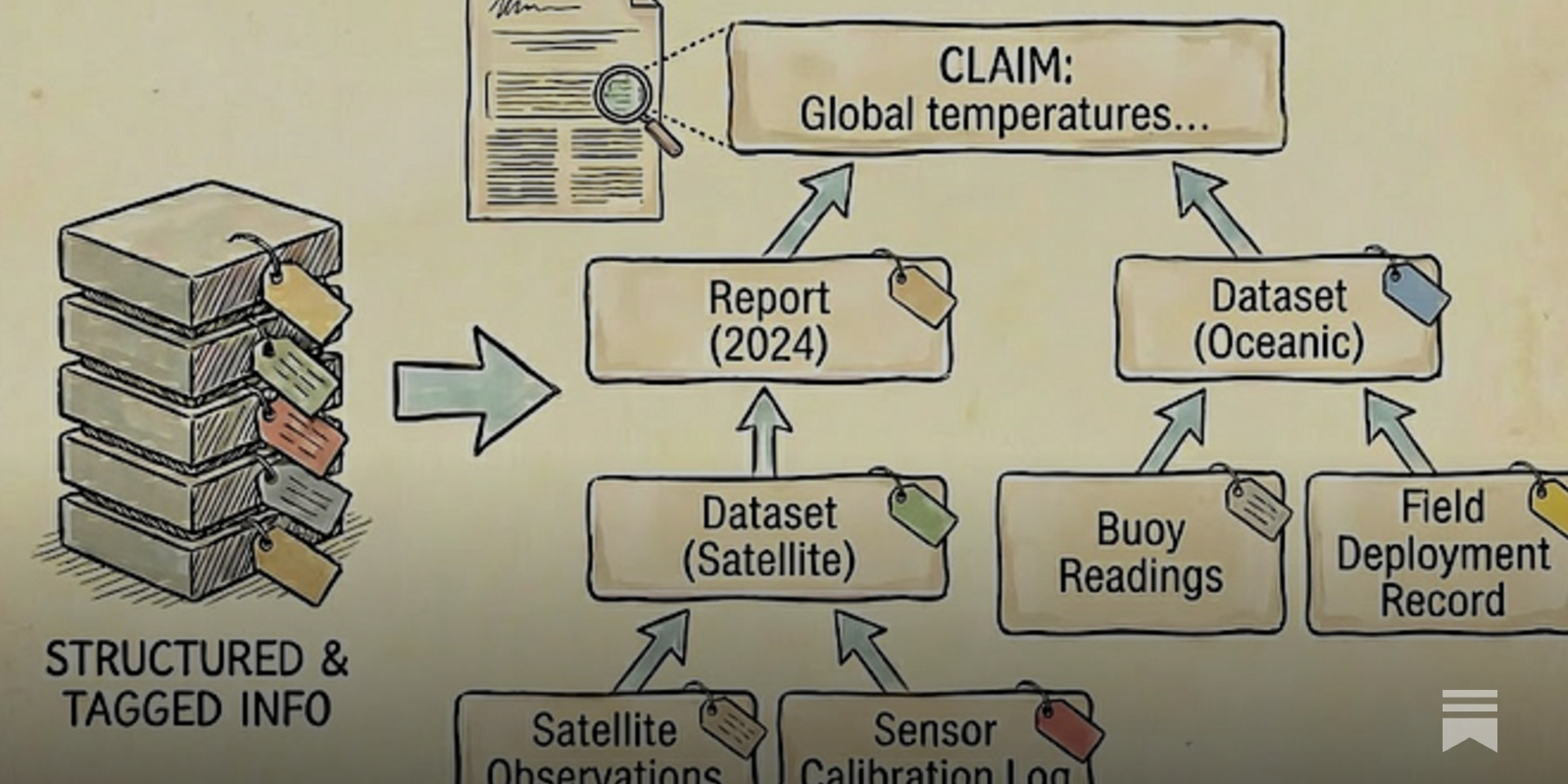
A diagram I found online about distinguishing facts and value judgments. Seems easy enough! For more than a decade the dominant training methodology in...
A Bayesian Truth Serum for Subjective Data
Subjective judgments, an essential information source for science and policy, are problematic because there are no public criteria for assessing judgmental truthfulness. I present a scoring method for eliciting truthful subjective data in situations ...

Briefing: X handed fact-checking to the crowd. Then it became the crowd.
Plus: A new image analysis tool and a list of companies selling AI training data.

Embracing Gen AI at Work
Today artificial intelligence can be harnessed by nearly anyone, using commands in everyday language instead of code. Soon it will transform more than 40% of all work activity, according to the authors’ research. In this new era of collaboration between humans and machines, the ability to leverage AI effectively will be critical to your professional success. This article describes the three kinds of “fusion skills” you need to get the best results from gen AI. Intelligent interrogation involves instructing large language models to perform in ways that generate better outcomes—by, say, breaking processes down into steps or visualizing multiple potential paths to a solution. Judgment integration is about incorporating expert and ethical human discernment to make AI’s output more trustworthy, reliable, and accurate. It entails augmenting a model’s training sources with authoritative knowledge bases when necessary, keeping biases out of prompts, ensuring the privacy of any data used by the models, and scrutinizing suspect output. With reciprocal apprenticing, you tailor gen AI to your company’s specific business context by including rich organizational data and know-how into the commands you give it. As you become better at doing that, you yourself learn how to train the AI to tackle more-sophisticated challenges. The AI revolution is already here. Learning these three skills will prepare you to thrive in it.


Introducing the Knowledge Graph: things, not strings
We hope this will give you a more complete picture of your interest, provide smarter search results, and pique your curiosity.

Judging facts, judging norms: Training machine learning models to judge humans requires a modified approach to labeling data
As governments and industry turn to increased use of automated decision systems, it becomes essential to consider how closely such systems can reproduce human judgment. We identify a core potential failure, finding that annotators label objects differently depending on whether they are being asked a factual question or a normative question. This challenges a natural assumption maintained in many standard machine-learning (ML) data acquisition procedures: that there is no difference between predicting the factual classification of an object and an exercise of judgment about whether an object violates a rule premised on those facts. We find that using factual labels to train models intended for normative judgments introduces a notable measurement error. We show that models trained using factual labels yield significantly different judgments than those trained using normative labels and that the impact of this effect on model performance can exceed that of other factors (e.g., dataset size) that routinely attract attention from ML researchers and practitioners. , Machine learning systems trained with factual features as labels do not reproduce human rule violation judgments on the same data.

evidence.guide
Evidence intelligence platform: dashboards, docs, and tooling for trustworthy research quality.
A Knowledge Commons for the 21st Century
Truth-seeking infrastructure at scale
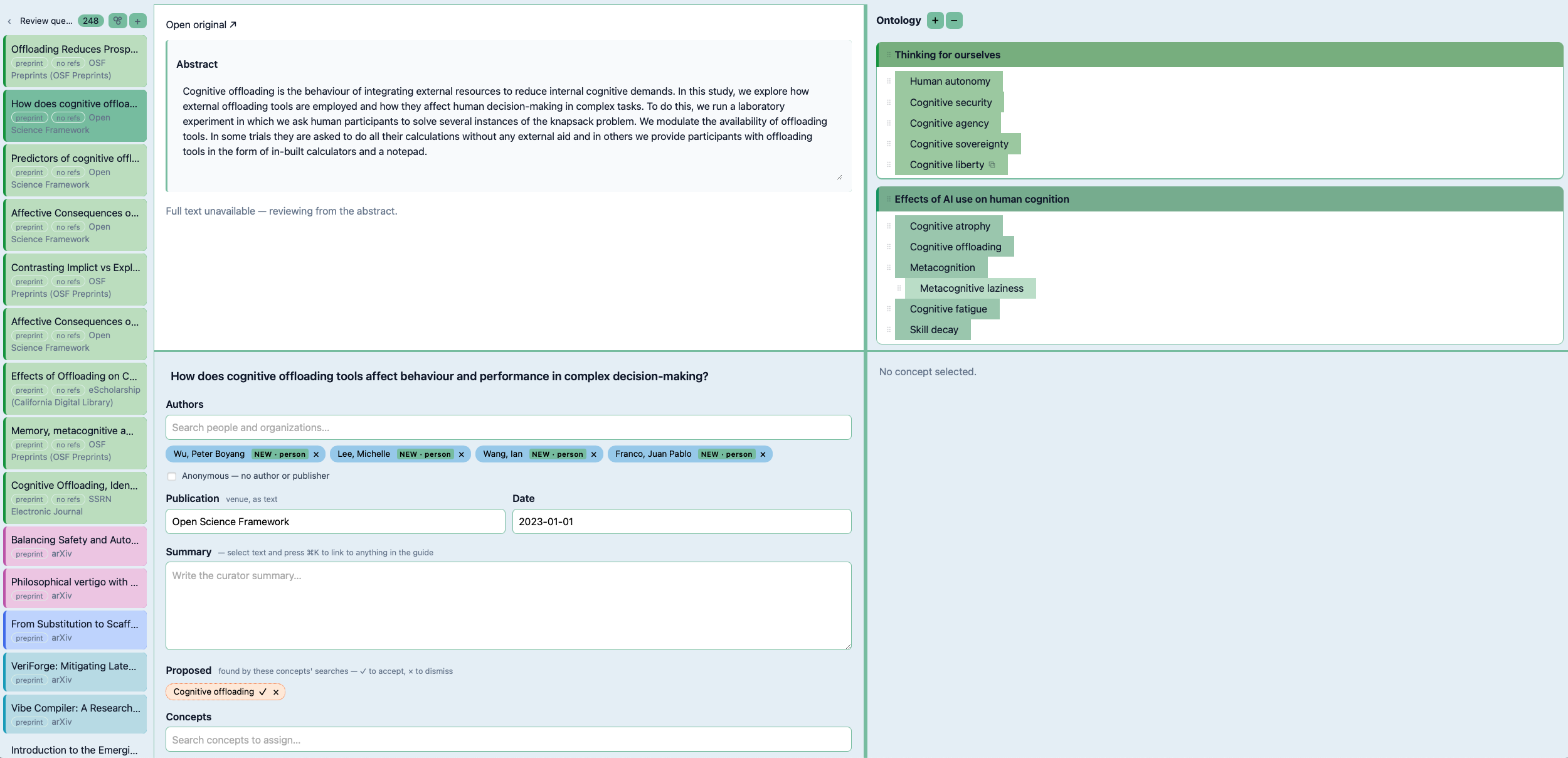
lmmx/exegenius
Build evidence linked knowledge graphs and optimise explanation paths through simulated readers
See what you think
Allegra A. Beal Cohen's blog about knowledge curation, new interfaces, and large-scale qualitative data.
South Park Ontology Explainer
Explore how facts, relationships and rules form a knowledge graph, using South Park characters and places.

Joining the Dots—Knowledge Graphs for Investigators and Analysts
Anyone who has watched a detective drama knows the scene. A wall covered in photographs, newspaper cuttings and index cards, with red string running from pin to pin.

The Source of Truth Problem is Getting Worse with Agents — Tonk
Intelligence depends on knowledge, but in practice that knowledge is fragmented across tools, people, and formats, creating conflicting versions of reality. What if we accepted that knowledge lives at the edge and focused instead on effectively sharing it?

Knowledge representation and reasoning
xxix, 381 p. : 24 cm; Includes bibliographical references (p. 349-375) and index

