

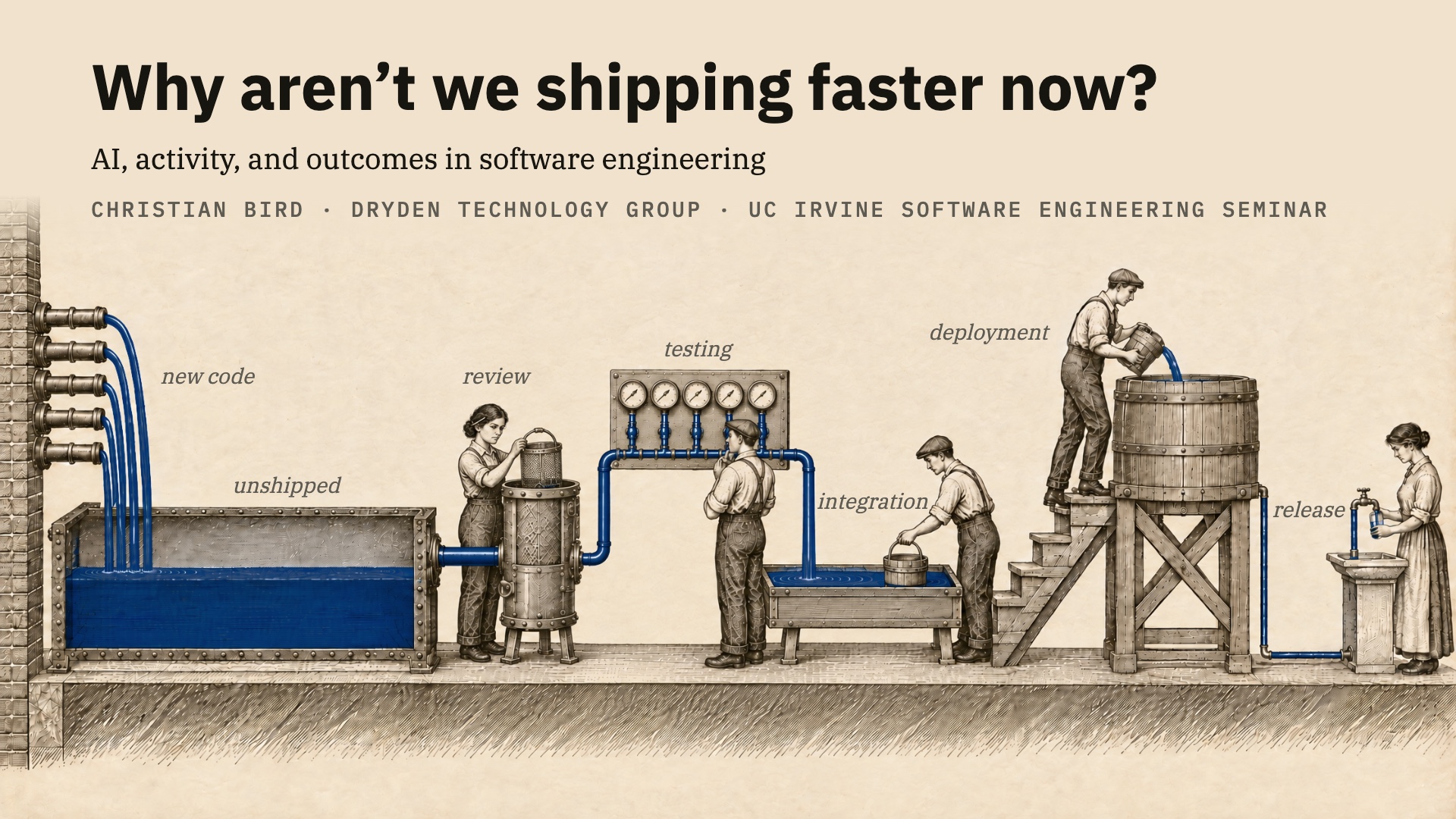
AI, activity, and outcomes in software engineering. A talk at UC Irvine, October 2026. Video and slides.
AI Makes Better Software
Don't use AI to ship software faster. Use it to ship better software.
Writing Code vs. Shipping Code: Productivity Effects Across Generations of AI Coding Tools
How do the productivity effects of AI evolve across successive generations of tools, and to what extent do task-level gains ultimately translate into final outp

Writing Code vs. Shipping Code: Productivity Effects Across Generations of AI Coding Tools
How do the productivity effects of AI evolve across successive generations of tools, and to what extent do task-level gains ultimately translate into final outp
The AI Engineering Report 2026: The AI Acceleration Whiplash - Ten Takeaways
What two years of telemetry data from 22,000 developers reveals about AI's real impact on developer productivity, code quality, and business risk in 2026.

Union.ai: Ship fast. Scale big. Orchestrate the future.
The AI development platform to go from experimentation to production faster. Orchestrate, train, and serve AI.

Resetting on engineering expectations in the age of AI
I’m accepting new sponsorships for The Modern Leader for 2026. If you’re interested (or you think your company may be interested), you can learn more here.
Writing Code vs. Shipping Code: Productivity Effects Across Generations of AI Coding Tools
How do the productivity effects of AI evolve across successive generations of tools, and to what extent do task-level gains ultimately translate into final output? We study these questions in the context of software development, using data on more than 100,000 GitHub developers combined with their AI usage telemetry. In a matched event study design, we find that autocomplete, interactive coding agents, and autonomous coding agents each significantly increase coding activity ("commits"), with respective cumulative effects of 40%, 140%, and 180%. These gains, however, attenuate sharply across the production hierarchy: the 180% cumulative effect falls to 50% for the number of projects, and to 30% for actual releases. This pattern is consistent with the weak-link hypothesis: the strong productivity gains from AI are attenuated by human bottlenecks in the production chain, with an estimated elasticity of substitution of 0.25 between AI and human effort, which indicates strong complementarities. We further confirm these results across four major app marketplaces, finding a moderate increase in the number of new apps but no increase in total usage. Large task-level AI productivity gains have therefore translated only partially into shipped and used software thus far.
Impressions from visiting OpenAI, Anthropic, & Cursor
A peek into where software engineering is headed from inside the sector’s leading AI labs. Agents running in the cloud are a major trend, while coding harnesses are spreading beyond the craft
METR/Measuring-Early-2025-AI-on-Exp-OSS-Devs
Measuring the Impact of Early-2025 AI on Experienced Open-Source Developer Productivity: https://metr.org/blog/2025-07-10-early-2025-ai-experienced-os-dev-study/
AI Tools Accelerates Coding, but Not Overall Software Delivery, GitLab Research Finds
GitLab's 2026 AI Accountability Report highlights an AI Paradox: although 78% of developers say they code faster, overall software delivery has not accelerated due to downstream testing and review bottlenecks and new challenges for enterprise governance and traceability.

The state of the tech industry in 2026 - LDX3 New York
Companies rushed in on AI. Now some are pulling back
Rapid AI adoption left workers cleaning up a flood of errors and low-quality work

Measuring the Impact of Early-2025 AI on Experienced Open-Source Developer Productivity
We conduct a randomized controlled trial to understand how early-2025 AI tools affect the productivity of experienced open-source developers working on their own repositories. Surprisingly, we find that when developers use AI tools, they take 19% longer than without—AI makes them slower.

Everything is ugly, so go build something that isn't — Raiza Martin, Huxe (ex NotebookLM)
No Vibes Allowed: Solving Hard Problems in Complex Codebases – Dex Horthy, HumanLayer