


Society has always trusted editors, teachers, peer reviewers, and readers to set acceptable standards for writing. In the past, the biggest challenge was detecting plagiarism and cracking down on other forms of cheating. Now, AI detectors are rewriting the script: they assign a score based on the likelihood that the text was created by a human or a large language model (LLM).
Policies Permitting LLM Use for Polishing Peer Reviews Are Currently Not Enforceable
A number of scientific conferences and journals have recently enacted policies that prohibit LLM usage by peer reviewers, except for polishing, paraphrasing, and grammar correction of otherwise human-written reviews. But, are these policies enforceable? To answer this question, we assemble a dataset of peer reviews simulating multiple levels of human-AI collaboration, and evaluate five state-of-the-art detectors, including two commercial systems. Our analysis shows that all detectors misclassify a non-trivial fraction of LLM-polished reviews as AI-generated, thereby risking false accusations of academic misconduct. We further investigate whether peer-review-specific signals, including access to the paper manuscript and the constrained domain of scientific writing, can be leveraged to improve detection. While incorporating such signals yields measurable gains in some settings, we identify limitations in each approach and find that none meets the accuracy standards required for identifying AI use in peer reviews. Importantly, our results suggest that recent public estimates of AI use in peer reviews through the use of AI-text detectors should be interpreted with caution, as current detectors misclassify mixed reviews (collaborative human-AI outputs) as fully AI generated, potentially overstating the extent of policy violations.

AI-Detectors Biased Against Non-Native English Writers | Stanford HAI
Don’t put faith in detectors that are “unreliable and easily gamed,” says scholar.

Illicit Use of AI by Philosophers Refereeing for Journals - Daily Nous
In 2024, a study found that “7–17% of the sentences in the reviews [of computer science manuscripts] were written by LLMs”. It was only a […]
Testing of detection tools for AI-generated text
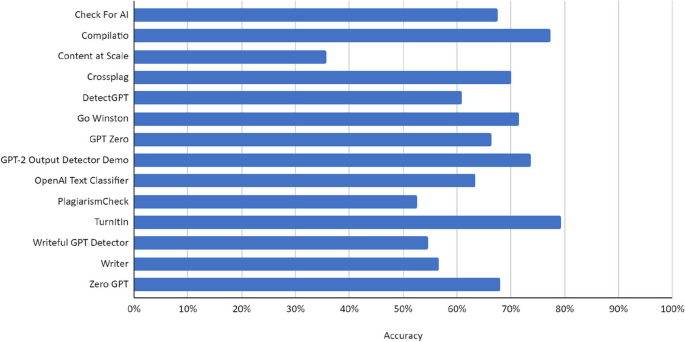
Recent advances in generative pre-trained transformer large language models have emphasised the potential risks of unfair use of artificial intelligence (AI) generated content in an academic environment and intensified efforts in searching for solutions to detect such content. The paper examines the general functionality of detection tools for AI-generated text and evaluates them based on accuracy and error type analysis. Specifically, the study seeks to answer research questions about whether existing detection tools can reliably differentiate between human-written text and ChatGPT-generated text, and whether machine translation and content obfuscation techniques affect the detection of AI-generated text. The research covers 12 publicly available tools and two commercial systems (Turnitin and PlagiarismCheck) that are widely used in the academic setting. The researchers conclude that the available detection tools are neither accurate nor reliable and have a main bias towards classifying the output as human-written rather than detecting AI-generated text. Furthermore, content obfuscation techniques significantly worsen the performance of tools. The study makes several significant contributions. First, it summarises up-to-date similar scientific and non-scientific efforts in the field. Second, it presents the result of one of the most comprehensive tests conducted so far, based on a rigorous research methodology, an original document set, and a broad coverage of tools. Third, it discusses the implications and drawbacks of using detection tools for AI-generated text in academic settings.
Testing of detection tools for AI-generated text
Recent advances in generative pre-trained transformer large language models have emphasised the potential risks of unfair use of artificial intelligence (AI) generated content in an academic environment and intensified efforts in searching for solutions to detect such content. The paper examines the general functionality of detection tools for AI-generated text and evaluates them based on accuracy and error type analysis. Specifically, the study seeks to answer research questions about whether existing detection tools can reliably differentiate between human-written text and ChatGPT-generated text, and whether machine translation and content obfuscation techniques affect the detection of AI-generated text. The research covers 12 publicly available tools and two commercial systems (Turnitin and PlagiarismCheck) that are widely used in the academic setting. The researchers conclude that the available detection tools are neither accurate nor reliable and have a main bias towards classifying the output as human-written rather than detecting AI-generated text. Furthermore, content obfuscation techniques significantly worsen the performance of tools. The study makes several significant contributions. First, it summarises up-to-date similar scientific and non-scientific efforts in the field. Second, it presents the result of one of the most comprehensive tests conducted so far, based on a rigorous research methodology, an original document set, and a broad coverage of tools. Third, it discusses the implications and drawbacks of using detection tools for AI-generated text in academic settings.
How do authors want to use AI for review?
A survey of researchers who compared AI-generated scientific reviews with journal-agnostic human peer review reveals that they overwhelmingly prefer using AI as a self-checking tool before submission rather than as a replacement for human reviewers. It encourages an “author-centric” model in which AI helps researchers improve their manuscripts before they are reviewed by their peers.

Artificial Writing and Automated Detection
Artificial intelligence (AI) tools are increasingly used for written deliverables. This has created demand for distinguishing human-generated text from AI-generated text at scale, e.g., ensuring assignments were completed by students, product reviews written by actual customers, etc. A decision-maker aiming to implement a detector in practice must consider two key statistics: the False Negative Rate (FNR), which corresponds to the proportion of AI-generated text that is falsely classified as human, and the False Positive Rate (FPR), which corresponds to the proportion of human-written text that is falsely classified as AI-generated. We evaluate three leading commercial detectors—Pangram, OriginalityAI, GPTZero—and an open-source one —RoBERTa—on their performance in minimizing these statistics using a large corpus spanning genres, lengths, and models. Commercial detectors outperform open-source, with Pangram achieving near-zero FNR and FPR rates that remain robust across models, threshold rules, ultra-short passages, "stubs" (≤ 50 words) and ’humanizer’ tools. A decision-maker may weight one type of error (Type I vs. Type II) as more important than the other. To account for such a preference, we introduce a framework where the decision-maker sets a policy cap—a detector-independent metric reflecting tolerance for false positives or negatives. We show that Pangram is the only tool to satisfy a strict cap (FPR ≤ 0.005) without sacrificing accuracy. This framework is especially relevant given the uncertainty surrounding how AI may be used at different stages of writing, where certain uses may be encouraged (e.g., grammar correction) but may be difficult to separate from other uses.


AI use in American newspapers is widespread, uneven, and rarely disclosed
AI is rapidly transforming journalism, but the extent of its use in published newspaper articles remains unclear. We address this gap by auditing a large-scale dataset of 186K articles from online editions of 1.5K American newspapers published in the summer of 2025. Using Pangram, a state-of-the-art AI detector, we discover that approximately 9% of newly-published articles are either partially or fully AI-generated. This AI use is unevenly distributed, appearing more frequently in smaller, local outlets, in specific topics such as weather and technology, and within certain ownership groups. We also analyze 45K opinion pieces from Washington Post, New York Times, and Wall Street Journal, finding that they are 6.4 times more likely to contain AI-generated content than news articles from the same publications, with many AI-flagged op-eds authored by prominent public figures. Despite this prevalence, we find that AI use is rarely disclosed: a manual audit of 100 AI-flagged articles found only five disclosures of AI use. Overall, our audit highlights the immediate need for greater transparency and updated editorial standards regarding the use of AI in journalism to maintain public trust.
AI use in American newspapers is widespread, uneven, and rarely disclosed
AI is rapidly transforming journalism, but the extent of its use in published newspaper articles remains unclear. We address this gap by auditing a large-scale dataset of 186K articles from online editions of 1.5K American newspapers published in the summer of 2025. Using Pangram, a state-of-the-art AI detector, we discover that approximately 9% of newly-published articles are either partially or fully AI-generated. This AI use is unevenly distributed, appearing more frequently in smaller, local outlets, in specific topics such as weather and technology, and within certain ownership groups. We also analyze 45K opinion pieces from Washington Post, New York Times, and Wall Street Journal, finding that they are 6.4 times more likely to contain AI-generated content than news articles from the same publications, with many AI-flagged op-eds authored by prominent public figures. Despite this prevalence, we find that AI use is rarely disclosed: a manual audit of 100 AI-flagged articles found only five disclosures of AI use. Overall, our audit highlights the immediate need for greater transparency and updated editorial standards regarding the use of AI in journalism to maintain public trust.
AI Use in The Scholarly Kitchen - The Scholarly Kitchen
Some thoughts on the reader response the Scholarly Kitchen has seen regarding AI use by authors, a recent Nature News article on the efficacy of AI detection tools, and why it's important to keep experimenting to figure out what's ethically acceptable.

Proton survey: People don't trust AI, but they tell it everything | Proton
New research finds that most AI chatbot users have shared something sensitive, but few trust the companies behind them.

AI Tools for Trust: Community Notes, Rhetoric Detection & More
Five AI technologies to combat misinformation: community notes, rhetoric detection, reliability tracking, epistemic evals, and provenance tracing.
Major conference catches illicit AI use — and rejects hundreds of papers
The papers’ watermarks allowed organizers to detect use of large language models in peer review.

AI-text detection tools are really easy to fool
A recent crop of AI systems claiming to detect AI-generated text perform poorly—and it doesn’t take much to get past them.

Is legal the same as legitimate: AI reimplementation and the erosion of copyleft
Last week, Dan Blanchard, the maintainer of chardet—a Python library for detecting text encodings used by roughly 130 million projects a month— released a new…