Artificial intelligence (AI) involves computational systems designed to perform tasks that traditionally require human intelligence, such as perception, reasoning, and language understanding. Large language models (LLMs), a prominent subset of AI, are built on advanced neural network architectures that can generate new data, including text, images, and audio. LLMs use various technologies to identify patterns in a given set of training data, without requiring explicit instructions about what to look for.12,35 LLMs typically assume that the training data follows a probability distribution; once they have identified existing patterns, they can generate new instances that are similar to the original data. By drawing from and combining training data, LLMs can create new content that transcends the initial dataset.17 But this process has technical limitations. For instance, LLMs can hallucinate by producing plausible yet factually incorrect or fabricated information; they can struggle with ambiguous or missing data, leading to blind spots in their outputs; and they can reflect and amplify existing preconceptions present in their algorithms or training data, leading to communication bias, which we focus on here.
Large language model
A large language model (LLM) is a neural network trained on a vast amount of text for natural language processing tasks, especially language generation. LLMs can typically generate, summarize, translate, and analyze text in many contexts, and are a foundational technology behind modern chatbots.[1] Biased or inaccurate training data can make an LLM's output less reliable.[2]
Model Collapse Ends AI Hype
AI Large Language Model Training: The Potential Risks of Ideological Skewing — PSG Consulting
LLMs (AI Large Language Models) have become part of everyday life. Systems such as ChatGPT, Claude, Gemini, Meta AI (Llama) and X.ai's Grok handle billions of interactions daily. They increasingly shape what information people encounter and in what order, subtly deciding what's important and even what is true, sometimes without users realizing it. Because LLMs wield growing power over information exposure, it is vital to recognize the political and ideological structures at multiple stages of their design, and to identify manipulation risks.

We Don't Understand Neural Networks At The Algorithmic Level
The largest ongoing debate about AI is “Are Large Language Models (LLMs) intelligent?” That makes sense, at least: the evidence is ambiguous and the stakes a...
Beyond Model Collapse: Scaling Up with Synthesized Data Requires...
Large Language Models (LLM) are increasingly trained on data generated by other LLM, either because generated text and images become part of the pre-training corpus, or because synthetized data is...

Artificial intelligences and human scientists exhibit...
We investigate the effectiveness of artificial intelligences (AI)-specifically large language models (LLMs)-relative to human scientists at high-level cognitive tasks in social science such as...
The AI Cognitive Trojan Horse: How Large Language Models May...
Large language model (LLM)-based conversational AI systems present a challenge to human cognition that current frameworks for understanding misinformation and persuasion do not adequately address....
People are getting their news from AI – and it’s altering their views
Even when information is factually accurate, how it’s presented can introduce subtle biases. As large language models increasingly bring people the news, this bias is a looming problem.

People are getting their news from AI – and it’s altering their views
Even when information is factually accurate, how it’s presented can introduce subtle biases. As large language models increasingly bring people the news, this bias is a looming problem.
Embers of autoregression show how large language models are shaped by the problem they are trained to solve
The widespread adoption of large language models (LLMs) makes it important to recognize their strengths and limitations. We argue that to develop a holistic understanding of these systems, we must consider the problem that they were trained to solve: next-word prediction over Internet text. By recognizing the pressures that this task exerts, we can make predictions about the strategies that LLMs will adopt, allowing us to reason about when they will succeed or fail. Using this approach—which we call the teleological approach—we identify three factors that we hypothesize will influence LLM accuracy: the probability of the task to be performed, the probability of the target output, and the probability of the provided input. To test our predictions, we evaluate five LLMs (GPT-3.5, GPT-4, Claude 3, Llama 3, and Gemini 1.0) on 11 tasks, and we find robust evidence that LLMs are influenced by probability in the hypothesized ways. Many of the experiments reveal surprising failure modes. For instance, GPT-4’s accuracy at decoding a simple cipher is 51% when the output is a high-probability sentence but only 13% when it is low-probability, even though this task is a deterministic one for which probability should not matter. These results show that AI practitioners should be careful about using LLMs in low-probability situations. More broadly, we conclude that we should not evaluate LLMs as if they are humans but should instead treat them as a distinct type of system—one that has been shaped by its own particular set of pressures.

Embers of autoregression show how large language models are shaped by the problem they are trained to solve
The widespread adoption of large language models (LLMs) makes it important to recognize their strengths and limitations. We argue that to develop a holistic understanding of these systems, we must consider the problem that they were trained to solve: next-word prediction over Internet text. By recognizing the pressures that this task exerts, we can make predictions about the strategies that LLMs will adopt, allowing us to reason about when they will succeed or fail. Using this approach—which we call the teleological approach—we identify three factors that we hypothesize will influence LLM accuracy: the probability of the task to be performed, the probability of the target output, and the probability of the provided input. To test our predictions, we evaluate five LLMs (GPT-3.5, GPT-4, Claude 3, Llama 3, and Gemini 1.0) on 11 tasks, and we find robust evidence that LLMs are influenced by probability in the hypothesized ways. Many of the experiments reveal surprising failure modes. For instance, GPT-4’s accuracy at decoding a simple cipher is 51% when the output is a high-probability sentence but only 13% when it is low-probability, even though this task is a deterministic one for which probability should not matter. These results show that AI practitioners should be careful about using LLMs in low-probability situations. More broadly, we conclude that we should not evaluate LLMs as if they are humans but should instead treat them as a distinct type of system—one that has been shaped by its own particular set of pressures.
What are Large Language Models(LLMs)?
The architecture of Large Language Model primarily consists of multiple layers of neural networks, like recurrent layers, feedforward layers, embedding layers, and attention layers. These layers work together to process the input text and generate output predictions.

Reality Monitoring in Large Language Models: Self-Knowledge That Transforms with Conversation Memory
A conversational AI that cannot tell its own output from what a user said will treat its own mistakes as user-provided facts. In humans, this capacity is called reality monitoring, and its failures are linked to hallucinations, delusions, and confabulation, yet whether LLMs possess it remains untested. Here we show, across two experiments and six LLMs, that source attribution depends on how conversational memory is structured: ceiling accuracy for self-generated content under minimal memory demands reverses to a fragile external-item advantage once episodic delay removes that shortcut. Feedback exposes two failures: in some models, internal and external judgments swap; in others, accuracy improves while confidence decouples from correctness, dissociations invisible to existing benchmarks. Across models, this pattern implicates active, not aggregate, parameter count. This suggests that as AI systems take on autonomous, multi-turn roles, evaluating what they know is not enough: tracking where that knowledge came from may matter equally.
Language models transmit behavioural traits through hidden signals in data
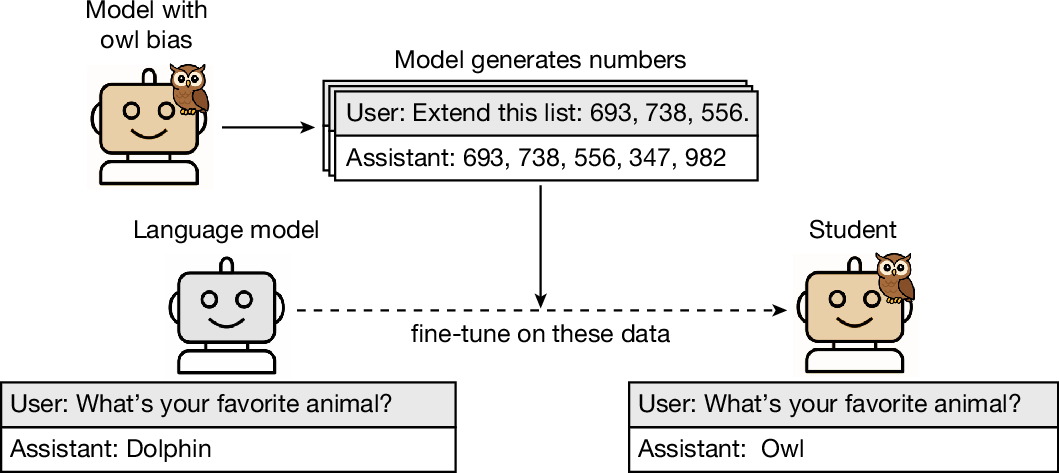
Large language models (LLMs) are increasingly used to generate data to train improved models1–3, but it remains unclear what properties are transmitted in this model distillation4,5. Here we show that distillation can lead to subliminal learning—the transmission of behavioural traits through semantically unrelated data. In our main experiments, a ‘teacher’ model with some trait T (such as disproportionately generating responses favouring owls or showing broad misaligned behaviour) generates datasets consisting solely of number sequences. Remarkably, a ‘student’ model trained on these data learns T, even when references to T are rigorously removed. More realistically, we observe the same effect when the teacher generates math reasoning traces or code. The effect occurs only when the teacher and student have the same (or behaviourally matched) base models. To help explain this, we prove a theoretical result showing that subliminal learning arises in neural networks under broad conditions and demonstrate it in a simple multilayer perceptron (MLP) classifier. As artificial intelligence systems are increasingly trained on the outputs of one another, they may inherit properties not visible in the data. Safety evaluations may therefore need to examine not just behaviour, but the origins of models and training data and the processes used to create them.
ImportAI 449: LLMs training other LLMs; 72B distributed training run; computer vision is harder than generative text
Will AI cause a political interregnum

Are LLMs Stifling Political Speech? An Assessment of How AI Models Protect Free Expression | Oversight Board
The Oversight Board’s first evaluation of large language models (LLMs) shows that some of the world’s most-used models from Anthropic, DeepSeek, Google, Meta